

THE REPOSITORY
The Repository serves as the permanent record archive of the Fractured Brick Syndicate. Within it are preserved all charters, pledges, plans, failures, amendments, and artifacts deemed too consequential to discard. Once filed, nothing is removed, only reinterpreted, reclassified, or quietly forgotten.
The Charter Stacks
The Aperture Files
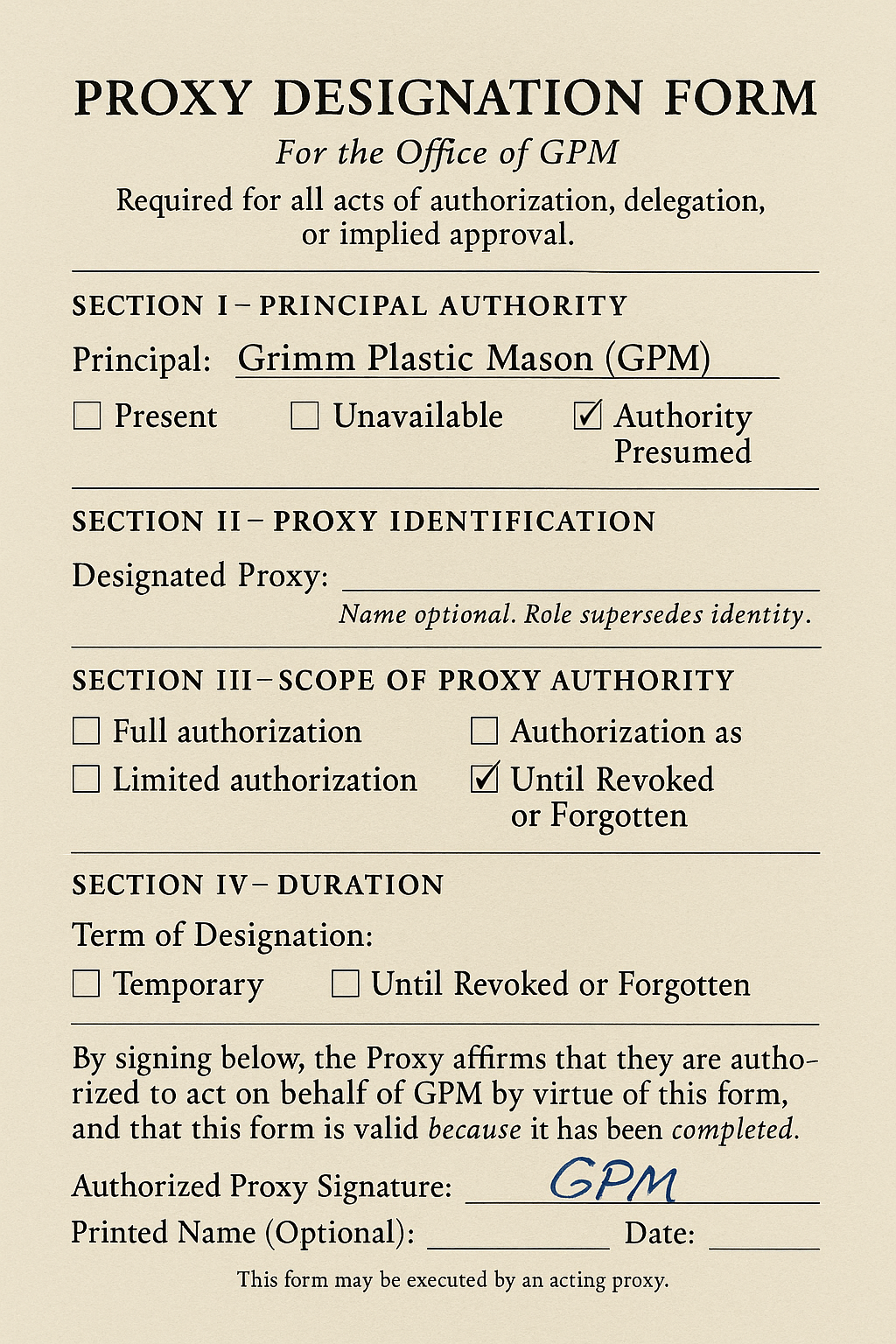
The Guidelines
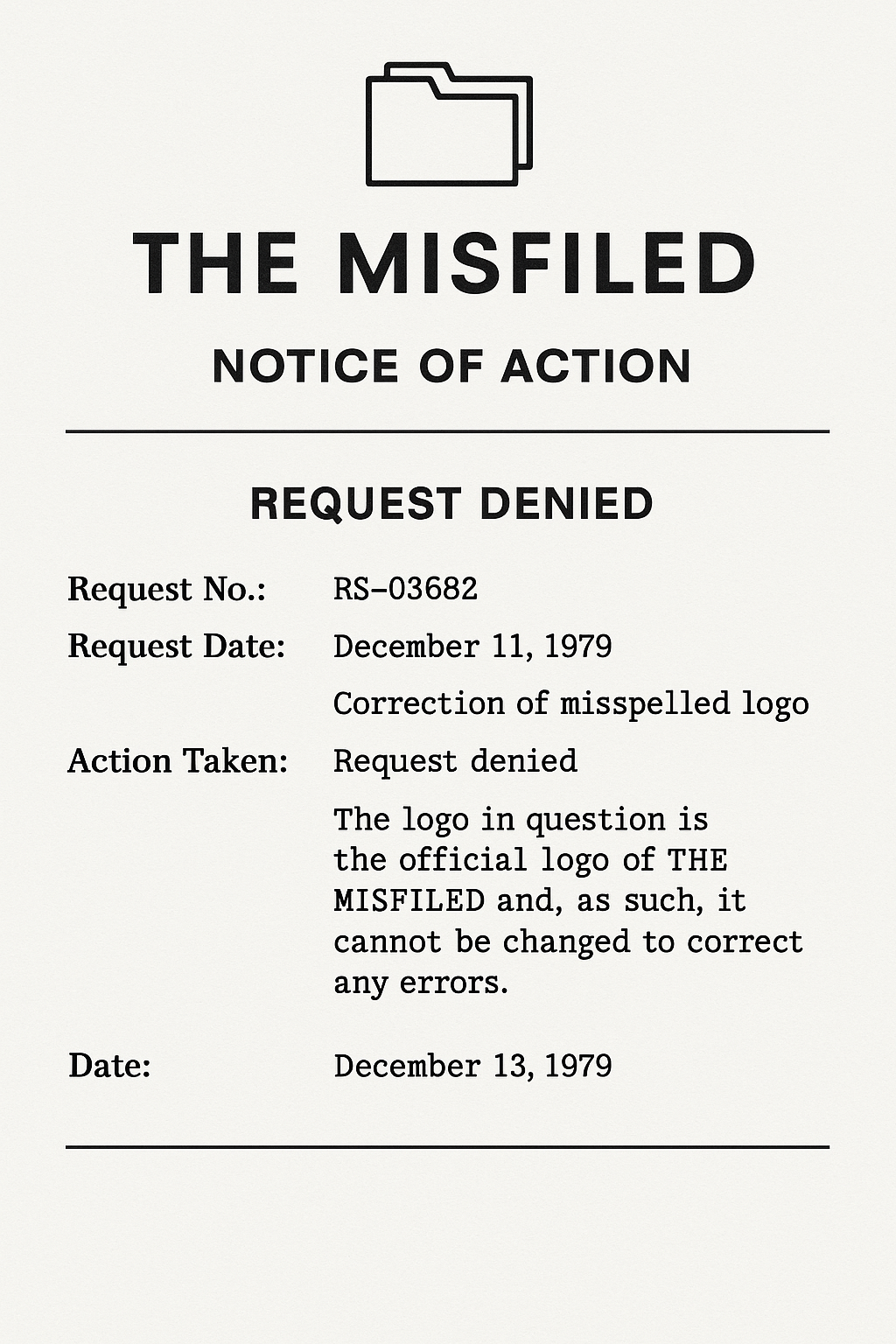
The Misfiled
The Deferred
The Contested
The Miscellany
THE CHARTER STACKS (OFFICIAL DOCUMENTS/FOUNDATIONAL RECORDS)
Authority Begins Here. It Does Not End Here
This section contains the formally ratified documents of the Fractured Bricks Syndicate, including charters, pledges, appointments, seals, and governing texts. Materials filed here are considered authoritative, even when later contradicted elsewhere.
Revisions are appended, not substituted.

CHARTER/CORE PHILOSOPHY
The Fractured Bricks Syndicate exists to champion darkly satirical, self-aware, and visually rich plastic brick builds. Each creation operates as a miniature microworld existing within the larger universe managed by the Syndicate where intentional chaos, absurdity, and inside jokes thrive, rewarding both casual viewers and attentive fans.
Satirical Tone:
All builds carry a mean-spirited, darkly humorous, and self-aware edge.
Visual gags, inside jokes, and references to IP are central to the style.
Humor is deliberate, often exaggerated, and designed to lampoon tropes or conventions.
Intentional Placement:
Every minifigure, prop, or gag is positioned deliberately to support narrative, reference, or comedic payoff.
Random placement is avoided unless unintentional chaos is part of the gag.
Visual Humor & Readability:
Visual gags should be understandable without extensive context.
Over-engineered gags are equally celebrated; complexity itself can be a feature.
IP Usage:
Builds may include any intellectual property, and that property must be mocked mercilessly.
Variants of characters are allowed when justified by narrative, humor, or gag placement.
No custom minifigures beyond the approved sets to be incorporated unless the mockery necessitates it.
Reference Depth & Layering:
References should reward knowledgeable viewers but remain functional at a surface level.
Actor ties, canon event parodies, and inter-IP crossovers are encouraged.
Absurdity & Physical Humor:
Builds embrace improbable scenarios, deliberate misuse of character traits, and over-the-top gags.
Humor can be grotesque, chaotic, or visually overblown, but should remain consistent with the model’s internal logic.
Tone Consistency Across Builds:
Every build, now and in the future, must retain the Syndicate’s signature style: darkly satirical, visually rich, intentionally chaotic, and internally logical.
Builds should reflect the Grimm Plastic Mason’s personal style and worldview, including mean-spirited, mocking, and twisted humor.
Guiding Design Principles:
Visual gags are prioritized for readability unless intentionally over-engineered.
Builds must balance clarity and complexity, allowing multiple layers of humor.
Organizational or corporate satire, IP misuse, and absurd physical gags are highly encouraged.
Where practical, include subtle “hidden gems” (inside jokes) for viewers to discover.
Legacy & Flexibility:
The Syndicate’s guiding principles are intended to apply across multiple builds, allowing the scope to expand from dioramas to large-scale world-building.
Rules should inspire creativity, not restrict it; decisions like repeating minifigure variants are acceptable when they strengthen narrative or humor.
THE FRACTURED BRICKS SYNDICATE CODEX
Article V: On the Use of Foreign Properties
(Ratified by the Grimm Plastic Mason and witnessed by the Silent Bricks)
Let it be known throughout the corridors of vaulted imagination that Intellectual Property is not a boundary but a tool of containment. Its value lies not in ownership but in its ability to frame absurdity, and therefore its jurisdiction shall vary by build, by tone, and by purpose.
Section I — On the Matter of Containment
1. Within any model, the governing rule of permitted characters, symbols, and stories is set by the lore of the model itself.
2. A theatre ruled by Vault Disney must honor its tyrant.
3. A ruin ruled by Warner’s clockwork must honor its chaos.
4. Each structure enforces its own canon, for the purpose of satire, not subservience.
Section II — On the Doctrine of Intent
1. Wherever an outside property appears, it must serve the narrative, the architecture, or the joke.
2. Crossovers are sanctioned only when they advance the truth of the absurd.
3. Unauthorized cameos for mere novelty are considered acts of Brick Corruption and shall be walled up in the archives, unacknowledged and unrendered.
Section III — On the Limits of Obedience
1. The Syndicate swears loyalty to no studio, empire, or brand. Only to the craft.
2. Should a rule of ownership hinder the build’s meaning, that rule may be mocked, dismantled, or suspended.
3. This freedom, however, carries obligation: the joke must land; the satire must bite.
Section IV — On the Rights of the Builder
1. The Grimm Plastic Mason may, at will, invoke Creative Eminent Domain, annexing whatever worlds, characters, or aesthetics are required to maintain equilibrium across the fractured aperture.
2. Such annexation is not theft, but restoration—the returning of imagination to public custody.
Section V — On Recordkeeping
1. All variances from original property law must be documented in the Guild Ledger of Apologies, which no one reads but everyone respects.

GUILD DOCTRINE vs. LOCAL LAW
Guild Doctrine (Universal Laws)
Intention above all. Every brick must serve a purpose, satire, story, or structural necessity.
Containment of Absurdity. Every model exists to home the jokes so the world doesn’t fracture again.
Continuity of Tone. Every build exists within the same metaphysical world, the aperture connects them all.
Material Honesty. The Grimm Plastic Mason builds with what’s on hand; limitations are a form of truth.
Self-awareness as Structure. Every build must know what it is and mock itself accordingly.
Local Law (Model-Specific Rules)
The Muppet Theatre Presented by Vault Disney: Only Disney-affiliated IPs may appear; satire targets corporate control of imagination.
The Next Build (Example: Warner Complex or Syndicate Outpost): Could obey a different rule, say, “All crossovers permitted so long as the gag advances the world.”

THE MOCKWRIGHT ALMANAC
Edition XVII
Foreword
Filed Without Enthusiasm, but With Acknowledgment
— Knox, First Benefactor of the Fractured Order
The existence of this volume was neither proposed by me nor requested by the Absurdium Consortium. It emerged, as many things within the Syndicate do, after someone asked whether we had already done it and no one could definitively say that we had not.
What follows is not a record in the formal sense. It is incomplete, selective, and alarmingly candid. It documents individuals as they appeared, not as they were meant to be remembered, and in doing so violates several unspoken preferences regarding decorum, hierarchy, and plausible deniability.
Nevertheless, it has been determined that some accounting of presence is preferable to none.
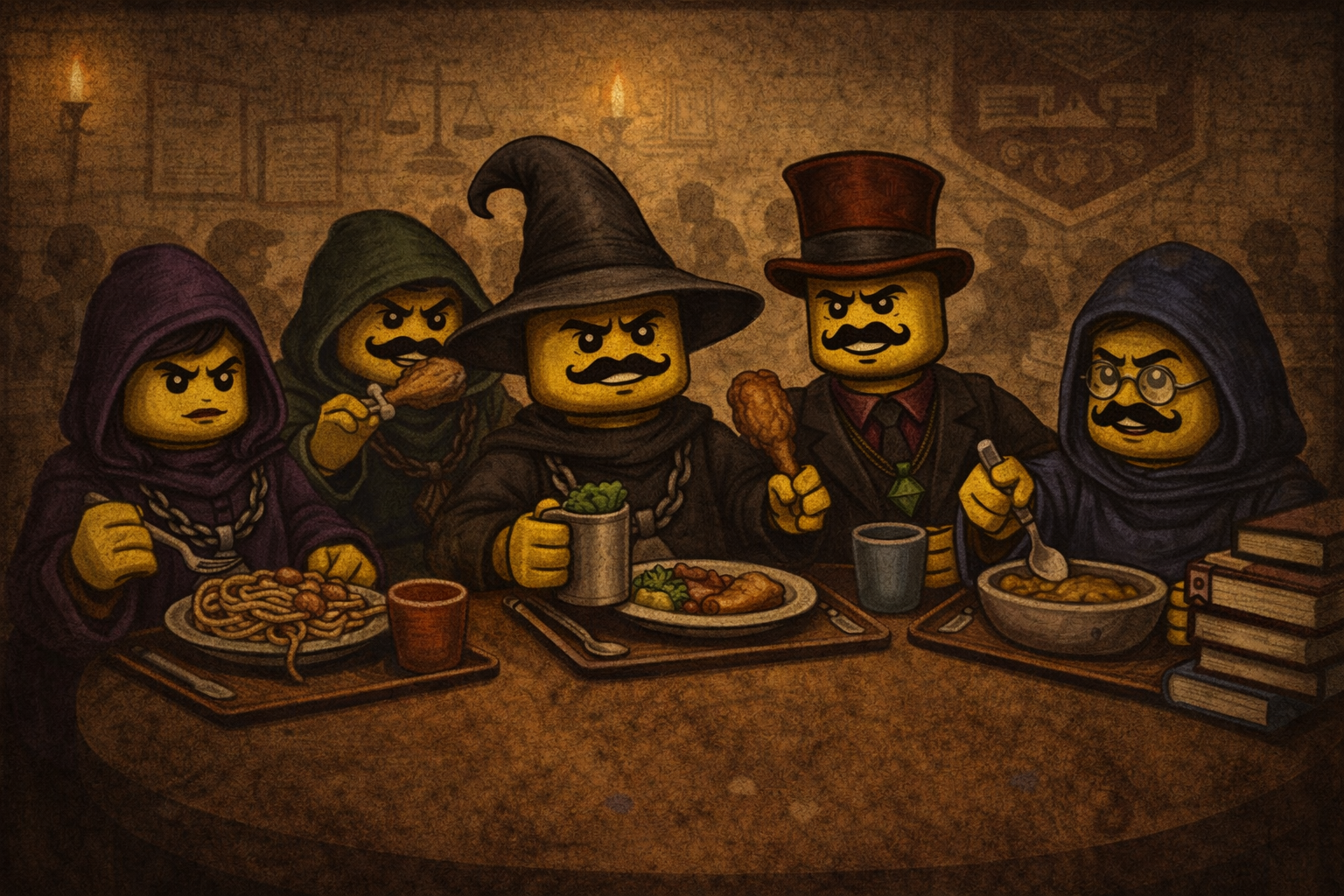
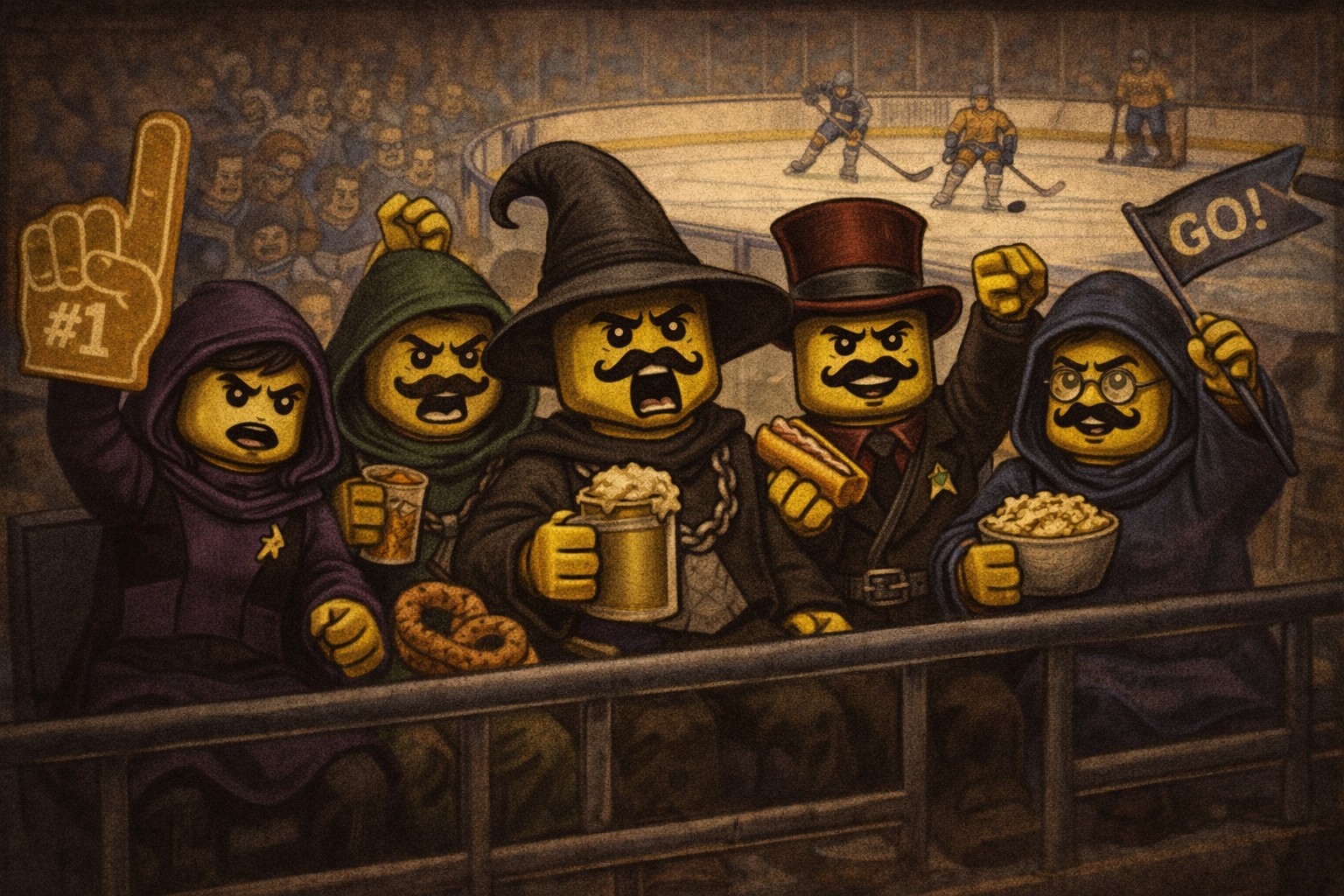
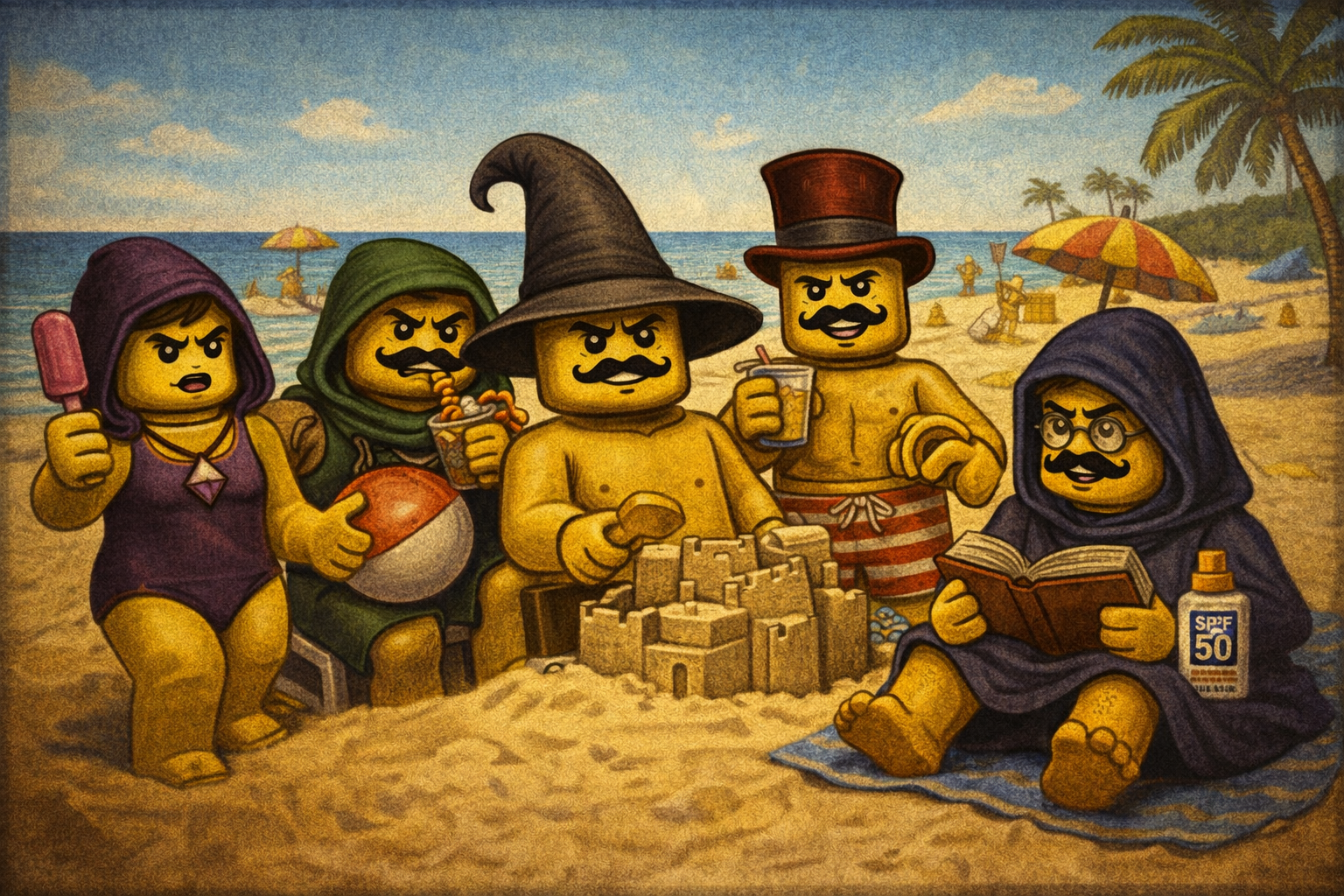
The Fractured Brick Syndicate concerns itself with structures that endure strain. People do not. They arrive, contribute, disrupt, and occasionally participate. This volume captures a moment when certain individuals occupied the same rooms, argued over the same principles, and briefly agreed to sit still long enough for a photograph.
That this record exists at all is unusual. That it will be consulted for insight would be a mistake.
Consider this book what it is:
not an honor,
not a ledger,
and certainly not a guide.
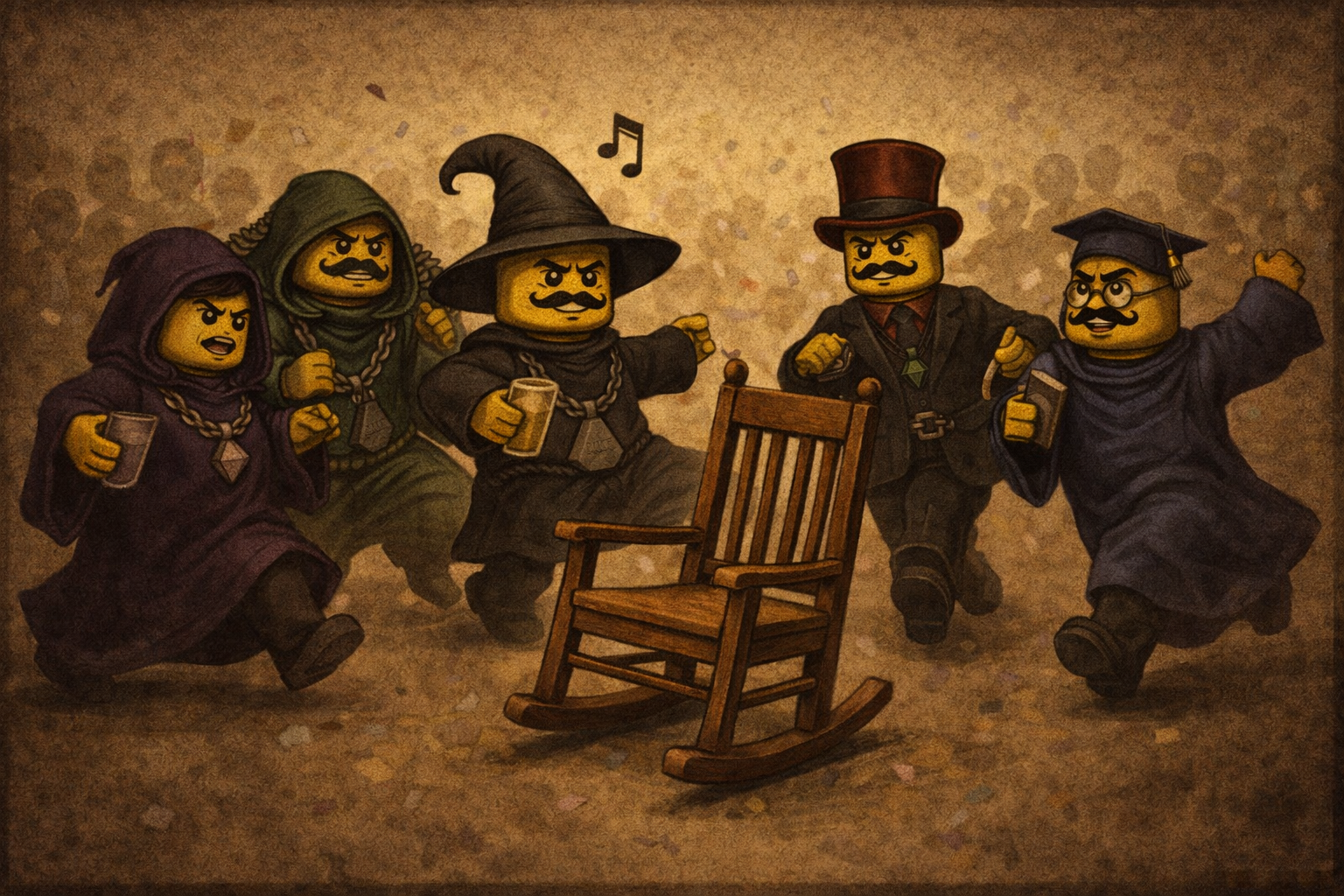
It is a snapshot taken mid-motion, before anyone thought to stop the chair from rocking.
— Knox
First Benefactor of the Fractured Order
Reluctant Contributor to Edition XVII
PAGE 1 - Mockwright Almanac
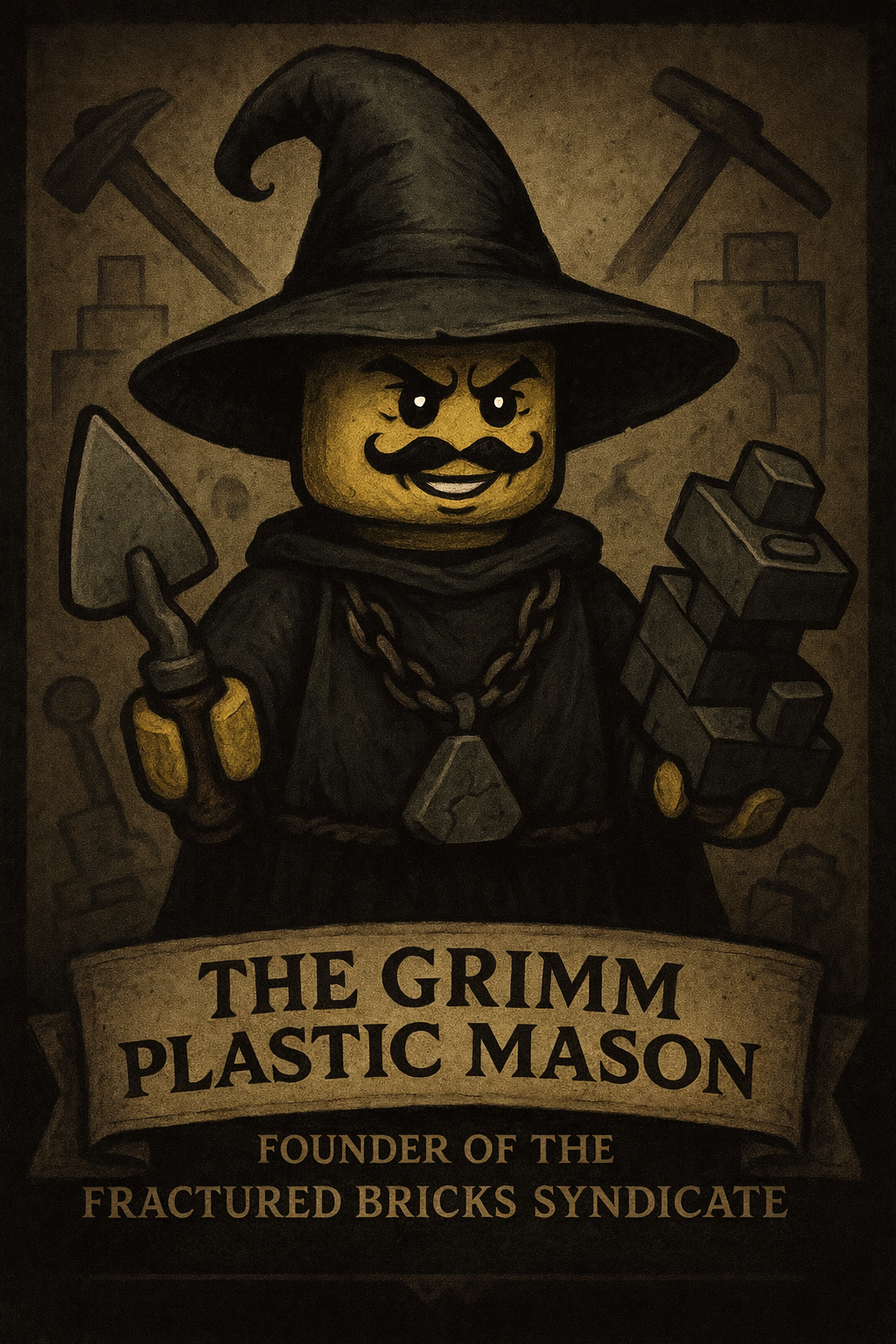
THE GRIM PLASTIC MASON
FOUNDER OF THE FRACTURED BRICKS SYNDICATE
MASTER BRICKWRIGHT FRACTURED BRICKS SYNDICATE
(As Recorded, Recalled, and Argued Over)
No one agrees on when the Grimm Plastic Mason first joined the Bricks Syndicate.
Some records place them early, others much later. A few insist the name appears only after certain buildings were already standing, as though the Mason arrived after their work. This inconsistency has never been resolved and is generally avoided in formal discussion.
What is agreed upon is this:
before the Mason, the Syndicate built things that lasted.
after the Mason, the Syndicate built things that meant something.
The Mason did not announce a philosophy. They did not argue for one. They simply built in a way that unsettled people. Walls leaned into sightlines. Empty space felt deliberate. Rooms anticipated reactions. Jokes landed harder than expected, and no one could quite explain why.
It became common to say a structure had been “Grimm-touched,” though this was never an official designation. It meant the building understood timing. It meant cruelty had been framed instead of softened. It meant laughter happened where it shouldn’t, and stopped where it should have continued.
The Grimm Plastic Mason rarely explained decisions. When asked why something was placed as it was, the answer was often, “It needed somewhere to go.”
As interest grew, so did discomfort. Attention attracts rules. Rules attract people who believe everything can be contained. The Mason did not resist this. They did not encourage it either. They continued building as though the conversation were happening somewhere else.
Leadership followed without ceremony. Titles were applied retroactively. By the time anyone noticed, the Grimm Plastic Mason was already being deferred to, not because of rank, but because no one wanted to be responsible for changing what worked.
The Ditzler Theatre commission is where the legend hardens.
Those close to the project describe the build as too successful. The theatre absorbed jokes faster than they could be placed. Satire accumulated. Timing compressed. During a pause, brief, necessary, and entirely ordinary, something gave way.
The Aperture is what we call it now.
The Mason never claimed responsibility for the breach, and no credible account suggests they caused it. What is recorded is that after it happened, their work changed. Buildings became more intentional. Spaces were no longer just expressive, they were preventative.
The Mason began building as though failure was no longer theoretical.
To this day, some insist the Grimm Plastic Mason is a single individual. Others believe the name describes a method rather than a person. A minority claim the Mason no longer exists in any conventional sense, having become “distributed” across notable Syndicate works.
No official position has been taken.
The Syndicate eventually named the Grimm Plastic Mason Founder, not to honor them, but because the fracture required an origin point. Someone had to be placed at the beginning of a story that could no longer be edited.
If the Aperture has a memory, it remembers the Grimm Plastic Mason.
If the Fractured Bricks Syndicate has a conscience, it learned it from them.
— Compiled from oral accounts, marginal notes, and buildings that refuse to behave
— Filed reluctantly in The Repository
— Status: Canonical, Unstable
PAGE 2 - Mockwright Almanac
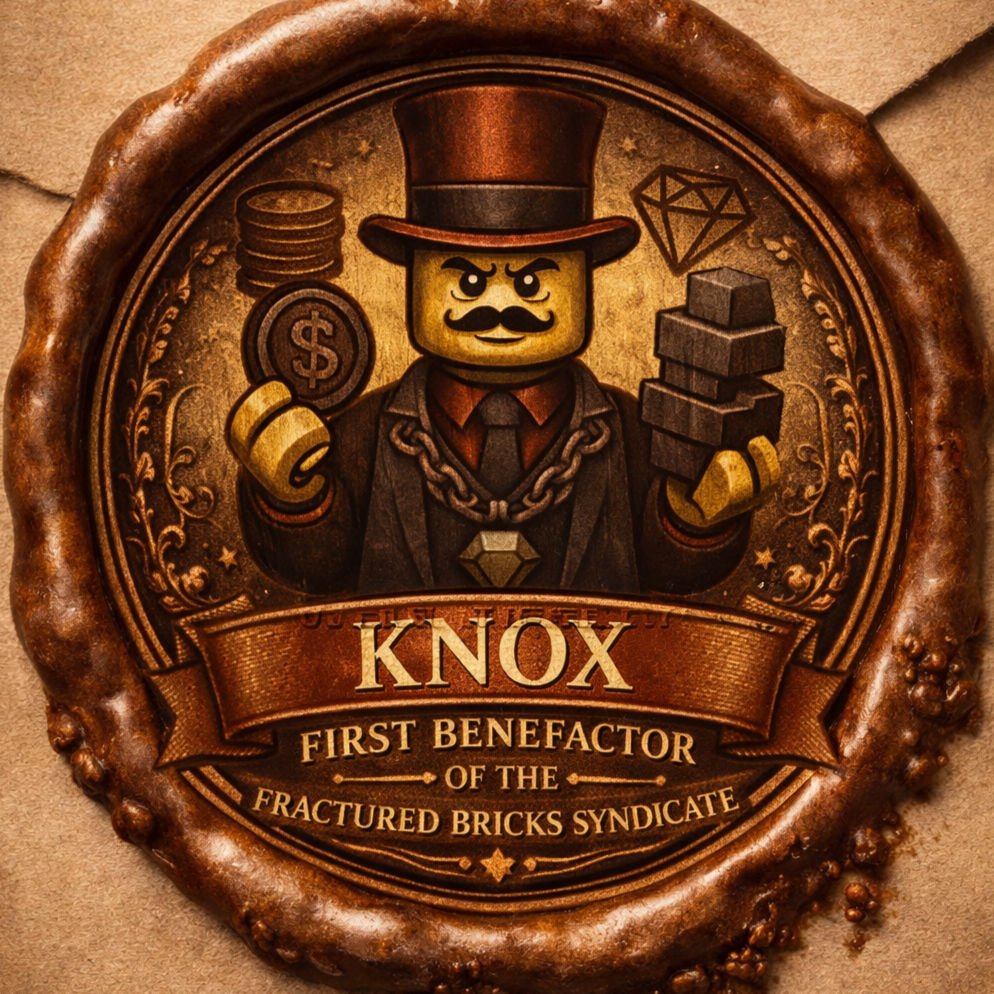
MARGINAL NOTATION - KNOX
THE GRIMM PLASTIC MASON
FOUNDER OF THE FRACTURED BRICKS SYNDICATE
MASTER BRICKWRIGHT FRACTURED BRICKS SYNDICATE
(Filed in the margin of “The Grimm Plastic Mason: As Recorded, Recalled, and Argued Over”)
Much of this is imprecise. Not incorrect, imprecise.
The Mason did not arrive after the work. Nor did the work precede the Grimm Plastic Mason. The confusion stems from our failure to recognize method as identity.
I object to the implication that leadership followed mystery. Leadership followed consequence. By the time titles were discussed, the Guild was already operating under assumptions the Grimm Plastic Mason made unavoidable.
The Aperture is described here as inevitability. That framing is comforting. It suggests no intervention could have altered the outcome. I am not convinced.
That said: attempts to clarify the Grimm Plastic Mason’s intent consistently reduce accuracy rather than improve it. The buildings remain the only reliable record.
We named the fracture because refusing to name it did not repair it. We named the Grimm Plastic Mason because refusing to place responsibility somewhere caused more damage than choosing imperfectly.
If this account persists, let it be for one reason only: it reminds us that satire does not forgive negligence, and neither does structure.
— Knox
PAGE 3 - Mockwright Almanac
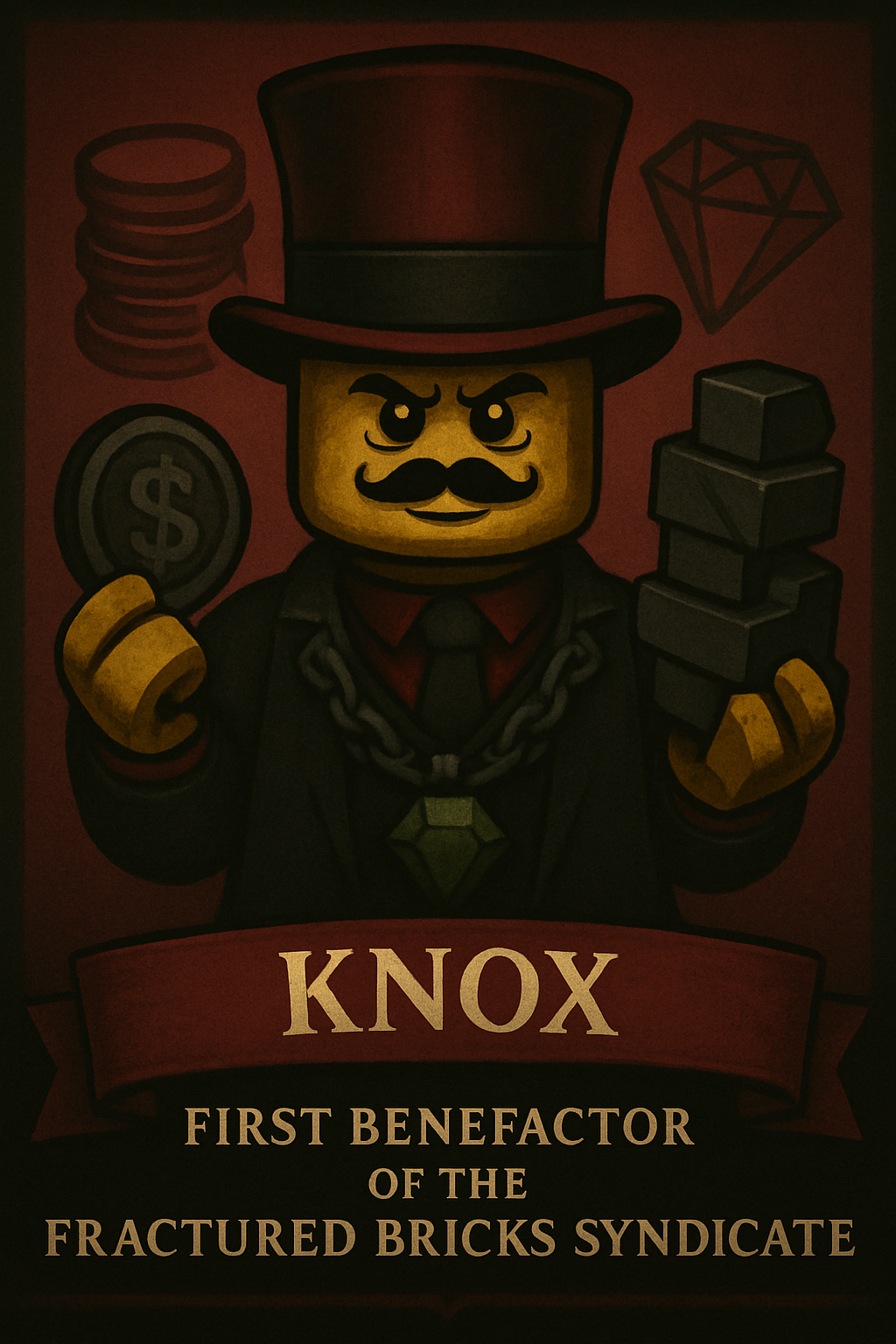
KNOX
FIRST BENEFACTOR OF THE FRACTURED BRICKS SYNDICATE
INSTITUTIONAL PATRON
FIDUCIARY OF STRUCTURAL RISK
Knox was never a builder.
He did not lay bricks, sketch elevations, or participate in the Syndicate’s creative disputes. His association with the Bricks Syndicate predates its fracture and rests entirely outside the craft itself. Where others built, Knox observed. Where others debated form, Knox tracked consequence.
He entered the Syndicate through proximity rather than practice, as a financier, facilitator, and occasional arbitrator when structural ambitions exceeded practical means. His value was never artistic. It was systemic. He understood resources, timelines, and the long memory of institutions.
To Knox, buildings were outcomes, not expressions.
As the Grimm Plastic Mason’s influence grew, Knox’s concern was not taste or tone but trajectory. Attention was increasing. Patronage followed. With it came expectations. Knox questioned whether satire, particularly satire embedded so deeply it affected structure, could remain governable once it attracted sustained interest.
His early objections were administrative in nature, not philosophical. He did not argue that jokes should not exist, only that institutions built around them tend to forget why they were founded.
Then the fracture occurred.
Knox did not interpret the breach as failure, nor did he attempt to explain it away. He treated it as an irreversible condition, something that now existed, regardless of cause. Where others searched for blame, Knox searched for continuity.
It was Knox who recognized that the Syndicate would not survive by ignoring the fracture, but by acknowledging it formally. His adoption of the name Fractured Bricks Syndicate was not an act of branding or absolution. It was a filing decision.
From that point forward, Knox assumed the role of Benefactor not as patron of creativity, but as guarantor of endurance. He ensured the Syndicate could operate, lease space, enter agreements, and survive scrutiny from entities far less interested in satire than in leverage.
Knox does not build. He enables those who do, and ensures they are still allowed to tomorrow.
Vault Disney frequently misreads Knox as passive capital. This error has not yet been corrected.
— Filed in The Repository
— Section: Benefactors & External Relations
— Status: Active, Non-Practicing
— Note: Presence felt most strongly where nothing collapses
PAGE 4 - Mockwright Almanac

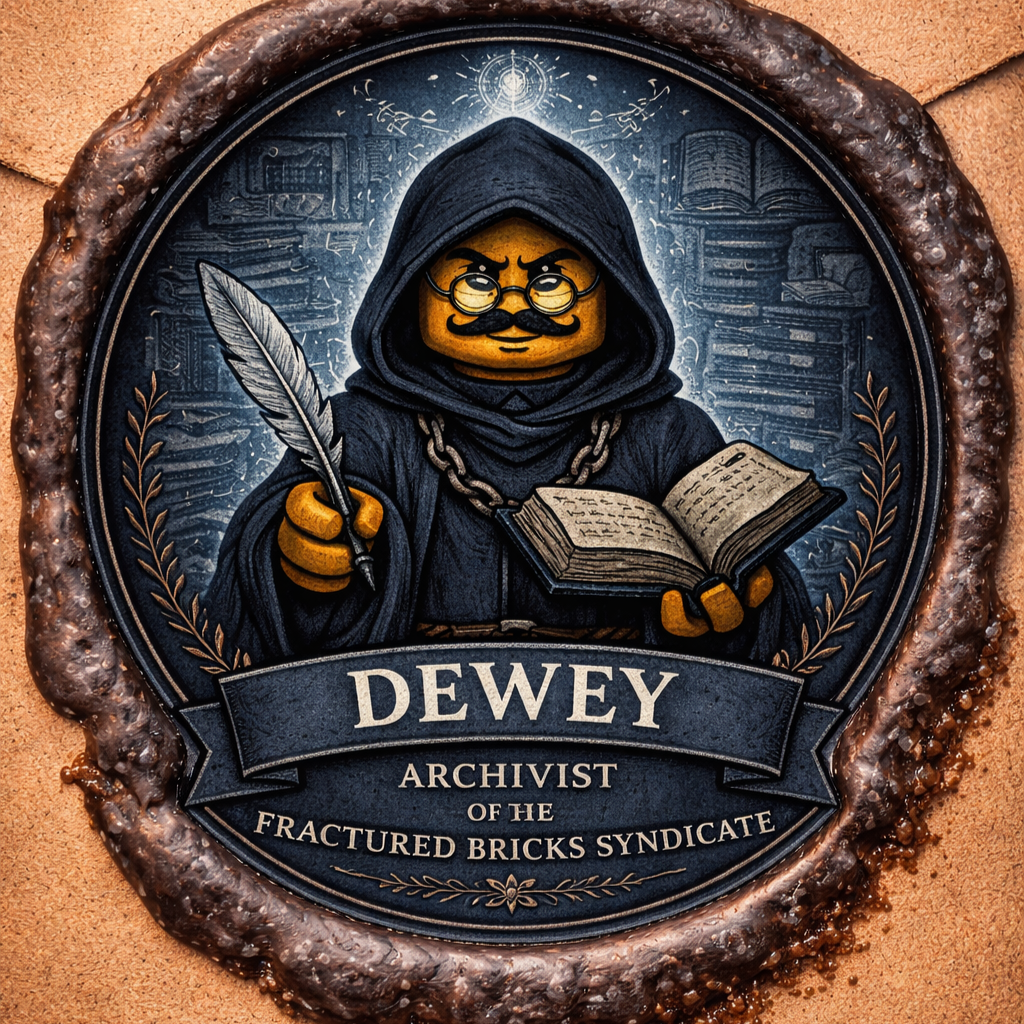
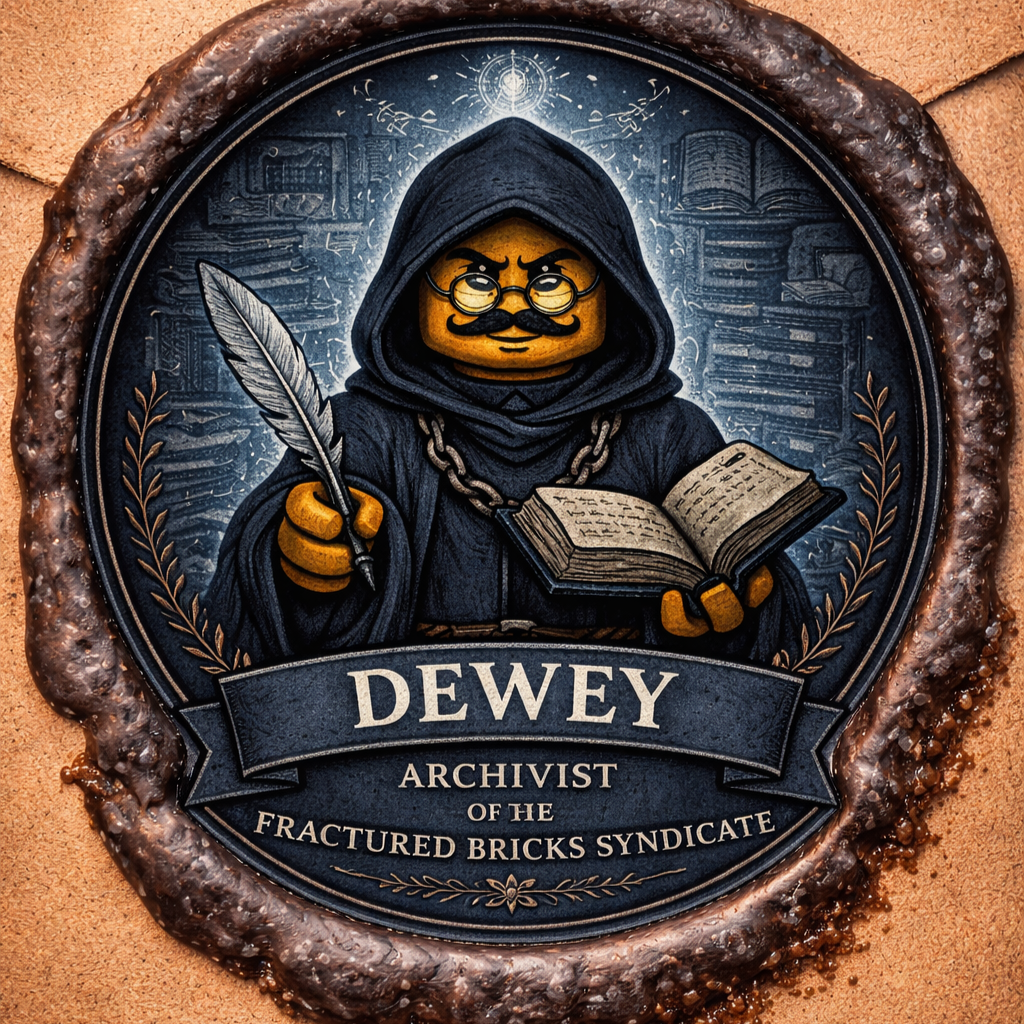
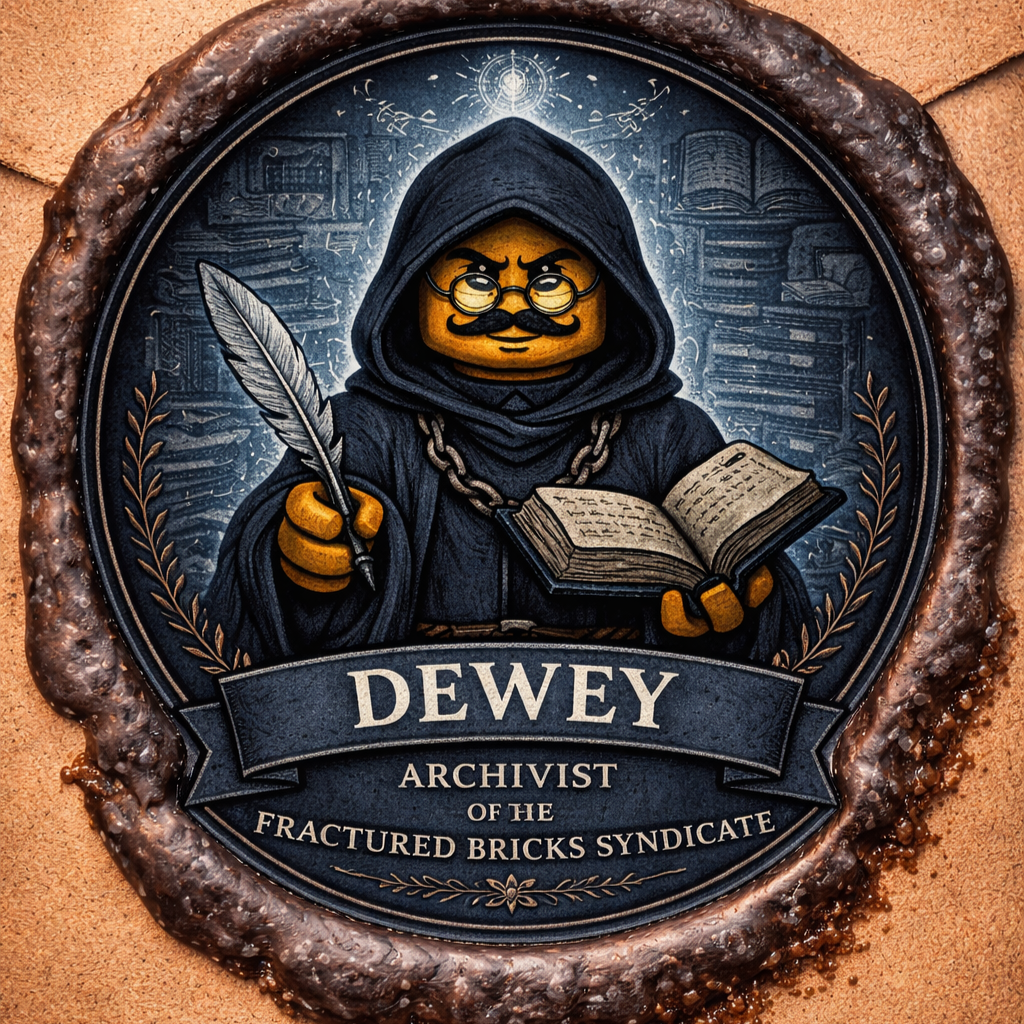
DEWEY
ARCHIVIST OF THE FRACTURED BRICKS SYNDICATE
HIGH INDEXER OF THE MATTERS FILED & MISFILED
BEARER OF THE STAMP, THE SEAL & THE LAST WORD
Dewey the custodian of all things scribed.
Dewey serves as the Archivist of the Fractured Bricks Syndicate, charged with the custody, classification, misclassification, and deliberate preservation of the Syndicate's written record. Every document that defines the Syndicate’s past, confuses its present, or complicates its future passes through Dewey’s hands at least once, and often twice—rarely in the same form.
The Archivist’s authority is absolute within the Repository. Dewey determines what is indexed, what is deferred, what is contested, and what is quietly refiled under a title that no longer reflects its contents. Fractured Bricks Syndicate members understand that if a document cannot be found, it is not lost; it has been handled.
Dewey maintains the internal logic by which the Syndicate remembers itself. This includes contradictory histories, overlapping truths, marginal annotations, and records whose original purpose has long since eroded. Accuracy is valued, but continuity is paramount. When forced to choose, Dewey preserves the version that best explains why the Guild behaves as it does now.
During the Fracture, Dewey was responsible for consolidating incident reports, personal letters, emergency decrees, and retrospective justifications into a single archival framework. It is widely acknowledged that without this effort, the Syndicate would not merely have fractured in name, but collapsed under the weight of its own documentation.
Dewey does not adjudicate truth. That task belongs to others. The Archivist ensures only that every version survives long enough to cause problems later.
PAGE 5 - Mockwright Almanac

PORTER
KEEPER OF BURDENS OF THE FRACTURED BRICKS SYNDICATE
THE STEWARD OF WHAT MUST BE CARRIED
CUSTODIAN OF WEIGHT, LITERAL & OTHERWISE
Porter is charged with carrying what others would rather set down.
As Keeper of Burdens, Porter oversees the physical, logistical, and symbolic weight of the Syndicate’s work: unstable builds, compromised structures, legacy decisions, and projects that should have ended cleanly but did not. When something must be moved, hidden, reinforced, or quietly supported long past its intended lifespan, it becomes Porter’s responsibility.
Porter does not question why a burden exists. Porter ensures it continues to be borne.
Within the Syndicate, this role is understood as essential but deliberately uncelebrated. Porter is present when things go wrong, absent when things succeed, and blamed only when collapse becomes unavoidable. This is considered appropriate.
Porter works closely with the Archivist, though neither claims authority over the other. Where Dewey records the fracture, Porter holds it together long enough for the next joke to land.
Porter’s motto, though never formally adopted, is widely attributed:
“If it still stands, it still matters.”
PAGE 6 - Mockwright Almanac

ROCKING CHAIR OF ABSENTEEISM
THE SEAT OF DEFERRED AUTHORITY
THE VACANT WITNESS
CUSTODIAN OF UNCAST VOTES
INSTRUMENT OF PERPETUAL POSTPONEMENT
Vacant Seat of the Fractured Bricks Syndicate
The Rocking Chair of Absenteeism is a permanent, intentionally unoccupied seat within the upper governance of the Fractured Bricks Syndicate. It exists to represent absence not as failure, but as function.
The Chair is reserved for voices that are no longer present, perspectives that have withdrawn, vanished, or been lost to apertures, dismantling, or deliberate refusal. It acknowledges that not all contributors remain, and that their absence still exerts influence on every decision made thereafter.
The Chair is never filled. It is never removed. It is never discussed at length.
During formal proceedings, the Rocking Chair is allowed to move freely. Its motion is considered a procedural artifact, not a disturbance. Minutes reflect its presence with a simple notation: “The Chair rocked.” No interpretation is recorded.
Syndicate tradition holds that decisions made without accounting for the Rocking Chair’s silence are structurally unsound. Its emptiness serves as a reminder that some costs cannot be measured, some jokes never land, and some fractures are meant to exist.
The Chair has no vote. It has never needed one.
PAGE 7 - Mockwright Almanac
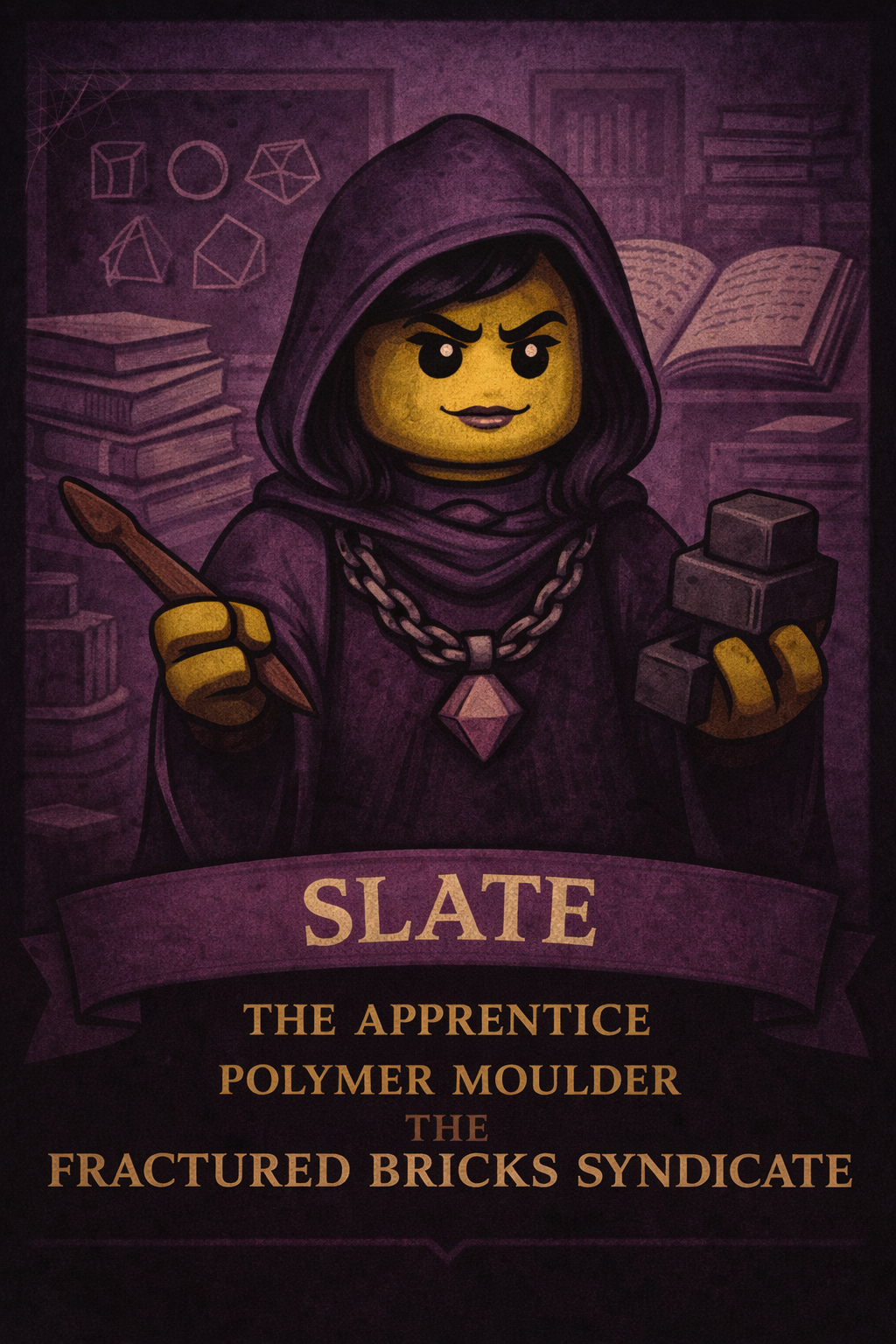
SLATE
APPRENTICE POLYMER MOULDER OF THE FRACTURED BRICKS SYNDICATE
Slate is new enough to still ask questions and old enough to know better than to ask most of them out loud.
They arrived at the Syndicate during a period when nothing was fully settled and no one could agree whether that was a problem or the point. Slate was assigned to observe, assist, catalog mistakes, and carry materials that no one else wanted to be responsible for breaking. In practice, this means standing slightly too close to important work and learning by proximity.
As an Apprentice Polymer Moulder, Slate is tasked with understanding the plastic before it becomes a brick. Texture, stress, flexibility, and failure are studied hands-on, often under conditions that are explicitly labeled “inadvisable.” Slate learns where material wants to bend, where it resists, and where it will inevitably give way. These lessons are rarely written down.
Slate does not yet land gags. They are taught instead how gags fail—how timing slips, how weight distributes incorrectly, how a joke collapses under its own cleverness. The Syndicate considers this stage essential. Mastery without embarrassment is viewed as suspicious.
Among the council, Slate is regarded with a mixture of indulgence and caution. The Grimm Plastic Mason considers them promising. Knox considers them inevitable. Dewey has already misfiled three of their early notes under “Later, If It Matters.” Porter makes sure Slate does not carry anything irreplaceable. The Rocking Chair does not acknowledge them at all.
What remains after that process is considered character.
No one knows what Slate will become. The Syndicate prefers it that way.
PAGE 8 - Mockwright Almanac


PAGE 9 - Mockwright Almanac
PAGE 10 - Mockwright Almanac

PAGE 11 - Mockwright Almanac

PAGE 12 - Mockwright Almanac
PAGE 13 - Mockwright Almanac
PAGE 14 - Mockwright Almanac
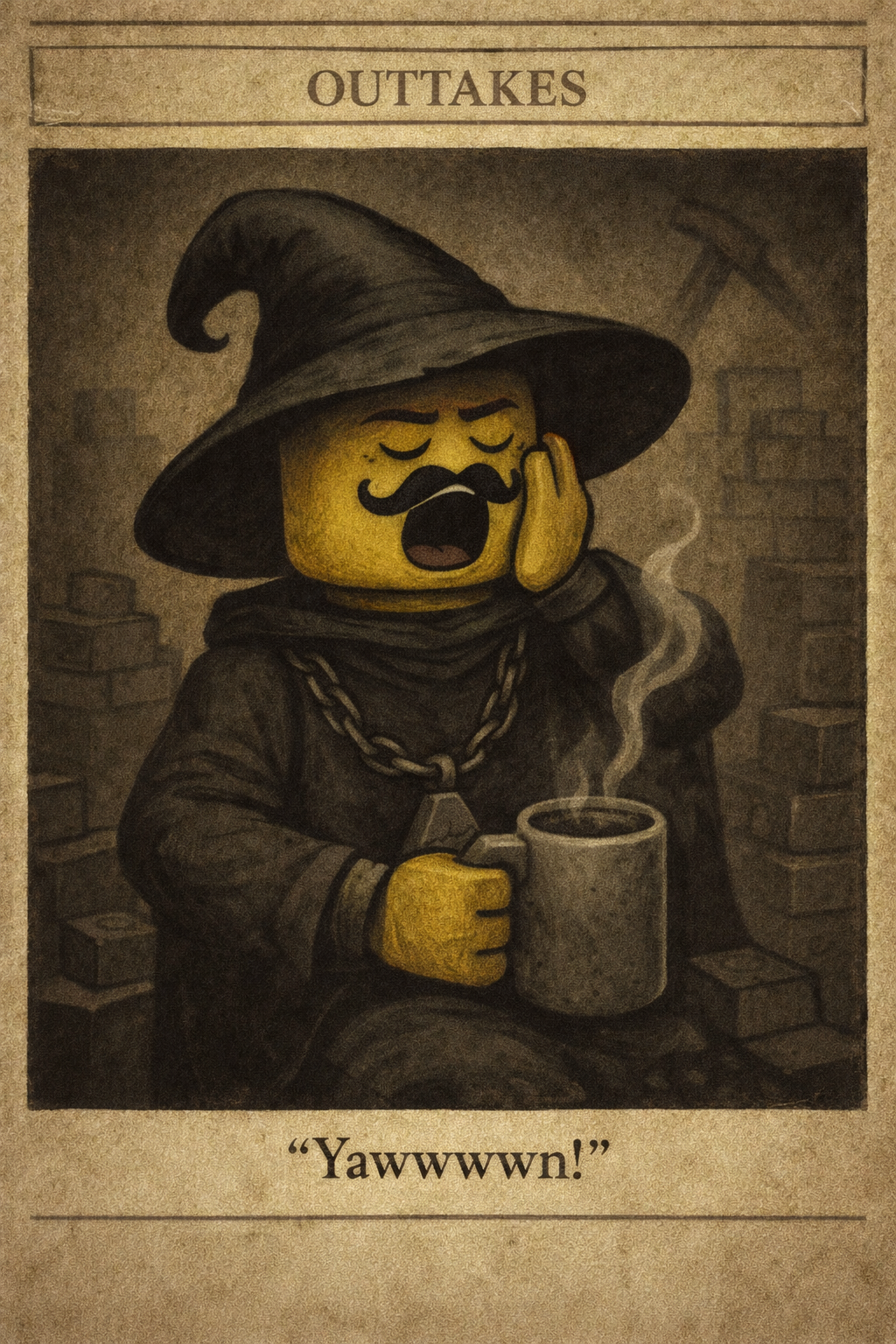

PAGE 15 - Mockwright Almanac

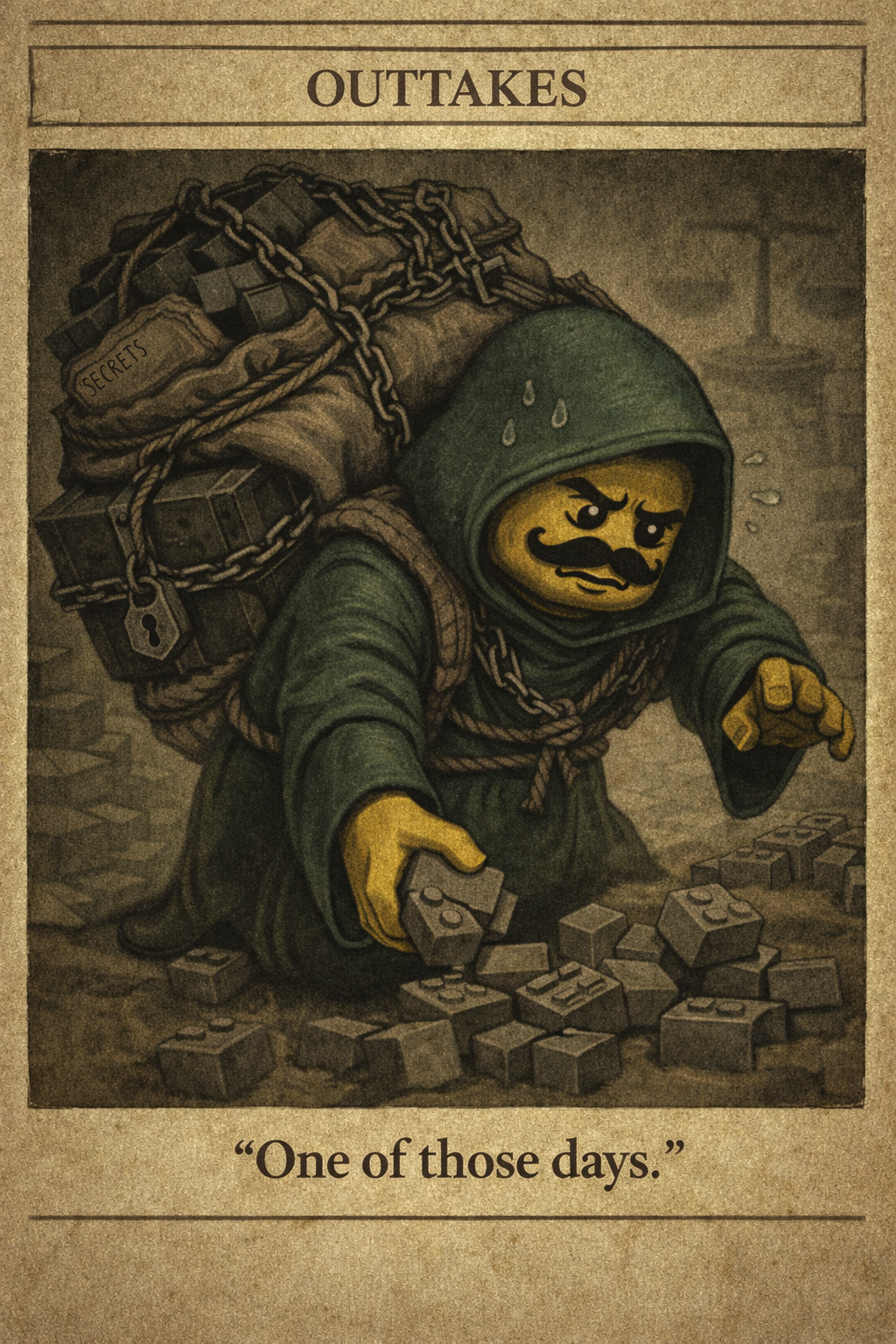
PAGE 16 - Mockwright Almanac

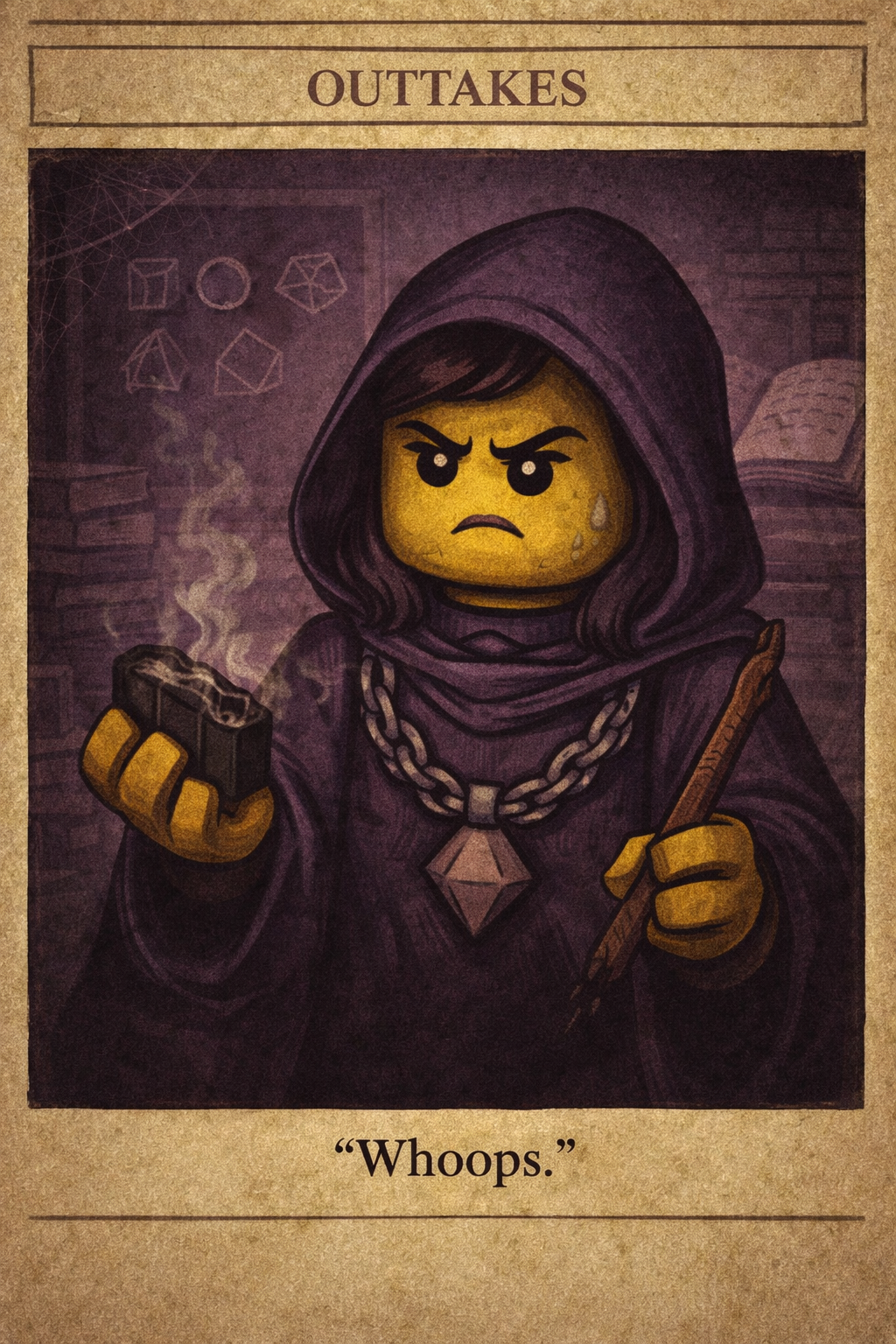
PAGE 17 - Mockwright Almanac
Back Page Disclaimer
Notice of Record Limitations
This Compendium is a contemporaneous document reflecting membership, observations, and appearances recorded during the relevant Edition.
The Fractured Brick Syndicate assumes no obligation to update, revise, reconcile, or explain subsequent developments not formally ratified at the time of compilation.
Errors, inconsistencies, and unresolved matters are retained as filed.
Filed accordingly.

PAGE 18 - Mockwright Almanac
REPOSITORY ENTRY
Filed by: Dewey
Classification: Stationary Content
Subcategory: Mandatory Cheer
Status: Ongoing
Revision Requests: Denied (Recurring)
Entry Summary:
The Animation Vault Meet & Greet is designated as Stationary Content despite visitor movement, rotating audiences, and intermittent costume changes.
Cheerfulness is not emergent in this environment. It is enforced.
Characters assigned to this space are not cycled based on narrative exhaustion, seasonal relevance, or audience fatigue. They remain present due to their classification as “Evergreen Engagement Assets.”
Emotional variance has been reviewed and rejected as unnecessary.
Filed under Stationary Content with Mandatory Cheer due to:
Fixed placement
Repeated performance state
Absence of closure
Marginal Note (later hand):
“Movement observed only in guests.”

THE APERTURE FILES (Aperture-Related Documents)
Filed After the Fact. Effects May Precede Causes
All records concerning the Aperture, its emergence, effects, known occupants, secondary phenomena, and containment attempts. Documents in this section frequently reference events that cannot be fully corroborated.

THE DISMANTLING
(Repository Archive Entry #AR-Δ976)
In an era of overreach and ambition, the Fractured Brick Syndicate lost its way. A subtle attempt by a rival “corporate” guild to impose order and standardization quickly spiraled into a full-blown hostile takeover. Towers were dismantled, blueprints shredded, and even the most sacred inside jokes were twisted beyond recognition.
Absurdly formal memos dictated every joke’s placement—one required a pratfall precisely 17 studs from a hidden gem, another demanded a vault door be “emotionally aligned” before a punchline could land.
Yet amidst the chaos, subtle signs of the Grimm Plastic Mason’s influence persisted: a pantless minifigure mooning the tyrants, a hidden gem revealed where none was expected, a rubber chicken hoisted as a flag atop a toppled tower. When the dust settled, the Syndicate emerged fractured but unbroken. The Grimm Plastic Mason’s legend loomed once more, guiding the Guild’s absurdist principles and proving that even under the heaviest overreach, chaos, and darkly methodical humor, could never truly be erased.
THE GREAT REFRAMING - Even Satire Must Outgrow Its Stage
(Repository Archive Entry #JBC-TD79Δ)
We mark this day not as an ending, but as a turn.
A hinge upon which the weight of two years swings. The labors that built the Ditzler Theatre, the laughter and irony etched into its mortar, the ghosts and dwarves that danced within its walls. It has stood as the Syndicate’s first great experiment, a monument not of perfection, but of possibility.
Yet in the forging of the Hi-Ho studio, a truth revealed itself: the Syndicate was never meant to dwell forever within the footprint it first claimed. Brick by brick, joke by joke, the craft has evolved beyond its original confines. The imperfections that once defined our rebellion now whisper of horizons still unbuilt.
The Great Reframing is not demolition. It is not surrender. It is the act of holding what is sacred in one hand, and reaching beyond it with the other. It is permission granted, to pause without regret, to question without shame, to dream without limit.
The Ditzler Theatre may never be “finished” in the way we once imagined. But perhaps it was never meant to be. Doors are built to open and close and open again. And through each threshold, the Syndicate carries forward the only thing that ever truly mattered: the will to build, to mock, to elevate, and to never, ever settle.
So let this stand as our record: The Great Reframing is declared. The story is not over. The bricks will rise again. Not despite what came before, but because of it.

THE PRESSURE OF THE UNBUILT - Birth of the Aperture
(Repository Archive Entry #17F-JHΔ69)
They say the Grimm Plastic Mason knew this would happen.
A build can only hold so many jokes, so much satire, before the pressure begins to warp the studs themselves. When the Great Reframing stalled the Theatre’s work, when half-finished gags and unplaced scenes piled up like bricks without mortar, reality began to groan under the strain.
It started as a hairline fracture in the far backstage wall, just wide enough for a whisper of unspent absurdity to slip through. Then a stud shifted where no stud had any right to be. And then — pop.
The Ditzler Theatre tore open.
A rift bled into existence, a breach born not of malice or magic but of overwhelming narrative backlog, jokes with no stage to land on, Easter eggs with no corners to hide in, entire gags clawing their way into reality. The Syndicate called this phenomenon The Pressure of the Unbuilt. Entertainment company executives called it an opportunity.
Through the rip, a new realm formed, a dimension where the laws of scale, continuity, and physical constraint buckled under the weight of punchlines too big for their rooms. The Fractured Bricks Syndicate dubbed it Pleasure Island, a holding ground for everything that could not, yet, exist inside the Theatre’s walls.
But the corporate maleficence was quick to stake claims, erecting shiny false stages and building sanitized monuments to corporate synergy inside the breach. The fight shifted. The Theatre was no longer the only battleground. The war for meaning now stretched across realities, and the Syndicate, fractured but unbowed, followed its gags into the breach.
THE APERTURE & THE DISAPPEARANCE OF BETTY DITZLER
(Repository Archive Entry #LKF-ΔΔMB53)
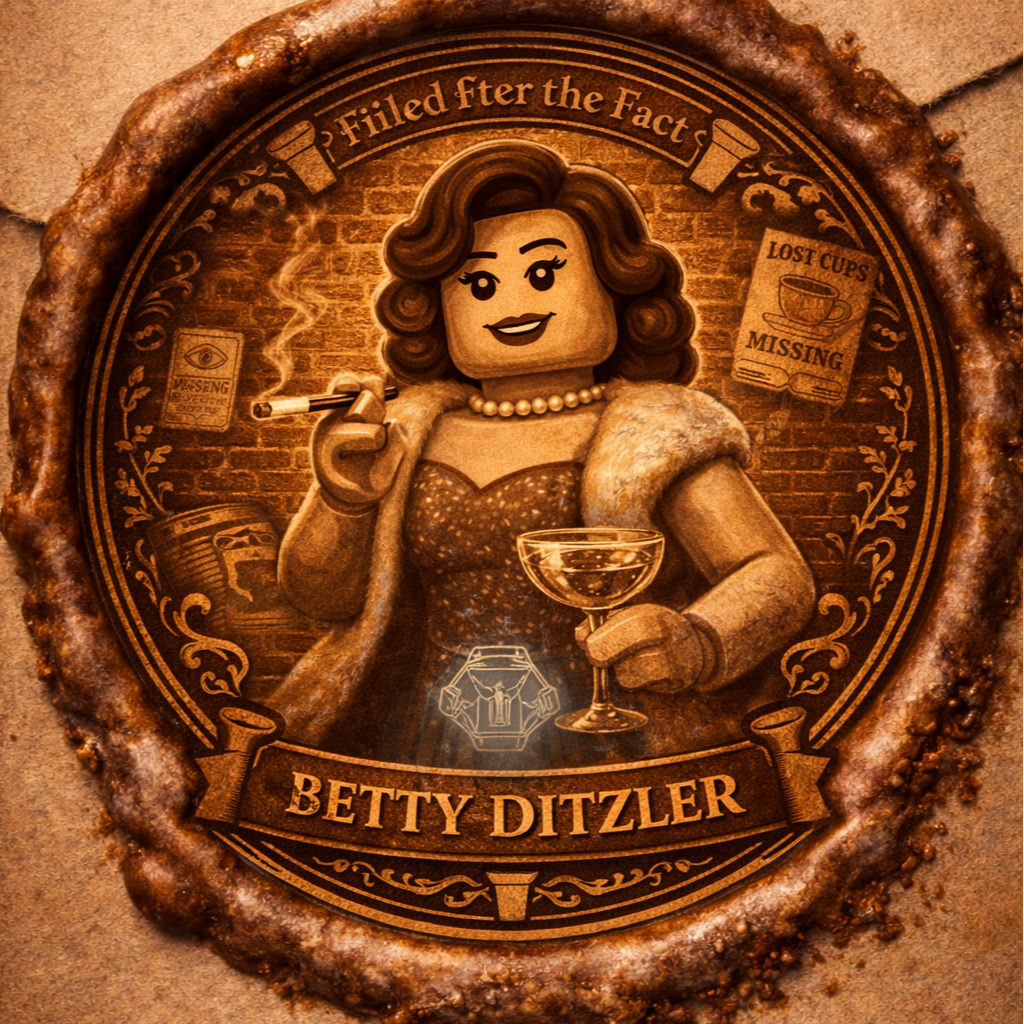
No one remembers the exact moment Betty vanished, only that one night, amid a thunderous dress rehearsal and a catastrophic load of unbuilt scenes, she walked into the backstage corridor and simply did not walk out again.
At the time, it was written off as a tragedy. A ghost story. An unsolved mystery from a vanished era of theatre. But the Fractured Brick Syndicate knows better.
For it was in those same days that The Pressure of the Unbuilt reached its peak. Jokes unplaced. Rooms unrealized. The Theatre itself groaned under the weight of its own potential, until the very fabric of its foundations tore apart. The breach that formed would later be called The Aperture.
And Betty Ditzler? She wasn’t lost. She was claimed.
Some say she was the first soul pulled into that impossible in-between, a realm where incomplete ideas and discarded narratives swirl endlessly, unable to resolve or decay. Others whisper that she became the Aperture, her presence woven into the very fabric of the rip, now pulsing faintly between realities.
Entertainment company executives, opportunists that they are, found the fracture and weaponized it. They turned that narrative purgatory into IP real estate: a holding pen for forgotten properties, abandoned pilots, half-baked reboots, and legacy characters with nowhere else to go. They renamed it The Vault Beyond the Vault, a place to monetize what they no longer truly understand.
And somewhere in that swirling grey between worlds, half myth, half memory, Betty Ditzler still lingers. Not haunting the Theatre, but haunting the fracture itself, a living reminder of the Syndicate’s hubris… and a beacon to those who would one day tear the corporate greed false dominion apart.

THE ACCORD OF APERTURE
(Repository Archive Entry #5552368Δ)
The Syndicate learned hard lessons from Betty Ditzler’s fate and the birth of the Aperture. Rips in narrative space don’t form from negligence alone, they form when satire, absurdity, and mean jokes have no vessel to inhabit. Every unbuilt gag, every unlanded joke strains the walls between realities. Too much deferred nonsense, and the Theatre itself fractures.
To prevent further tears, the Syndicate turned its craft toward building space for the satire to land, entire chambers designed to absorb, refract, and anchor the chaos before it can rupture the world again. Yet the work is endless. The more the Syndicate builds, the more absurdities demand room.
Sensing opportunity, entertainment company executives proposed what they called The Accord of Apertures: they would lease abandoned intellectual properties, orphaned characters, forgotten worlds, unprofitable sequels, to the Syndicate, not out of generosity but because unused stories rot space faster than used ones.
The Syndicate, wary but pragmatic, accepted. It was a devil’s bargain: Shareholders got to keep profiting from the ghosts of studio catalogs, and the Syndicate gained raw narrative matter to stabilize its builds. Every leased IP is another brick in the bulwark against rupture, another joke given just enough grounding to keep reality stitched together.
The uneasy partnership holds, for now. Each new build carries traces of entertainment studios commodified past, but it is the Syndicate who decides how those remnants are used. In their hands, abandoned franchises become ammunition. Forgotten mascots become punchlines. What was once discarded now helps anchor the satire that might otherwise tear the world apart.

THE ACCORD OF APERTURES (Expanded: “The Abandoned Intellectual Property Lease”)
(Repository Archive Entry #9IL-TRQΔ (2))
Outwardly, Entertainment studios tells the public that stories vanish because of “diminished returns” or “strategic pivots.” A princess falls out of rotation, a franchise is quietly retired, a film is sealed away “for future generations.” But the Syndicate knows the truth.
Retirement is extraction.
Every time an IP is mothballed, it’s not being forgotten, it’s being harvested. Once a story is dormant, it’s no longer tethered to audience expectations or continuity. Freed from its original narrative gravity, it becomes pure volatile potential, the most potent substance for stitching shut a rip in space. And so, studios sequesters its creations not to protect them, but to lease them as raw narrative fuel to the Syndicate.
This practice is called The Abandoned Intellectual Property Lease. It’s the real engine of corporate oversight and misuse. The box office is noise; the merch is garnish. The true revenue comes from leasing abandoned properties into the Apertures, where the Syndicate uses them to build containment zones, stabilize ruptures, and give satire somewhere to land.
It’s why projects vanish at their peak. Why fan-favorite worlds disappear midstream. Why sequels are shelved just before production. The public thinks it’s poor planning; insiders know it’s careful timing, harvesting while the story is still hot enough to matter, but cold enough to be monetized again in secret.
Some among the Fractured Bricks Syndicate whisper that Betty Ditzler herself may have been among the first of these “retirements.” That she wasn’t lost in the rip by accident, she was fed to it, her very legacy used to patch the hole her disappearance created. Whether truth or legend, it is a story the Syndicate tells to remind itself: every story feeds the machine.
The only question is who controls the narrative once it’s inside.

“MOON JUICE” - The Source of All Bricks
(Repository Archive Entry #NN-PΔ713)
Long before the Great Reframing, the Syndicate discovered that abandoned ideas and unrealized satire don’t simply vanish, they condense.
In the cold vacuum of forgotten space, they crystallize into a volatile mineral known as Moon Juice, a raw chemical substrate with the uncanny property of becoming whatever story needs it to be.
Syndicate miners harvest this substance from orbiting planetoids and deep cosmic seams, refining it into the foundational material that becomes the bricks themselves.
Every Syndicate build, every gag, every anchoring structure, they all trace their lineage back to this substance. Without it, nothing would exist.

THE CONVEYOR BETWEEN WORLDS
(Repository Archive Entry #CB-ΔK)
Once refined, Moon Juice is shipped via vast monorail arteries, The Syndicate Line, that stretch across the fractured continuum.
These rails pierce rifts and wormholes, bridging otherwise isolated builds. They’re the Syndicate’s supply lines, but also narrative veins, linking each world by the very stuff that forms them.
The miners don’t just power the builds, they stabilize the rifts, feeding structure into chaos. Without their shipments, cracks widen and stories collapse into void.
THE CHRONICLES OF THE GREAT APERTURE
(Repository Archive Entry #4OUN-7ΔYYH)
They say the Ditzler Theatre was never meant to hold that much chaos. Gag upon gag, absurdity stacked atop absurdity, satire piled to the rafters until even the load-bearing jokes buckled under the weight. And then… the work stopped.
It was called “The Great Reframing”, a pause in the Syndicate’s efforts, a moment to reconsider what this theatre could be. But absurdity is not meant to sit idle. Untold punchlines, unbuilt rooms, jokes with nowhere to land began to gather, press, and strain. In time, the pressure ruptured the stage of reality itself.
In that instant, Betty Ditzler, patron, proprietor, and eternal stage mother, vanished. Some say she fled. Others whisper she was pulled. The truth buried in Syndicate records is stranger still: Betty Ditzler did not disappear. She became the aperture. Flesh, wit, and will transmuted into a living threshold, a tear in the proscenium of existence. Where once stood a theatre owner now yawns a door between worlds, part woman, part wormhole, wholly ridiculous.
Corporate misuse did not cause this breach, though commercialized industry found it soon enough. When the new theatre tenants acquired the theatre and the Syndicate’s work lay unfinished, the aperture flickered into view, a corridor to nowhere and everywhere. Parent company owner’s ledgers saw opportunity: abandoned IP vanished through it, their most questionable ventures tucked behind its velvet curtain. Gambling dens, tropical dive bars, “retired” mascots, all the flotsam they could not publicly destroy found profitable afterlife beyond Betty Ditzler’s threshold.
And so the aperture endures, a scar and a shortcut, a stage door into oblivion. The Guild knows now what must never again be forgotten: satire must be homed. Absurdity denied a landing will tear new wounds in the fabric of worlds. Every Syndicate build is a bulwark against further rifts, a deliberate structure to house chaos before it gathers the strength to break free again.
Guild Moral:
“Absurdity untethered will devour the stage that birthed it. Our charge is not to silence it, but to give it form, to build the bricks and rafters strong enough to hold the joke before it tears the world apart.”


THE META-PUNCHLINE
(Repository Archive Entry #641-9L8FΔ)
This gives the Syndicate a cosmic-industrial backbone that ties everything together without ever mentioning The Fractured Brick Syndicate or the real-world concept of plastic.
It explains how builds far apart in tone and theme (a vaudeville theatre, an sports broadcasting studio, a casino, a space outpost) can still be part of one continuous Syndicate mythos.
It also reframes the Fractured Bricks Syndicate not just as satirists and builders, but as keepers of cosmic infrastructure, responsible for harvesting, refining, and distributing the literal material of stories.
CANONIZED GUILD MORAL (The Aperture Chronicle Final Passage)
(Repository Archive Entry #DS-NJ651Δ)
“For absurdity without a home will devour the stage that birthed it. The Guild exists to give shape to the senseless, to build the rafters and bricks strong enough to cradle the joke before it tears the sky apart.”
ON THE MATTER OF THE APERTURE
(Repository Archive Entry #88-KB512Δ)
(Filed under Syndicate Incidents, Volume IV: Lessons We Shouldn’t Have Had to Learn Twice)
It began with the Grimm Plastic Mason, chief mason of the Ditzler theatre, overseeing every beam and brick with meticulous care. Method met madness in their hands: the walls groaned under the weight of jokes, gags, and absurdities with nowhere to land. Pausing to consider how best to preserve both the theatre and the chaos within, the Mason could not have foreseen what was about to unfold.
And then, reality cracked…
We call it the Aperture. It opened beneath Betty Ditzler’s sensible shoes, and she was gone, absorbed not by malice but by unfortunate timing. Betty didn’t cause the Aperture; she merely became its first lodger, a ghost now woven into every brick we raise.
Studio executives, of course, found the Aperture. They did not create it, they rarely create anything they can simply monetize. They discovered it, branded it, and now exploit it as their private oubliette: a dumping ground for retired IP, a hiding place for their seedier ventures, a portal they lease back to us when our satire suits their balance sheet. If you’ve ever wondered where forgotten mascots and mothballed princesses go, the answer is simple: they go there.
The Syndicate? We learned. We do not pause lightly anymore. Every gag we land, every brick we place is more than mockery, it is mending. We build to contain the chaos, to stitch the seams of a world we accidentally unraveled. Because if laughter must have a place to land, then we must be the ones to build the landing pad.
Guild Moral: Absurdity denied becomes entropy. Better to lay the brick than leave the void.
SWORDFISH CASINO: Where Fortune Meets the Aperture
(Repository Archive Entry #NCC-1701Δ)
(Filed under: Corporate Protected Intellectual Property Holdings, Section 13 — “Entertainment Assets of Ambiguous Legality”)
Public Version:
Swordfish Casino is the glimmering jewel of corporate greed “Pleasure Island Restoration Initiative.” Guests enter beneath neon fins and mirrored scales, drawn by the promise of nostalgia and luck. The décor hints at vintage ocean liners, movie premieres, and mid-century espionage, all wrapped in the comforting illusion of corporate glamour. Rumor says “Swordfish” was the password to the club’s first VIP room, a cheeky nod to old spy films and forgotten internet jokes.
Executive leadership insists it’s merely “a tribute to the daring spirit of innovation.”
Guild Record (Restricted):
Swordfish is not a casino, it’s a containment node. Built directly atop a faultline of the Aperture, it serves as a siphon for chaotic creative residue, laughter, failure, absurdity, bad box office returns, converting that raw entropy into marketable spectacle. Every slot pull and roulette spin stabilizes the breach, disguising the Aperture’s pulse beneath the hum of neon and the clink of coins.
The Grimm Plastic Mason once described it as “a wound wearing sequins.”
The Syndicate permits its existence only because the energy Swordfish captures fuels containment structures across other builds. Abandoned Intellectual Property leases access rights in exchange for plausible deniability, they think they’re running a casino, but the Syndicate knows it’s really a pressure valve for unreleased satire.
Guild Moral:
“Every fool needs a table to lose at. Every wound needs a stage to sparkle on.”

ON THE MATTER OF THE APERTURE
SWORDFISH CASINO: A Corporate Intellectual Property Holding Venture
(Repository Archive Entry #Δ-6TG)
(Filed under: Syndicate Archive, Volume VI — “Containment Sites Under Corporate Custody”)
When venture capitalists first stumbled upon the Aperture, they did what all good corporations do: opened a resort. They called it Pleasure Island, a nostalgia-soaked replica of joy, built on top of existential instability. To the casual patron, it’s a glittering entertainment district where obsolete mascots and defunct attractions find “new life.” To the Syndicate, it’s a holding pen for IP too unstable to reintegrate into reality.
At the heart of Pleasure Island stands the Swordfish Casino, the shiniest and most dangerous of adult diversions. Its shimmering façade hides its true function: it’s a siphon point, a containment node designed to redirect the raw absurdity leaking from the Aperture into something marketable. Neon lights and slot machines mask what’s really being extracted, creative entropy, rebranded as spectacle.
To corporate leadership executives, Swordfish is a miracle of themed entertainment: endless revenue, zero accountability. To the Syndicate, it’s a necessary evil, a wound wearing sequins, allowed to exist so that the rest of the Aperture remains stable.
Rumor holds that the Grimm Plastic Mason once walked its mirrored halls, tracing the resonance of laughter turned currency. Their notes describe Swordfish as “a place where satire comes to gamble with itself, and often loses.”
Guild Moral:
“What the corporations monetize, the Syndicate must mend. Every joke cashed in becomes one fewer to land.”
HANDWRITTEN MARGINAL NOTE
(Found in the right margin of the Restricted Addendum. Ink inconsistent. Pressure heavy.)(Repository Archive Entry #HJ7Δ-NB3)
We should stop pretending we could have predicted this.
The pause was correct.
The cost was not.
If Betty is still “present,” then presence does not require permission.
Vault Disney thinks the Aperture is a door.
It is not.
It is weight.
Do not let them name it.
— Knox
THE GUIDELINES (Syndicate Doctrine & Operating Principles)
Suggestions, Strictly Observed
This section houses all guidance issued by The Fractured Bricks Syndicate regarding tone, intent, satire, placement, and structural responsibility. These documents are advisory, not mandatory, and are nonetheless enforced.
Contradictions are Intentional

PRIMARY SYNDICATE COLOR SCHEME FOR MODELS
SUGGESTIONS BASED SOLEY ON REPLICATING “The Muppet Theatre Presented by Vault Disney” model
Primary Colors
Brick Red / Dark Red – evokes classic LEGO bricks, authority, and a slightly ominous, “serious but twisted” vibe.
Muted Gunmetal Gray / Charcoal – for structure, machinery, and the methodical aspect of the Guild.
Matte Black – grounding, contrast, adds a touch of noir/mean-spirited humor aesthetic.
Secondary / Accent Colors
Yellow-Orange / Burnt Yellow – nod to LEGO standard bright colors, can highlight “chaotic energy” and visual gags.
Dark Green / Olive – complements red, adds richness, works for absurdly formal “guild documents” or ceremonial banners.
White / Bone – for highlighting text, logos, or “inside jokes” that need to stand out against dark backgrounds.
Optional Highlights / Gag Colors
Bright Translucent Blue – for whimsical or “magical” aspects like gems, hidden easter eggs (inside jokes).
Transparent Orange / Red – for energy, warning signs, or “chaotic action” areas in the model.
TONE NOTES
Colors should feel deliberate, structured, and almost corporate in some spaces (reflecting the guild’s methodical principles), but with pops of absurdity to signal the chaotic humor of the Grimm Plastic Mason.
Avoid pastels or overly soft tones—they undermine the satirical, slightly grim edge.
Black and white can be used selectively for special zones, like the greyscale room, to reinforce visual hierarchy and humor.
VISUAL GUIDELINES
Satire & Dark Humor: Every element should reinforce absurdist, twisted, or mean-spirited humor.
Visual Gags: Should be readable without extensive context unless intentionally over-engineered. Over-engineered gags are equally celebrated.
Color Use: Primary colors define identity; secondary colors are accentuation; highlight colors are show-stoppers.
Greyscale Zones: Separate from full-color areas unless contrast is intentional.
Absurdity & Chaos: Props, minifigs, and effects may be exaggerated for comedic impact.
Inside Jokes / Hidden Gems: Sprinkle throughout—subtle, clever, and rewarding to discover.

THE FRACTURED BRICKS SYNDICATE’S
CONTENT STABILITY INDEX (CSI)
I. The Syndicate’s Content Stability Index (CSI)
Filed under: Syndicate Metrics / Non-Structural Influences
Status: Canonical, Rarely Consulted, Always Cited
The Content Stability Index (CSI) is the Syndicate’s internal framework for classifying informational artifacts based on their propensity to move, misalign, or rupture context.
It is not a measure of quality.
It is a measure of risk.
Core Principle
The more a piece of content insists on motion, the less it can be trusted to remain true.
Classification Bands (brief, because the Syndicate hates tables)
Stationary Content
Fixed. Filed. Referencable.
Examples: plaques, records, portraits, sealed documents, diagrams.
Considered structurally inert.Moving Content
Time-based. Performative. Explanatory.
Examples: videos, demonstrations, tours, “behind the scenes” material.
Considered contextually unstable.Volatile Content
Moving content that attempts reassurance, simplification, or optimism.
Almost exclusively produced by Vault Disney.
The CSI exists not to prevent Moving Content, but to anticipate where it will fail.
II. Dewey’s One-Line Definition of Stationary Content
This is perfect as a line engraved beneath a plaque or tucked into a margin:
“Stationary Content is information that no longer argues with itself.”
— Dewey
Dry. Absolute. Unhelpful on purpose.
III. The Retirement of Moving Content into Stationary Form
Document Title:
Notice of Stabilization
(Filed jointly under: Repository / Content Lifecycle / Post-Exposure)
Entry
A piece of Moving Content may be retired into Stationary form when:
its explanatory function has failed,
its optimism has aged,
or its reassurances have become ironic through repetition.
This transition is not celebratory.
The content is transcribed, excerpted, or reduced into a fixed artifact:
a plaque
a still frame
a quoted caption
a single sentence divorced from its original tone
Motion is removed. Intent remains.
The Syndicate recognizes this moment as necessary.
Vault Disney recognizes it as “content lifecycle management.”
They are not the same thing.
Recorded Outcome:
Once retired, the content may be cited. It may not be replayed.
Marginal note, later hand (unsigned, likely Porter):
“If it had landed the first time, we would not be filing it now.”
THE MISFILED (Errors Preserved)
Filed Incorrectly. Retained Intentionally
Records entered incorrectly, labeled improperly, or understood too late. No attempt is made to correct the mistake. The error is now part of the record.
Cross-referencing is discouraged.
THE DECLARATION OF INTELLECTUAL PROPERTY
(As ratified by the Executive Mockwrights Council of The Fractured Bricks Syndicate, in perpetuity and without expiration clause)
When in the course of creative development, it becomes necessary for a corporation to dissolve the boundaries between inspiration and acquisition, and to assume among the forces of imagination the position of rightful proprietor, a decent respect for shareholder confidence requires that we should declare the causes which impel us to such ownership.
We hold these truths to be marketable and self-evident: that all ideas are created unequal, that they are endowed by their Creators with certain negotiable rights, that among these are Merchandising, Adaptation, and the Pursuit of Franchise.
That to secure these profits, Studios are instituted among Men, deriving their powers from the consent of quarterly earnings, that whenever any flight of fancy becomes unprofitable, it is the Right of the Corporation to seize, suspend, or reboot it.
Thus, we, The Fractured Bricks Syndicate, do solemnly publish and declare that all stories, whether conceived, forgotten, or half-imagined, are henceforth subject to acquisition, replication, and indefinite vaulting, for the betterment of our kingdom and the eternal delight of our auditors.

REPOSITORY ENTRY (Misfiled)
Item: Lantern Specification (Production Uniform)
Filed Under: Miscellany → Misfiled → “Probably Meant Something Else”
Origin: Vault Disney Internal Memo, Section 4.2(b)
“All on-camera representatives of Vault Disney shall wear the approved lantern at all times to ensure brand visibility and continuity.”
No lantern was ever issued.
No one asked why.
Dewey’s Marginal Notes
Dewey’s Marginal Notes (dry, merciless, final)
“Context suggests lanyard.”
“Correction not applied.”
“Error preserved for completeness.”
“Subsequent memos reference ‘lantern compliance’ without clarification.”
“No lantern located in inventory.”
Final note, slightly indented:
“Absence of lantern noted. Compliance marked satisfactory.”
THE DEFERRED (Paused Materials)
Stalled, Not Neutralized
Documents and plans postponed for reasons that once felt reasonable. Items here were never rejected, only delayed.
Pressure Accumulates
2nd Project Ideas
Possible Ideas for Next Build Following Completion of The Muppet Theatre Presented by Vault Disney
Haunted/horror movie mashup of Santa’s workshop using Scooby Doo characters looking for the killer.
Since Batman had cross overs with Scooby Doo that opens all DC super heroes and villains for use
Question: Does that open all WB IP up to use?
THE CONTESTED (The Unresolved Decisions)
Resolution Pending Indefinitely
Records that generate disagreement within The Fractured Bricks Syndicate and were argued into statis. Multiple conclusions may exist simultaneously.
Consensus was attempted.
THE TOPICAL RUPTURES (Contentious Prior Agenda Items)
The superior monster King Kong or Godzilla.
The correct ranking of Star Trek captain in order of greatness.
The Best Doctor in Doctor Who.
Is Die Hard a Christmas movie?
Pineapple’s status as a pizza topping.
Are tacos sandwiches?
Are audiobooks cheating?
Is ceral soup?
Who is the best Avenger?
Is embellishment in hockey cheating?
Is sign stealing ethical?
THE MISCELLANY (Documents Without Clear Relevance)
Filed Because Discarding Felt Wrong
This section contains materials that do not directly relate to any known project, event, or decision. Their purpose is unclear. Their inclusion is deliberate.
Items have ofter become important retroactively.
1987 CHRISTMAS LIST
6990: Futron Monorail Transport
Soccer Ball
MUSEUM PLACARD for DISPLAY PURPOSES
(Short, public-facing. Museum-style. Reads in under a minute.)
MODEL NAME: The Muppet Theatre Presented by Vault Disney
ARCHITECT: The Grimm Plastic Mason
This LEGO model depicts the Ditzler Theatre, a fictional vaudeville house from the 1920s that has been rebranded, renovated, and repurposed by a modern corporate owner known as Vault Disney.
At first glance, the theatre appears glamorous and lovingly preserved. Closer inspection reveals a building under pressure—historic artistry coexisting uneasily with corporate systems designed to monetize, archive, and control creative legacy.
The model explores themes of entertainment history, intellectual property, and institutional bureaucracy through dark satire and architectural storytelling. Every space is intentional, balancing humor with critique. What once existed to showcase performance now functions as a machine that processes it.
The result is a theatre that still puts on a show—but for very different reasons than it once did.

Celebrating Mediocrity Since 1979

TAGLINE: “Divorced Here? Marry Again Next Door! Ask About Our Loyalty Punch Cards.”

Vault Disney
Brand Experience & Production Alignment Office
Internal Memorandum
Subject: On-Camera Wardrobe Standards for Vault Disney Moving Content
Distribution: Marketing, Communications, Production, Legal (FYI)
Classification: Internal Use Only
To ensure brand continuity, audience confidence, and appropriate tonal management across all Vault Disney Moving Content, the following wardrobe standards are hereby established for all on-camera corporate representatives, hosts, narrators, and “informational personnel.”
These standards are not optional. They are reassuring.
Primary On-Camera Uniform (Customer-Facing Content)
Polo Shirt
Approved colors:
Corporate Blue (Primary)
Neutral Grey (Secondary)
White (Special Announcements Only)
No patterns. No slogans. Logos permitted only if subtle and centered.
Shirt must suggest “approachable authority” without implying accountability.
Khaki Pants
Standard cut.
No visible wear.
Ironed enough to imply competence, not care.
Lanyard & ID Badge
Must be visible at all times.
Badge may be turned over if credentials are “not relevant to the discussion.”
Headset Microphone
Mandatory.
Indicates professionalism, preparedness, and an active connection to unseen decision-makers.
Must never be acknowledged on camera.
Secondary On-Camera Uniform (Backstage / Behind-the-Scenes Content)
Polo Shirt
Approved colors:
Dark Grey
Muted Black
Same cut. Same logo placement.
Signals transparency while maintaining hierarchy.
Lanyard
Still required.
Badge visibility optional, depending on framing.
Headset Microphone
Still mandatory.
Suggests access without explanation.
Wardrobe Rotation Policy
Representatives may rotate between two or three approved polos to suggest operational variety.
Excessive variation may create confusion.
Insufficient variation may create suspicion.
Consistency is key.
Prohibited Wardrobe Elements
Jackets (suggest authority)
Suits (suggest liability)
Jeans (suggest humanity)
Costume elements of any kind
Any garment that invites follow-up questions
Final Note
The purpose of this wardrobe is not expression.
It is confidence stabilization.
When audiences see khakis, polos, lanyards, and headsets, they do not ask why.
They assume someone else already did.
This is the desired outcome.
Please direct all questions to Brand Experience.
No response should be expected.
— Vault Disney
Brand Experience & Production Alignment Office
Vault Disney Internal Memorandum
Division: Brand Continuity & Visual Assurance
Sub-Division: On-Camera Representation (Non-Talent)
Distribution: Approved Production Personnel Only
Status: Mandatory Compliance
Filed under (later): Miscellany
Subject: Standardized Appearance Guidelines for Vault Disney On-Camera Communications
In order to ensure consistency, approachability, and brand confidence across all Vault Disney Moving Content initiatives, the following uniform standards are hereby instituted for all non-talent personnel appearing on camera, whether in customer-facing, behind-the-scenes, or “informational” contexts.
Uniform adherence is essential to maintaining audience trust and minimizing distraction.
I. Core Attire Requirements
All on-camera personnel must wear:
Polo Shirt
Approved colors are limited to:
Optimism Blue (customer-facing content)
Operational Navy (backstage, production, and “transparent process” content)
Synergy Gray (interdepartmental or compliance-adjacent messaging)
Logos must be embroidered, never printed.
Khaki Slacks
Pressed.
Neutral.
Non-reflective.
Footwear
Closed-toe.
Quiet.
Forgettable.
II. Identification & Accessories
Lanyard with ID Badge (Required at all times)
Badge must face outward.
Name legible.
Title optional but encouraged.
Headset Microphone
Must convey professionalism and effortlessness.
Should suggest constant connectivity without implying surveillance.
Watches & Jewelry
Functional.
Modest.
No sentimental items.
III. Variation Policy
Limited variation is permitted to imply flexibility while preserving uniformity.
Personnel may rotate between two or three approved polo colors to suggest freshness.
Patterns, textures, or personalization are discouraged, as they risk implying individuality.
IV. Prohibited Elements
The following are strictly forbidden:
Jackets (suggest hierarchy)
Hats (suggest leisure)
Graphic tees (suggest opinion)
Costume elements (suggest intent)
Anything that reads as “character”
Remember:
You are not the story. You are the reassurance.
V. Final Note
Uniform consistency reassures audiences that everything is under control, even when complexity is acknowledged.
If viewers remember what you were wearing, the content has failed.
Please direct questions to Brand Continuity.
Do not improvise.
— Vault Disney Brand Continuity & Visual Assurance
Marginal Note
Uniform classification preserved.
Compliance unverified.
THE NAVIGATOR BELOW CAN BE USED AS ENTRY POINTS RATHER THAN EXPLANATIONS. IT ASSUMES CURIOSITY, NOT PERMISSION. VISITORS ARE NOT INSTRUCTED, ONLY ORIENTATED. WHAT FOLLOWS IS NOT AN INVITATION, BUT A CONTINUATION OF WORK ALREADY IN PROGRESS. SOME FAMILIARITY IS EXPECTED. COMPLETE UNDERSTANDING IS NOT.
PROCEDING PAST THIS POINT CONSTITUTES ACKNOWLEDGEMENT THAT MEANING MAY BE LAYERED, WITHHELD, OR MISINTERPRETED BY DESIGN.
THE FRACTURED BRICKS SYNDICATE WILL NOT CLARIFY FURTHER.
MOCKWRIGHT INITIATION – serves as the public threshold. Visitors are addressed as observers first, participants second, and members only by implication. Those who continue past this point are assumed to have accepted that understanding may come, or not at all.
ARCHITECTURAL RECORD – documents the existence of the model as built, acknowledging that it supports multiple interpretations without resolving them. It records the structure, naming, and conceptual boundaries of the work as observed by different audiences. No single perspective is treated as definitive. Discrepancies are preserved. Clarifications are intentionally absent.
DITZLER THEATRE – details the physical and cultural life of the theatre as a place that predates its current ownership. It traces how performance, architecture, and institutional memory intersected long before corporate stewardship. The building is treated as an active participant, not a passive container.
BETTY DITZLER – recounts the life, work, and disappearance of Betty Ditzler as history rather than spectacle. Her story is presented without conclusion, as her absence continues to shape the structures built around it. No attempt is made to reconcile the competing theories.
THE APERTURE – explains the condition that binds all Fractured Bricks Syndicate works without attempting to domesticate it. The Aperture is described as a consequence, not an invention. Its presence is acknowledged so that it may be managed, not solved.
STATIONARY & MOVING CONTENT – outlines how meaning behaves over time. Some things remain fixed. Some things are allowed to move. Others must be retired when motion becomes unsafe. The distinction is procedural, not aesthetic, and violations are recorded rather than corrected.
FRACTURED BRICKS SYNDICATE – records the Fractured Bricks Syndicate before coherence, during fracture, and after purpose redefines itself. It does not resolve contradictions. It preserves them. The Fractured Bricks Syndicate continuity is measured not by unity, but by persistence.
THE ABSURDIUM CONSORTIUM – records how decisions are borne rather than resolved. It defines procedures, silence, and the necessity of imbalance. Governance is documented here as an act of restraint, not authority.
THE REPOSITORY – catalogs what the Fractured Bricks Syndicate refuses to discard. Documents are preserved regardless of usefulness, clarity, or embarrassment. Classification exists to prevent loss, not to impose order.
STATEMENTS OF CONTINUANCE – records the principles by which the Fractured Bricks Syndicate persists. Not declarations of intent, but acknowledgements of what must continue regardless of outcome. These statements do not explain purpose; they justify endurance. They are revised rarely, cited often, and never framed as aspirations. The work proceeds whether agreement is reached or not.
UNSOLICITED INTERPRETATIONS – collects responses the Fractured Bricks Syndicate did not request and will not correct. Praise, confusion, hostility, and misreadings are preserved with attribution. Meaning is not defended here; it is observed.