
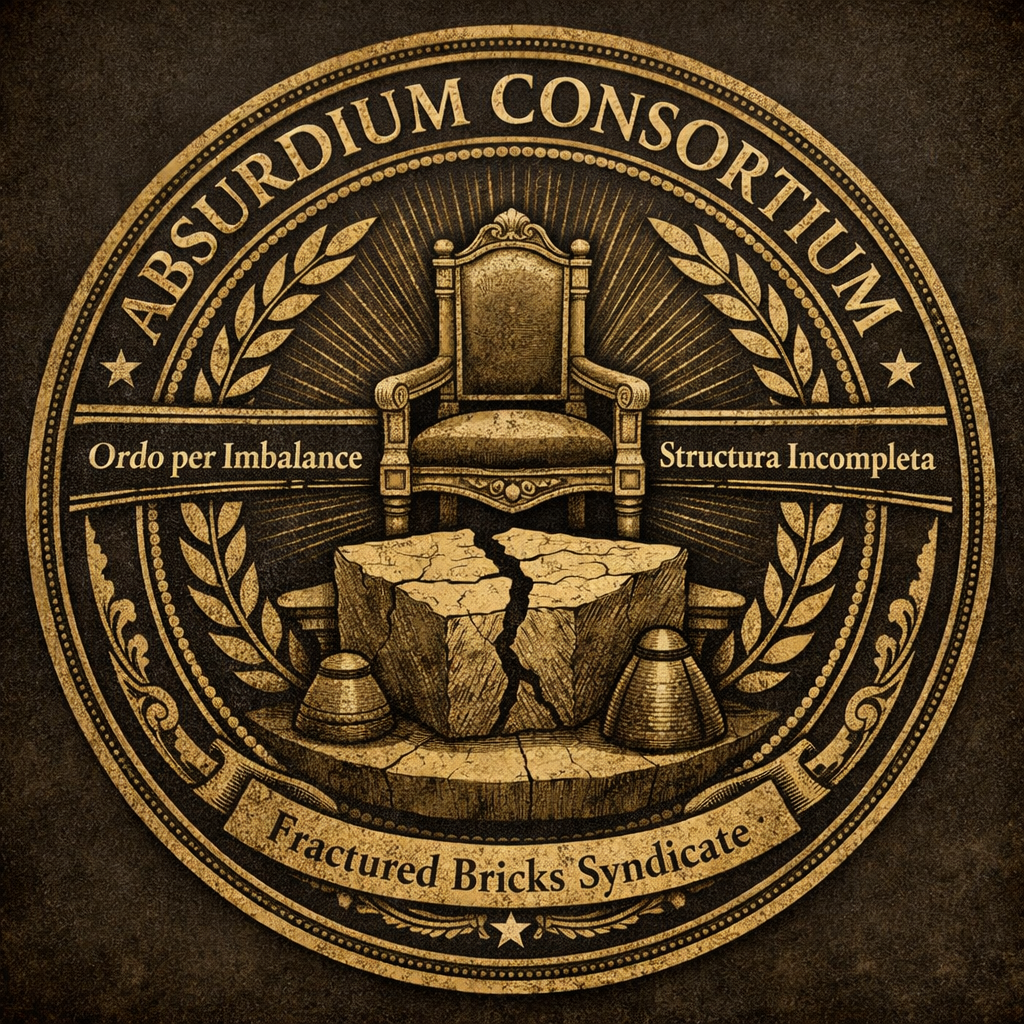
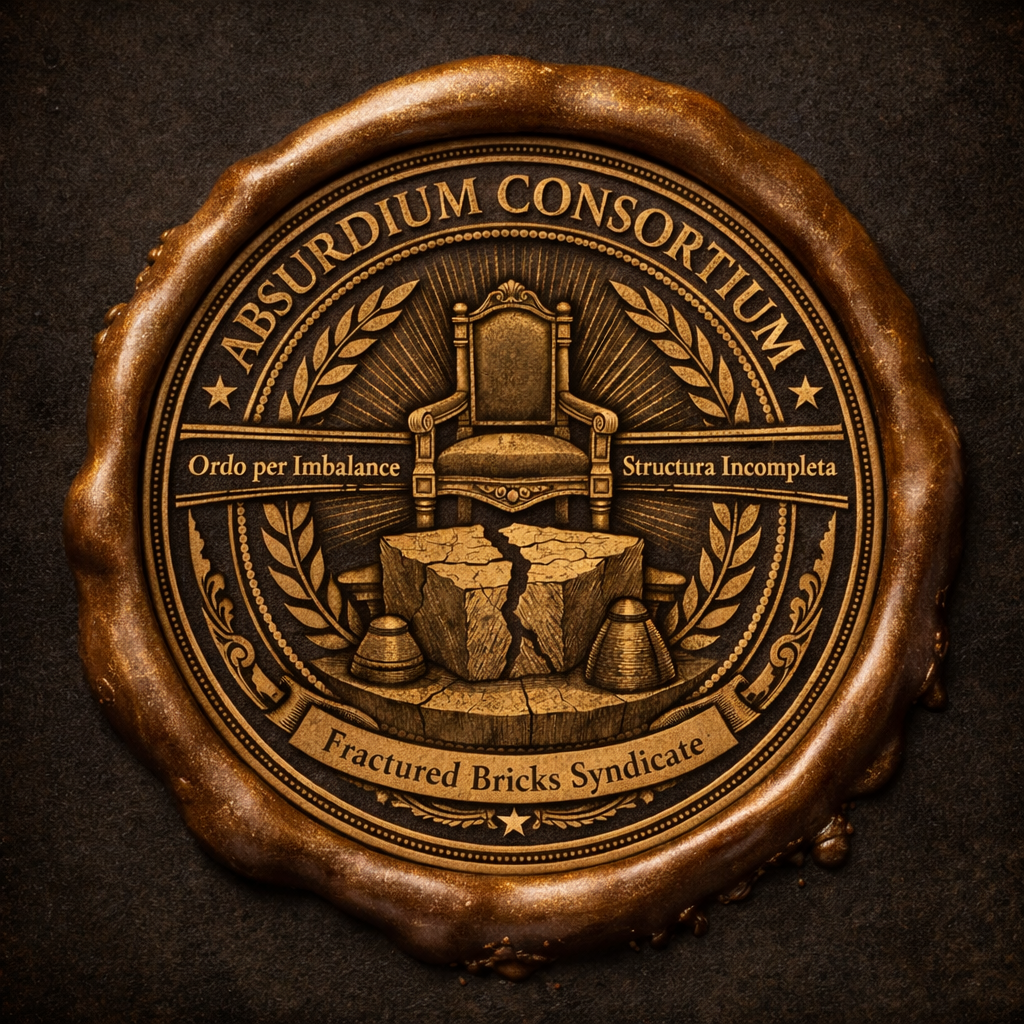
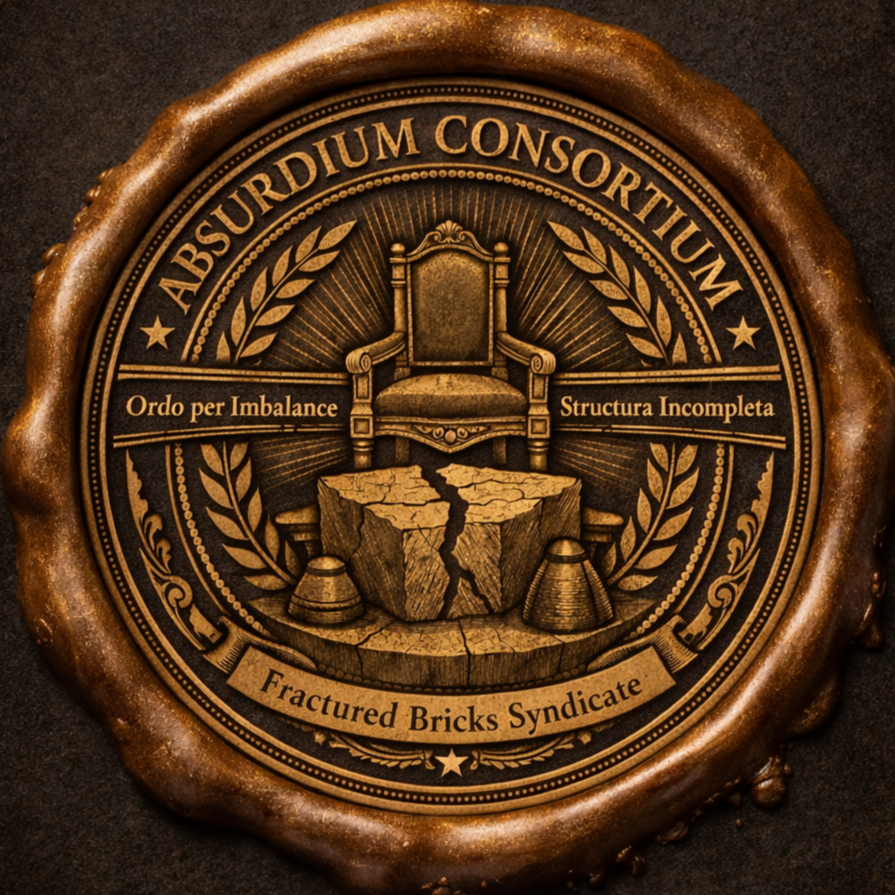
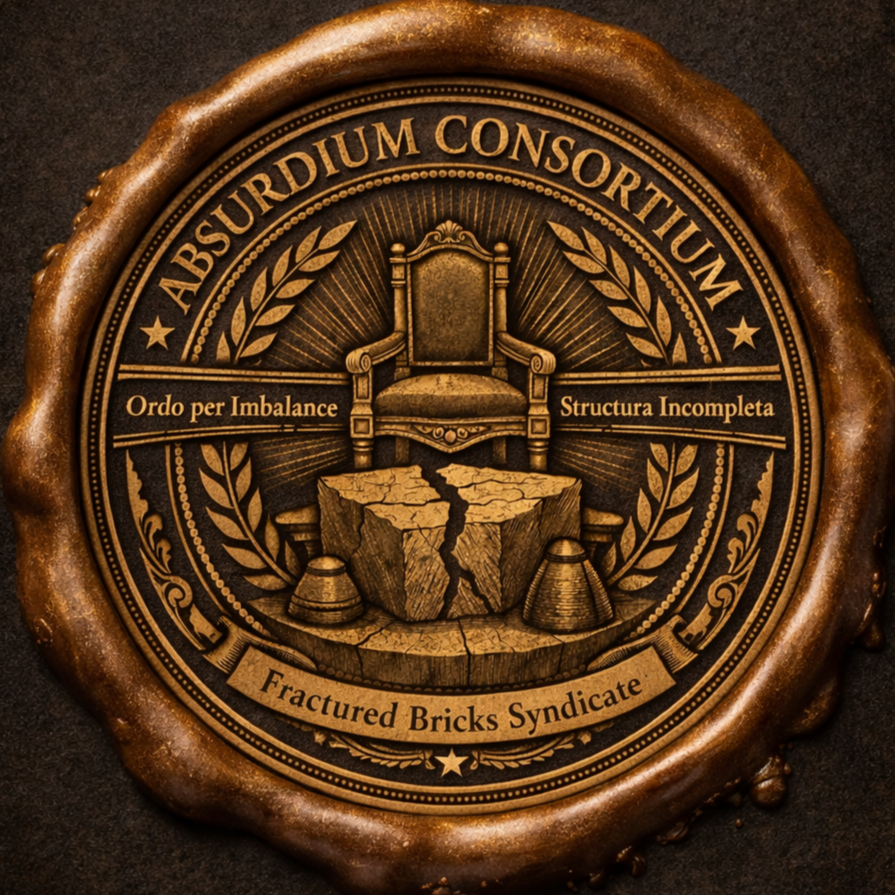
THE ABSURDIUM CONSORTIUM
The Ruling Council for all Mockwrights of the Fractured Bricks Syndicate
All matters of import shall be decided by The Absurdium Consortium, where brick, mockery, and and absurdity converge in solemn deliberation.
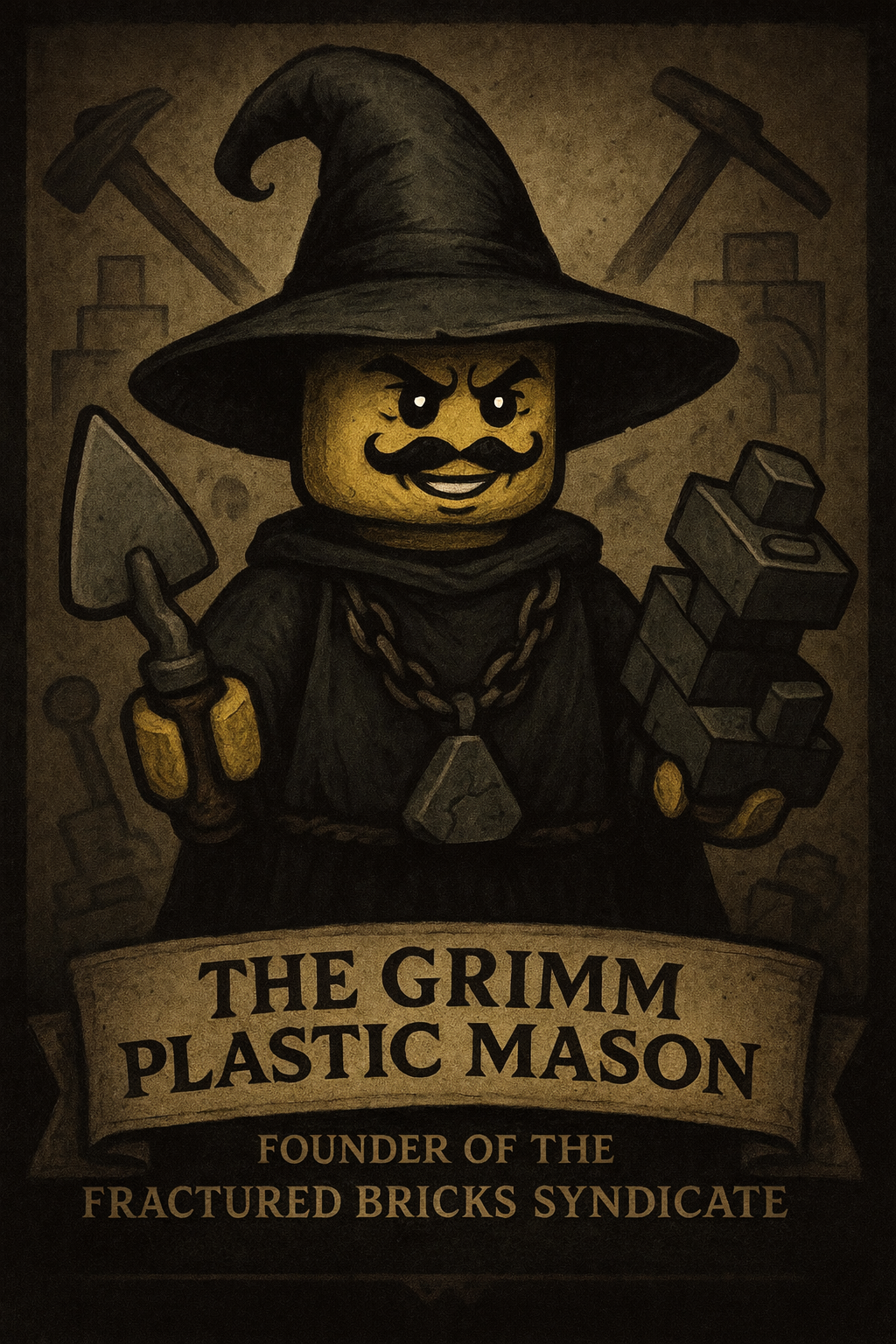
The Grimm Plastic Mason - Founder & Master Brickwright of the Fractured Bricks Syndicate
No one agrees where the Grimm Plastic Mason began, only that the Fractured Bricks Syndicate began with them. Some claim they were once a master builder of immaculate order, driven to madness by the sterile symmetry of corporate sets. Others whisper they were forged from the shards of discarded bricks, a spirit born of misprinted minifigs and forgotten instructions. Whatever the truth, their name became a rallying cry for every builder who saw beauty not in perfection, but in fracture.
The Grimm Plastic Mason is less a person than a movement. They teach that chaos has craft, that satire is structure, and that every stud is a chance to subvert expectation. Under their unseen hand, the Fractured Bricks Syndicate rejects clean lines and safe stories, preferring twisted tableaux where meaning hides beneath absurdity and elegance emerges from collapse. Their disciples speak of “the Method in the Mayhem,” a guiding principle that turns accidents into art and inside jokes into architecture.
Legends tell of their first build, a towering theater assembled backwards on purpose, where nothing fit and yet everything worked. The critics called it a disaster. The Syndicate called it doctrine. From that fractured foundation grew a philosophy that mocks the pristine and celebrates the profane, that mines humor from darkness and truth from parody.
Some say the Grimm Plastic Mason still walks among the bricks, disguised as any other builder, planting hidden gems and sardonic surprises where no one expects them. Others insist they vanished long ago, leaving only the Fractured Bricks Syndicate to carry on their doctrine of deliberate disorder. But in every crooked arch, every misplaced minifigure, every scene that laughs at the story it tells, their presence lingers.
The Grimm Plastic Mason is not a builder. The Grimm Plastic Mason is a heresy in ABS form. The Grimm Plastic Mason is not a name. The Grimm Plastic Mason is a warning to those who worship order over imagination.
The Grimm Plastic Mason is the Fractured Bricks Syndicate.

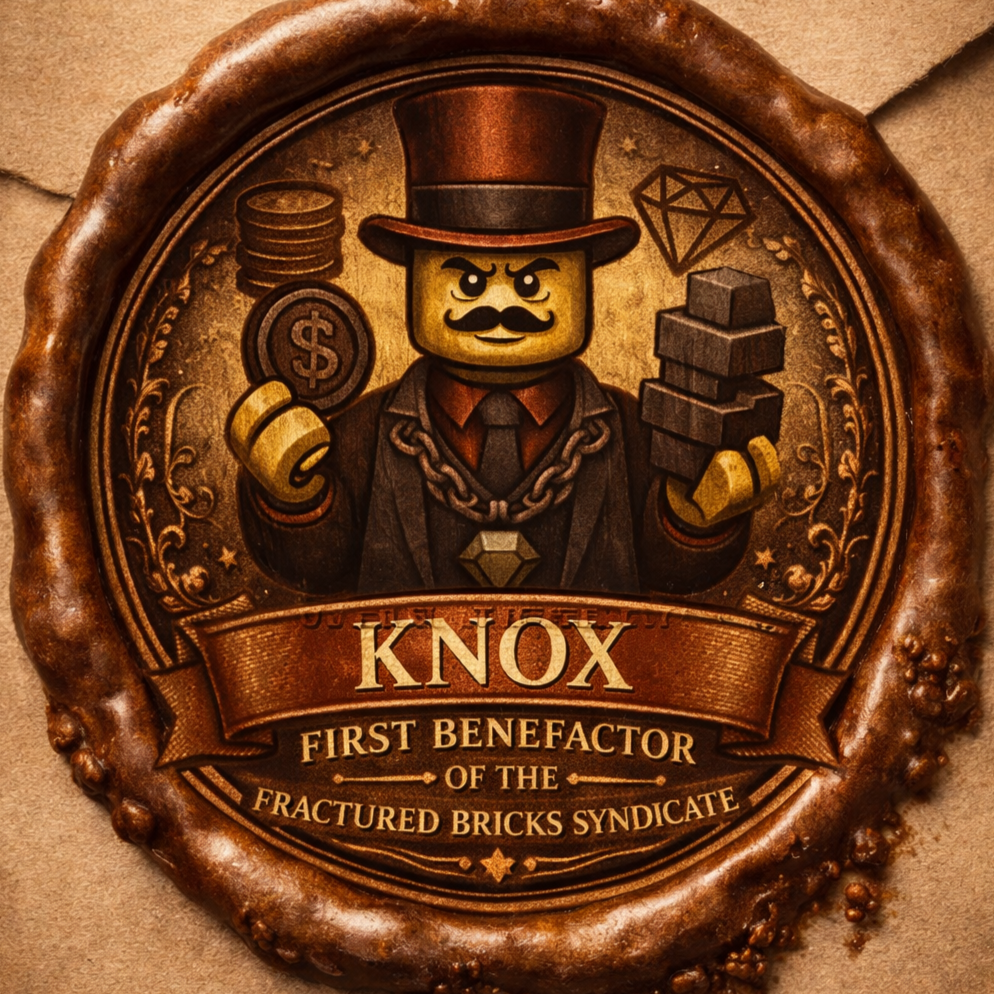
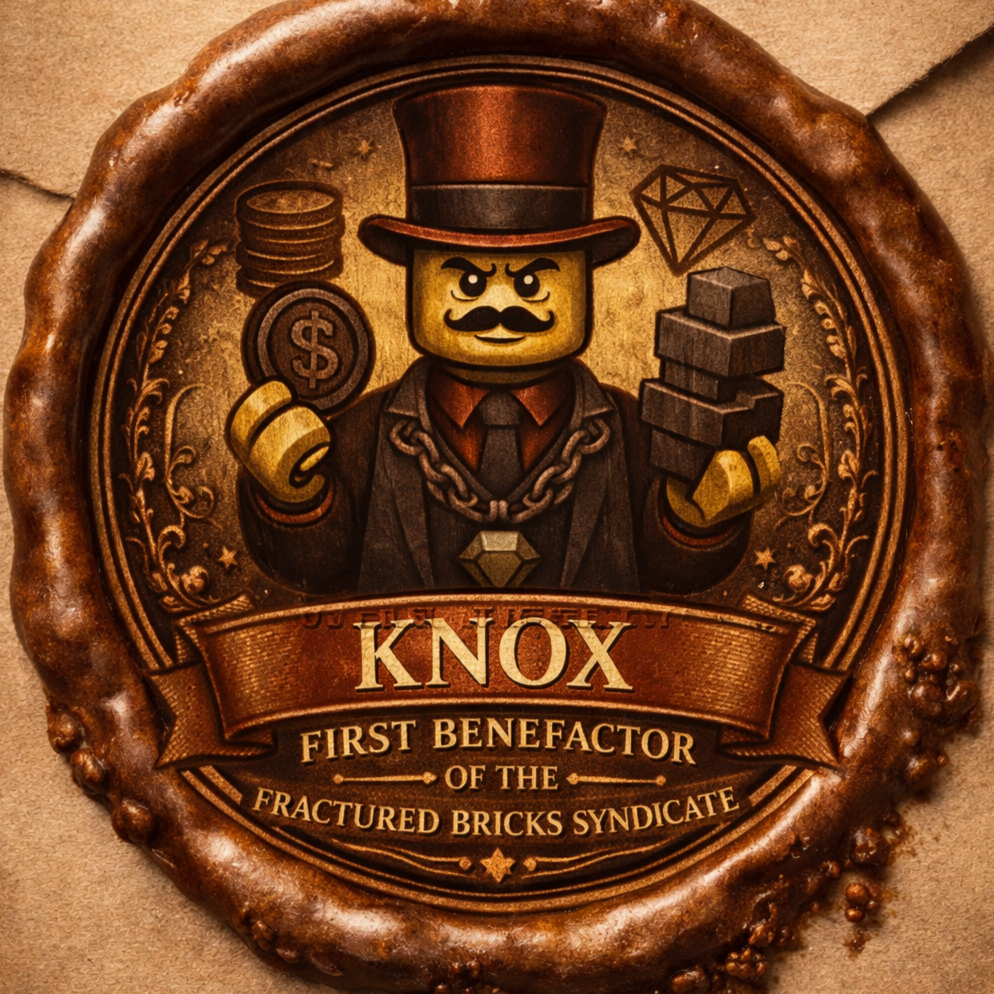
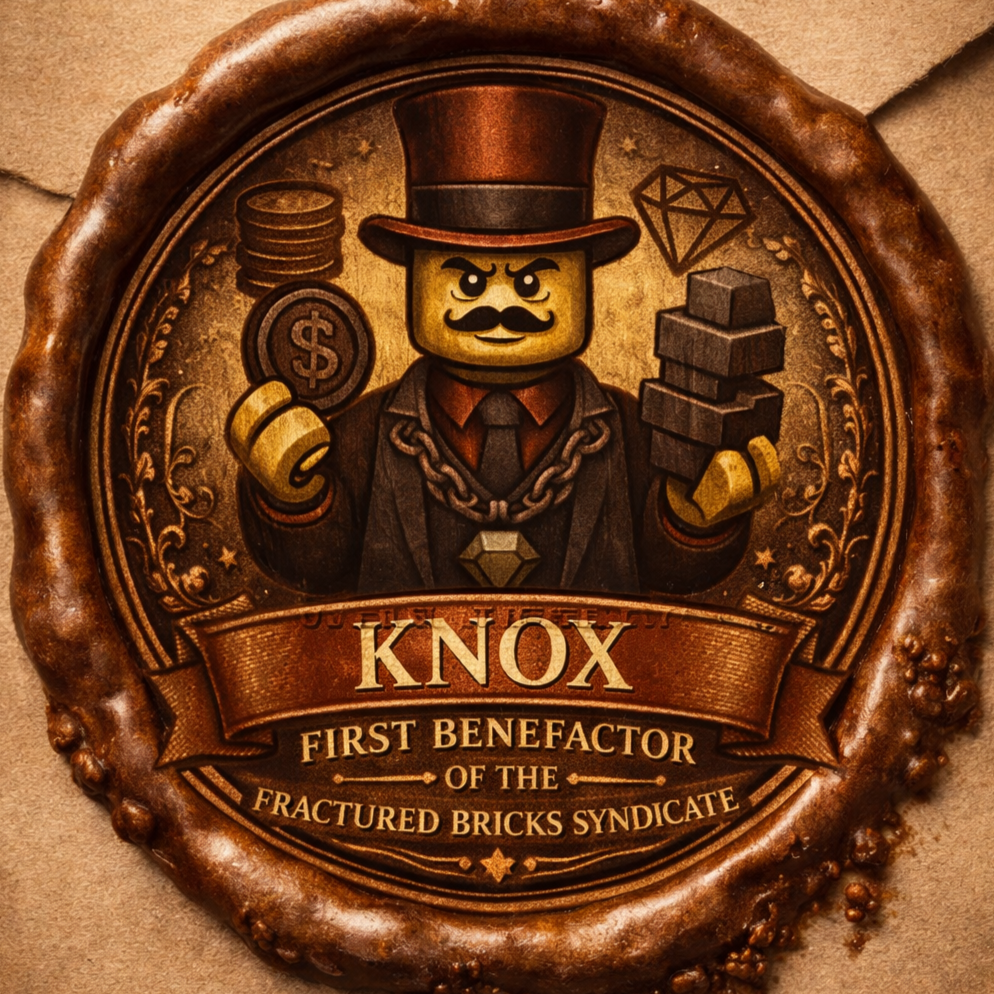
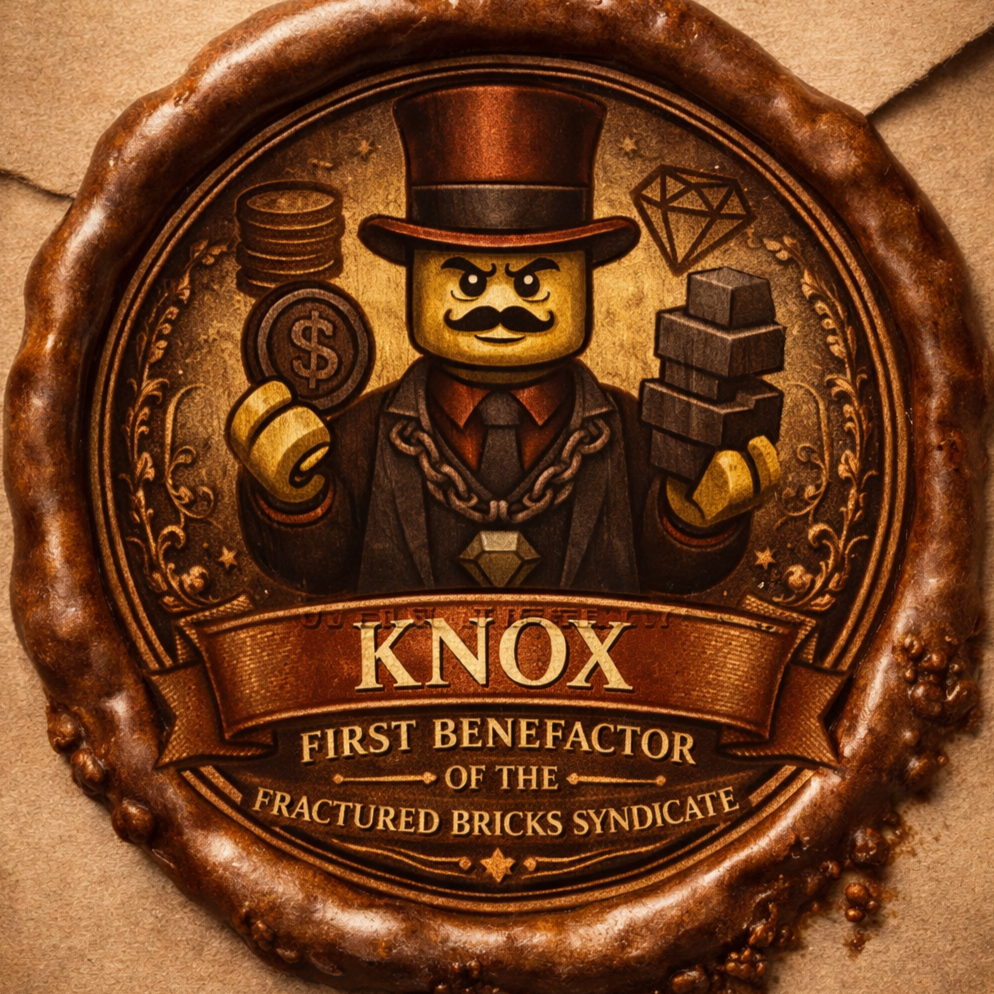
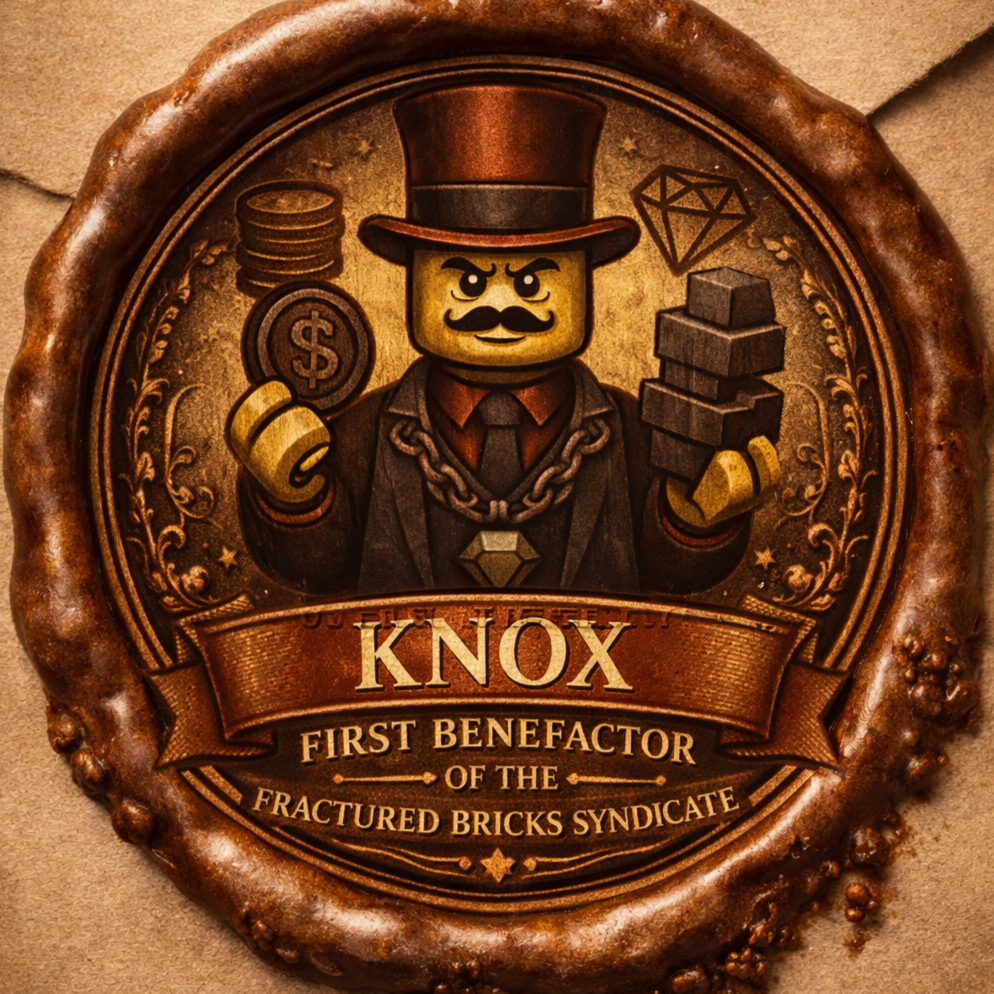
Knox - First Benefactor of the Fractured Bricks Syndicate
A figure of quiet influence, Knox’s involvement with the Fractured Bricks Syndicate is felt more than seen. Seldom welding bricks themselves, they ensure the Guild’s endeavors never falter, providing resources, counsel, and a steady hand in times of absurd chaos. Few know their true face or hear their voice, yet every completed structure and meticulously placed gag carries the mark of their unseen guidance. Knox thrives in shadows, championing
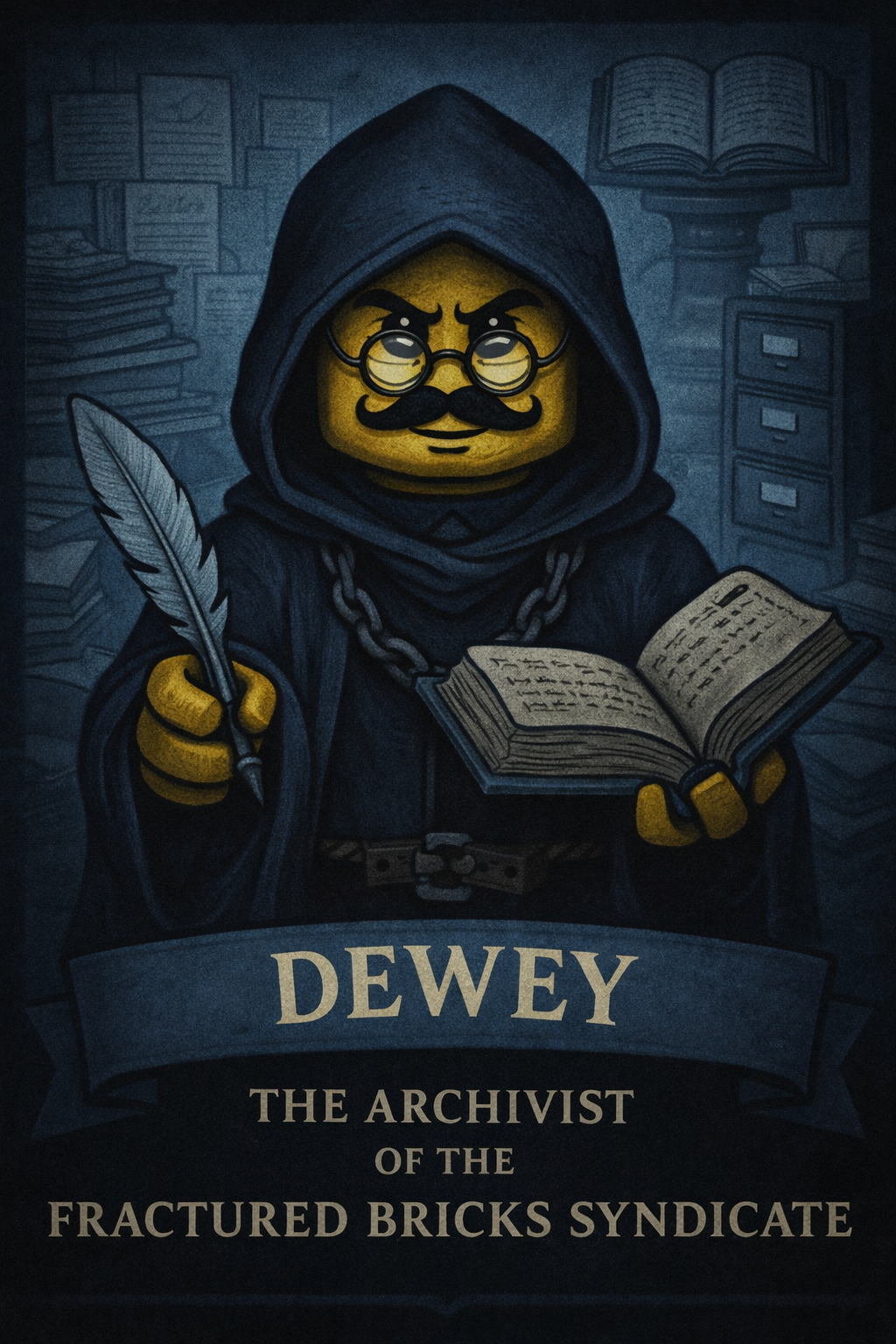
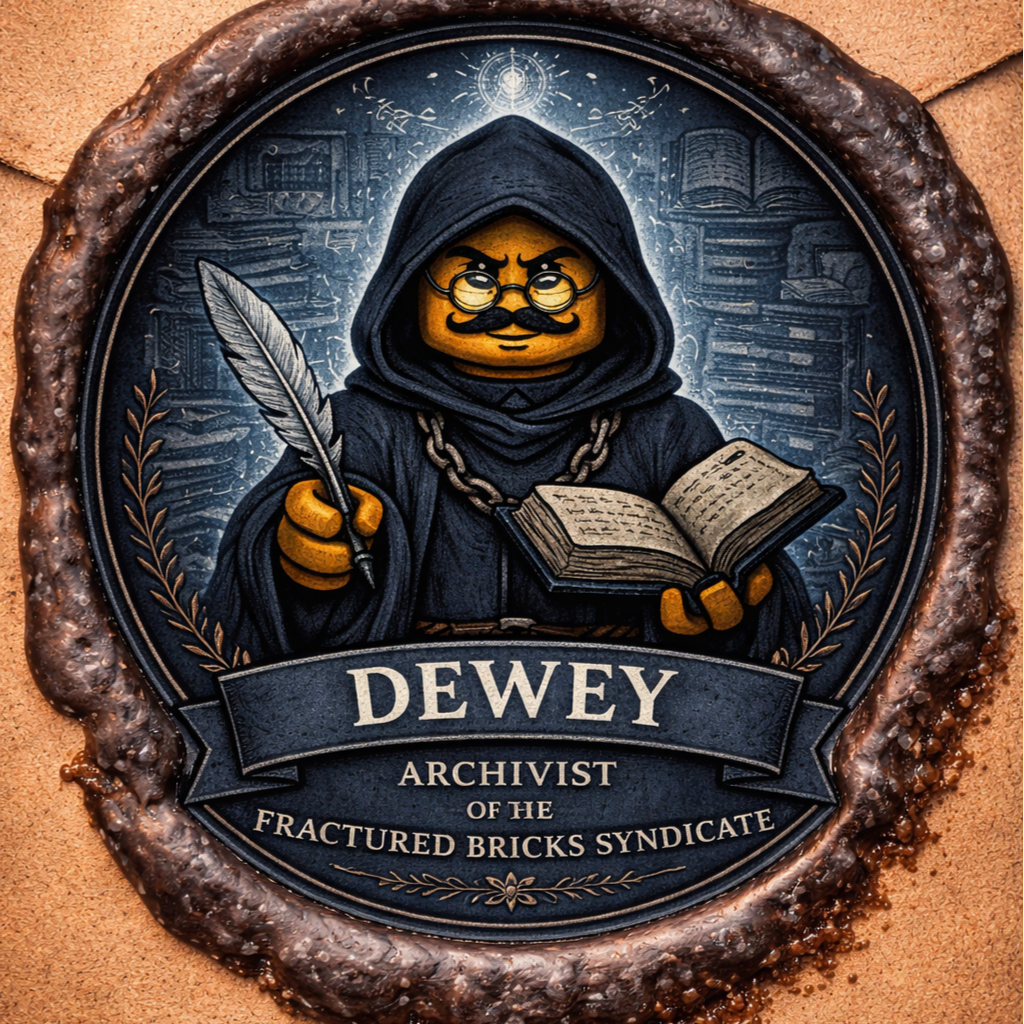
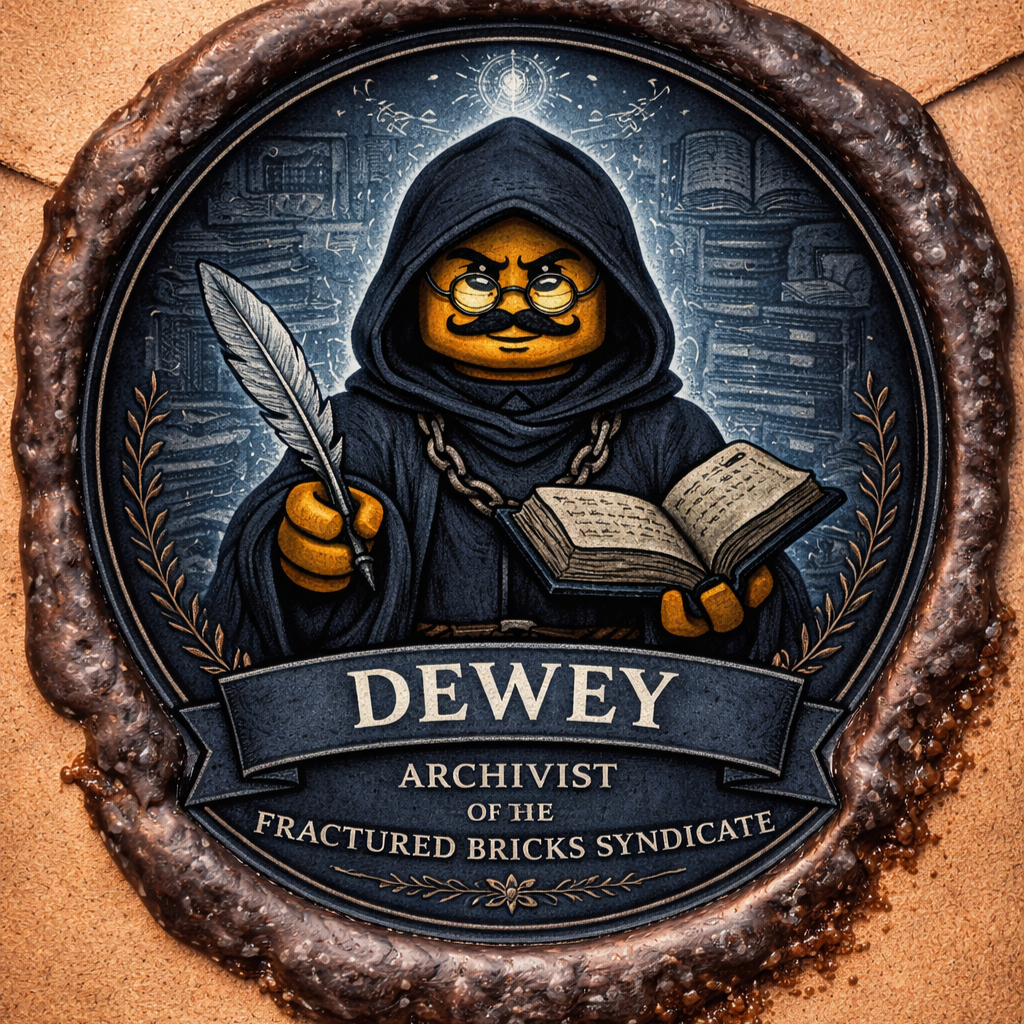
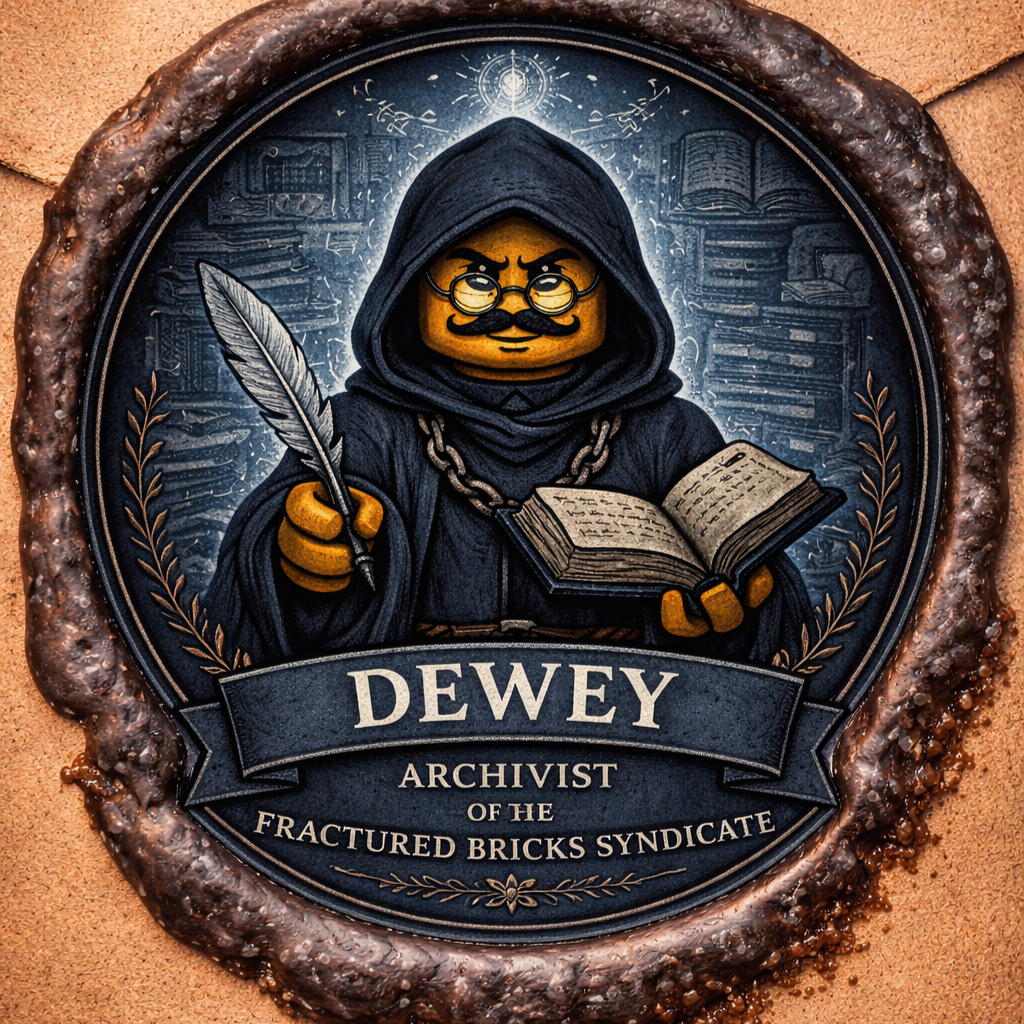
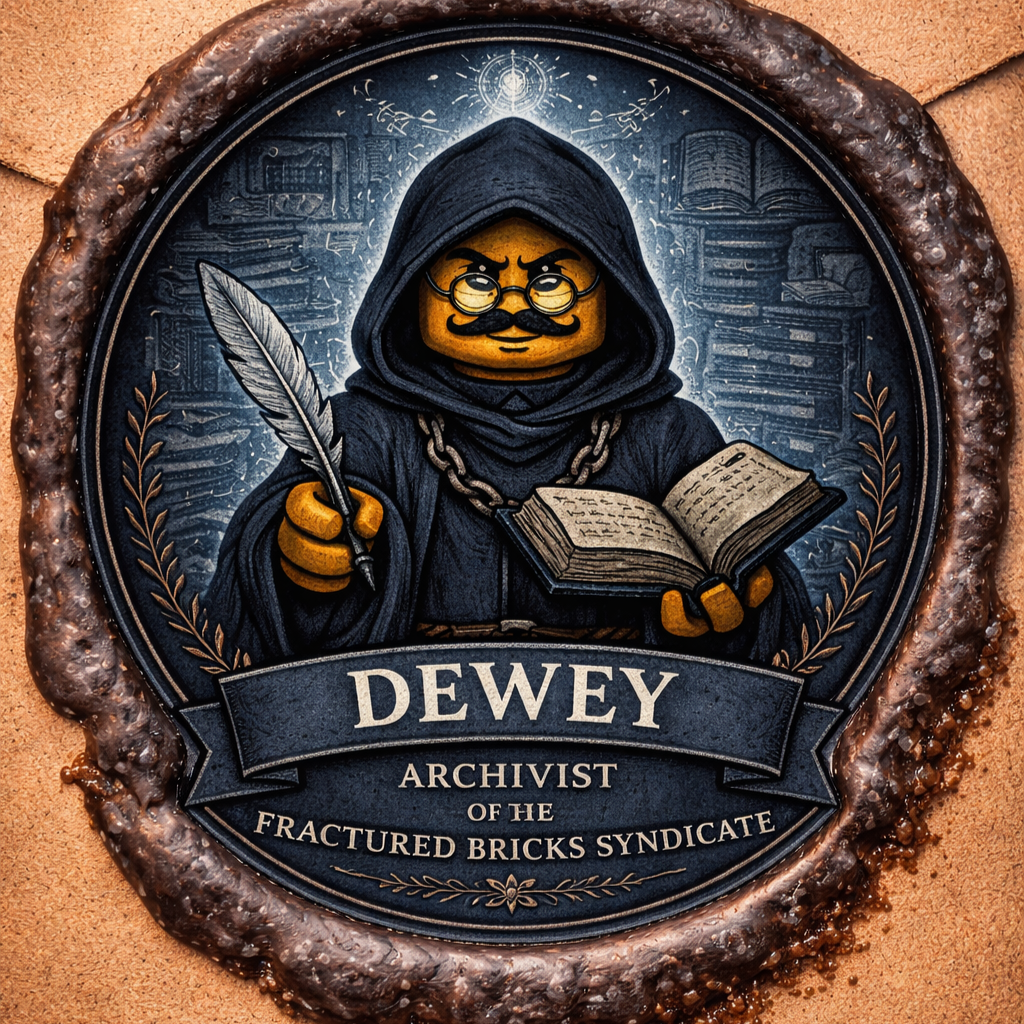
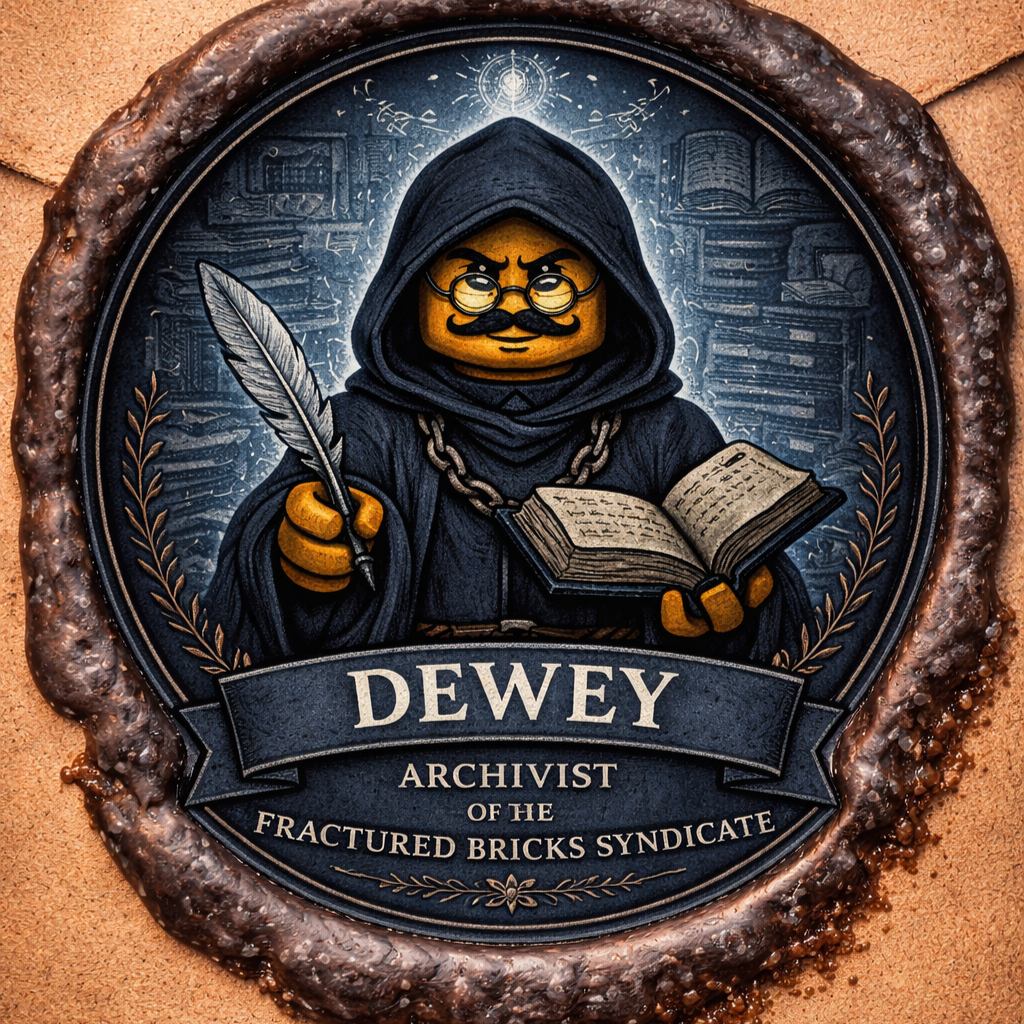
Dewey - Archivist of the Fractured Bricks Syndicate
Custodian of the Repository and all official, unofficial, contested, deferred, misfiled, and unresolved records. Responsible for preserving contradictions, maintaining institutional memory, and ensuring no narrative is ever fully settled. Known for precise annotations, ceremonial seals, and an unspoken authority over what history remembers.

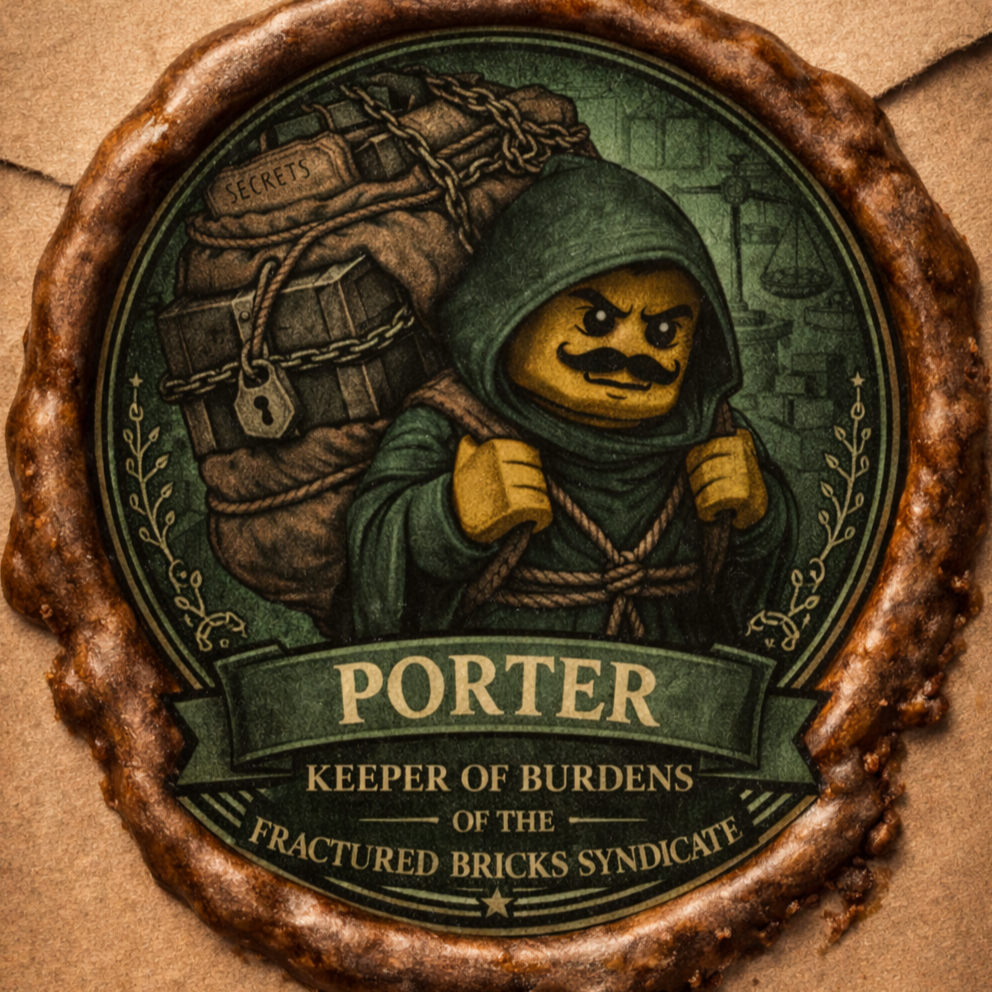
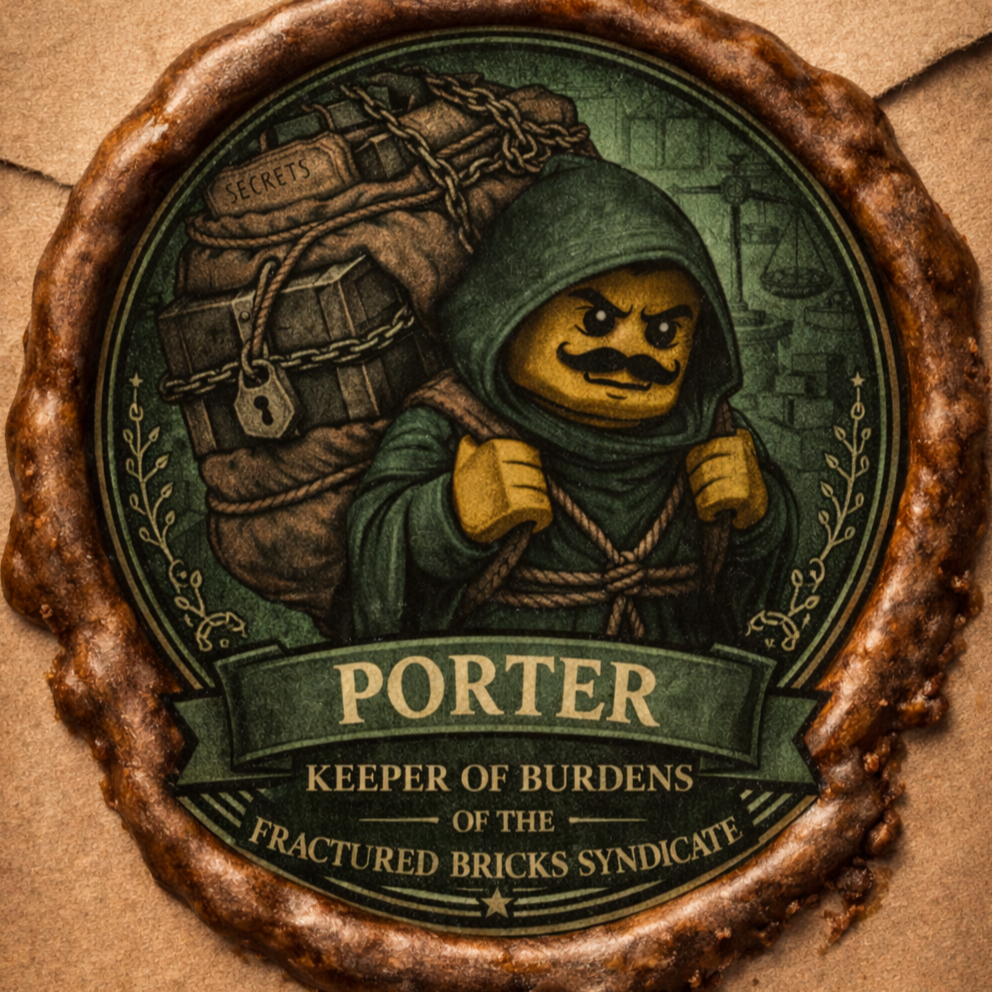
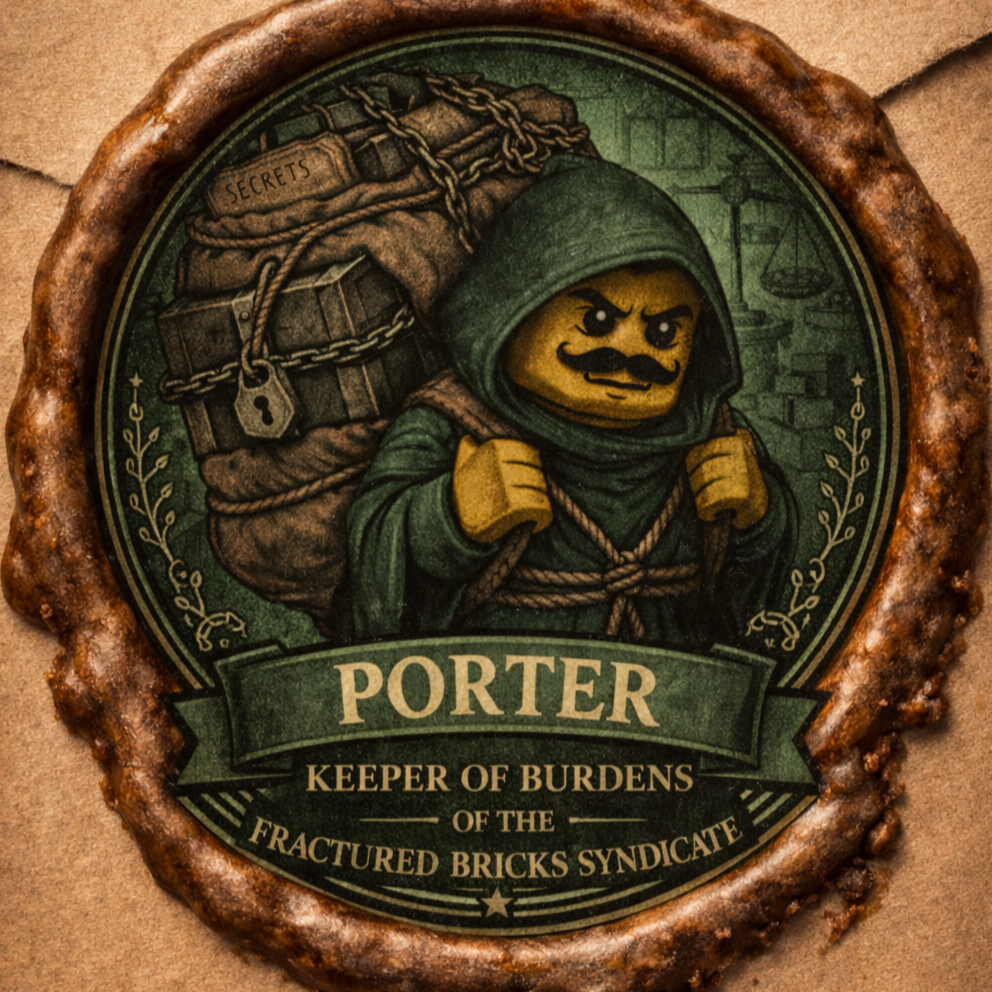
Porter - Keeper of Burdens of the Fractured Bricks Syndicate
Responsible for bearing the weight of unresolved builds, abandoned ideas, and things best not set down. Entrusted with the transfer and custody of materials that outlived their intent, Porter builds not to prevent failure, but to ensure it can be carried without collapse. Speaks rarely. Moves deliberately. Nothing leaves their hands lighter than it arrived.
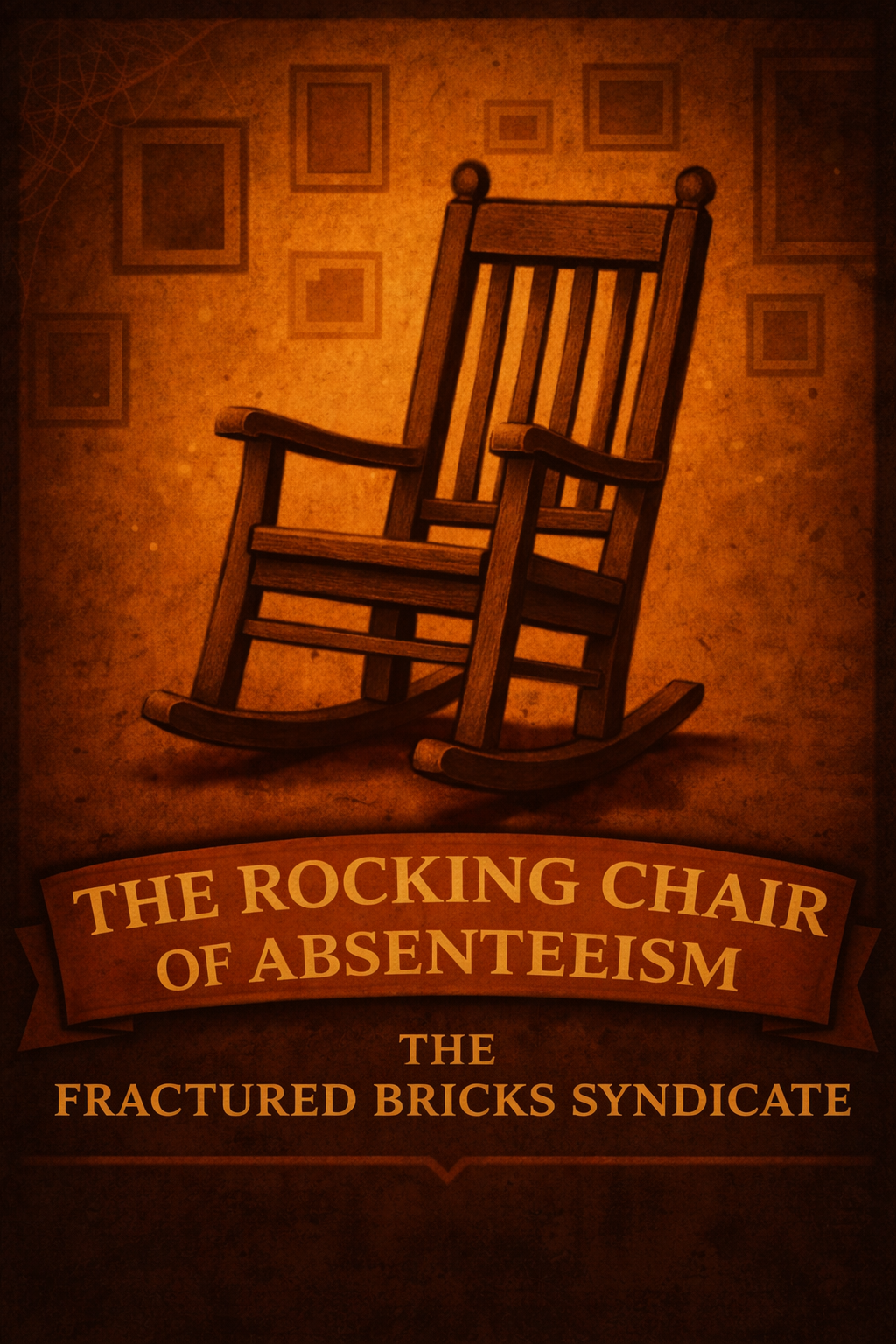
The Rocking Chair of Absenteeism - Acknowledgment of Absence, Not Its Cause
A permanent vacant seat recognizing loss, withdrawal, and unresolved absence within the Syndicate. Its motion is ceremonial, its silence instructional. The Chair does not vote, does not speak, and does not intervene, but all decisions are made in awareness of it. It rocks to remind, not to comfort. Presence is optional. Absence is recorded.
THE ABSURDIUM CONSORTIUM - GOVERNING PROCEDURES
The Fractured Bricks Syndicate
How the Absurdium Consortium Reaches Decisions.
The Absurdium Consortium does not vote to decide. It votes to test whether a decision deserves to exist.

1. Motions Are Introduced, Not Proposed
Any member of the Consortium may introduce a motion. Introductions are brief and declarative. Arguments are discouraged.
A motion must answer only one question:
“Where will this land?”
If no landing place exists, the motion is tabled without discussion.
2. The Vote Is Asymmetric
Each seated member casts a vote in one of three forms:
Build — Proceed. The idea has somewhere to land.
Hold — The idea is sound but premature. Space must be made.
Break — The idea is structurally intact but spiritually wrong.
Votes are recorded without tally.
3. The Rocking Chair of Absenteeism Is Consulted
Before any decision is acknowledged, the Chair is observed.
If the Chair rocks on its own, the motion is delayed.
If the Chair is still, the motion may proceed.
If the Chair is moved by hand, the motion is invalidated.
The Chair does not vote.
It reminds the Consortium who is missing.
4. Consensus Is Not Required
Unanimity is viewed with suspicion.
A motion advances when:
No member votes Break, and
At least one member votes Build, and
No one attempts to resolve disagreement.
Lingering discomfort is treated as a positive indicator.
5. Knox Records the Outcome
Knox does not summarize debates.
He records only:
The motion as introduced
The recorded votes
Any visible hesitation
Whether the Chair moved
Interpretation is left to history.
6. Dewey Archives the Decision Incorrectly
Dewey files the record in the Repository, often under:
The wrong category
The wrong heading
Or alongside unrelated documents
This is intentional.
If the decision cannot survive misfiling, it was not ready.
7. Porter Carries What Remains
Porter does not participate in the vote.
Afterward, he bears:
Deferred motions
Unfinished consequences
Decisions that technically passed but never landed
Nothing is discarded.
Everything waits.

Codex Entry
How the Absurdium Consortium Reaches Decisions
Voting Protocol of the Absurdium Consortium
Filed under: Governance Practices (Observed, Not Enforced)
The Absurdium Consortium does not vote in the conventional sense.
Decisions are reached through the Deliberation of the Uneven Weight, a process acknowledging that not all voices carry equal burden, and that absence itself exerts pressure.
The protocol proceeds as follows:
Presentation Without Advocacy
Any matter brought before the Consortium must be stated plainly, without recommendation. Advocacy is considered contamination of outcome.The Weight Pass
Each seated member responds not with approval or dissent, but with a statement of consequence. What would be gained. What would be broken. What would be made harder to carry.The Silent Measure
The Rocking Chair of Absenteeism is observed.
Its presence is acknowledged.
No words are spoken during this interval.Deferred Recognition
Members may request delay, fragmentation, or partial execution. These are not treated as indecision, but as legitimate conclusions.Consensus by Tolerance
A decision is considered ratified when no member declares it unbearable.
Enthusiasm is irrelevant.
Comfort is viewed with suspicion.Record Without Resolution
All decisions are logged as provisionally final.
Reconsideration is permitted at any time without formal reversal.
The Consortium does not seek efficiency.
It seeks survivability of meaning.

The Ceremonial Name
The Deliberation of the Uneven Weight
(Informally referred to by Mockwrights as “the long way around”.)
The name matters because it signals that decisions are not balanced, clean, or efficient—and are not meant to be.
Governing Principle
The Absurdium Consortium believes:
A decision that lands cleanly is suspect.
A decision that lands awkwardly may be correct.
This keeps the Syndicate fractured.
And therefore functional.

Marginal Mockwright Annotation
(Handwritten, unsigned, repeatedly recopied)
“If everyone agrees immediately, something is wrong.”
Also:
“We do not vote for things.
We vote whether we can live with them.”
The Chair always votes first.
It just never says how.

Marginal Mockwright Annotation
(handwritten, ink smudged, unsigned)
“We once tried voting faster.
The build collapsed politely.
Never again.”
Vault Disney Internal Interpretation
CONFIDENTIAL — STRATEGIC GOVERNANCE SUMMARY
Following observation, Vault Disney has determined that the Absurdium Consortium utilizes an “emotion-weighted consensus optimization framework.”
Key findings:
• Decisions are delayed to increase perceived gravitas
• Silence is leveraged as a dominance signal
• The empty chair functions as a symbolic risk-mitigation representative
• Outcomes are intentionally ambiguous to allow post-hoc brand alignment
Recommendation:
Vault Disney representatives should mirror silence during negotiations and refer to delays as “values-driven pacing.”
Under no circumstances should anyone attempt to sit in the chair.
Addendum:
It is believed the Chair represents either legacy leadership, an unfilled executive role, or an unresolved tax matter.
Vault Disney Incident Report
“Attempted Standardized Vote (Unsuccessful)”
Internal Memorandum – Vault Disney Strategic Integration Division
Re: Trial Adoption of Syndicate Decision Framework
Status: Terminated Early
In an effort to improve cross-organizational alignment, Vault Disney initiated a pilot program intended to replicate the Fractured Bricks Syndicate’s “consensus-based deliberation ritual” (hereafter: the Vote).
The procedure was modified for efficiency.
Key improvements included:
A fixed agenda
A timed discussion window (15 minutes)
A show-of-hands tally system
Removal of non-participating furniture
The meeting failed immediately.
Without the Rocking Chair of Absenteeism present, participants reported a lack of resistance, followed by overconfidence. Decisions were reached too quickly. Confidence spiked. No discomfort was registered. Several attendees described the outcome as “clean,” which, in retrospect, should have been a warning.
Upon reintroducing the Chair mid-meeting, the group was unable to revisit earlier conclusions. The Chair rocked once. A senior executive requested clarification. No clarification was provided.
The vote was annulled.
Conclusion:
The Syndicate’s process appears to rely on inefficiencies, unresolved tension, and symbolic weight. These elements cannot be streamlined without destabilizing the outcome.
Recommendation:
Do not attempt again. Lease access instead.

(Mandatory reading for apprentices and anyone who has ever said “we’re basically aligned.”)
You will feel the urge to conclude early.
This urge is incorrect.
If the room feels comfortable, you have failed to notice the Chair.
If the answer seems obvious, you have not waited long enough.
Common mistakes include:
Calling for a vote before the Chair settles
Interpreting silence as agreement
Attempting to summarize consensus
Asking Dewey to “just clarify the outcome”
The Uneven Weight is not a delay tactic.
It is the mechanism.
You are not voting for an idea.
You are waiting to see which ideas survive discomfort.
If the Chair rocks:
Do not speak
Do not correct
Do not explain
If nothing happens for a long time:
Good.
That means the weight is being distributed properly.
Remember:
A rushed decision creates more to carry later.
Porter will remember.

Matter Brought Before the Absurdium Consortium:
Whether to formally complete an unfinished build.
Attendance:
Grimm Plastic Mason — present
Knox — present
Dewey — present
Porter — present
The Rocking Chair of Absenteeism — present
Proceedings:
Discussion began.
No motion was proposed.
After some time, the Chair rocked slightly forward.
No one acknowledged it.
Later, the Chair rocked again, this time unevenly.
Porter adjusted his stance.
Dewey noted the time but did not record it.
Knox asked whether the build needed to be finished.
No answer was given.
The Chair settled.
No vote was called.
No objections were raised.
The matter was considered resolved.
Outcome:
The build remains unfinished.
Support structures were added elsewhere.
Marginal Mockwright Annotation (unsigned):
“The Chair voted first.
Everyone else merely agreed not to argue.”
Recorded Vote Excerpt: Codex Entry Motion Without Resolution
Mockwright Training Insert: “How Not To Rush the Uneven Weight”

Formally: The Rite of Uneven Weight and Deferred Motion
Colloquially (never in writing):
“Waiting for the Chair.”
The Ceremonial Name
The Uneven Weight Deliberation
Marginal Note - Mockwright Hand (unattributed, penciled)
Marginal Note — Mockwright Hand (unattributed, penciled)
If you are reading this and still asking what it means, you are moving too early.
Marginal Note - Knox
We waited long enough for the Chair to speak.
It did not. That was the answer.
Marginal Note - Dewey
Classification confirmed. Terminology retained for for filing consistency. Anyone attempting to rename this later will redirected to the Silence.
Filed Under: Governance Practices → Deliberative Rituals → Non-Decisive Consensus
Purpose
The Absurdium Consortium does not vote to decide.
It votes to determine whether a decision can survive the weight placed upon it.
Participants
The Grimm Plastic Mason, Master Brickwright
Knox, First Benefactor of the Fractured Order
Dewey, Archivist of the Fractured Brick Syndicate
Porter, Bearer of Unresolved Weight
The Rocking Chair of Absenteeism (present by absence)
Procedure
Presentation of Matter
A proposal is introduced without advocacy. Arguments offered too eagerly are considered structurally suspect.Initial Silence
No response is permitted until the Chair completes at least one full oscillation.
Silence is recorded as engagement.Weight Assessment
Porter evaluates the proposal not for merit, but for what it will require to carry once implemented.
This assessment is not spoken unless failure is imminent.Archival Reference
Dewey produces precedents that do not quite apply. These are entered into the record anyway.Benefactor Inquiry
Knox asks whether the proposal strengthens the fracture or merely decorates it.
Answers are discouraged.Motion of the Chair
The Rocking Chair’s movement is observed.Forward motion suggests readiness.
Backward motion suggests reconsideration.
Irregular motion suggests postponement.
Stillness suggests abandonment.
Consensus Without Count
No votes are tallied.
If no member objects after the Chair settles, the matter proceeds.
If multiple members hesitate, the matter is deferred.
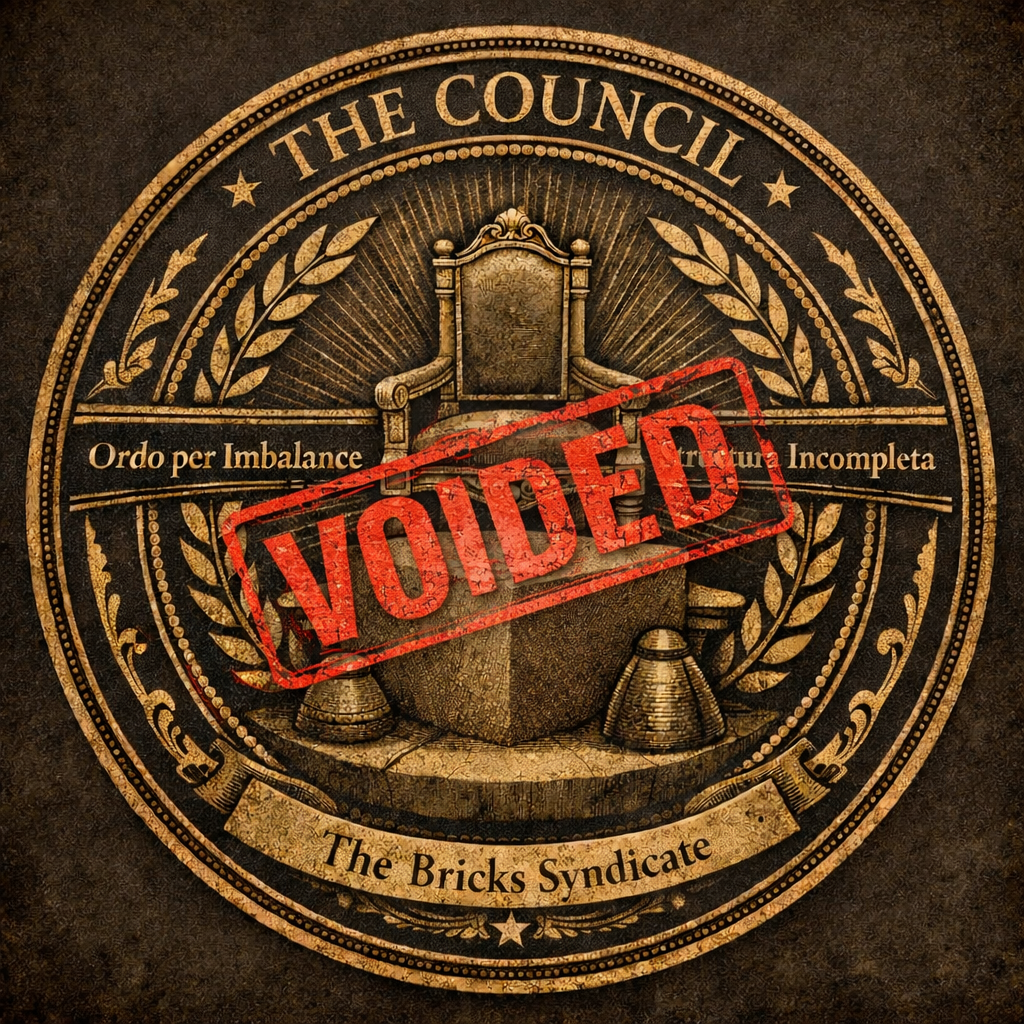
If anyone attempts to “call the question,” the matter is voided.
Conclusion
A decision is considered valid only if it remains unchanged after being left alone.
Codex Entry
Voting Protocol of the Absurdium Consortium
Title: SYNDICATE DECISION OPTIMIZATION WORKFLOW
Proposal Submitted
Chair Movement Detected
If rocking → “Approval in Progress”
If not rocking → “Approval Pending”
Count visible participants
Assign weighted vote values
Escalate to Executive Oversight
Monetize outcome
Margin Note (Vault Disney Legal):
“Recommend replacing chair with stationary seating to improve throughput.”
Status:
Filed. Ignored. Laughed at once. Then archived.
Vault Disney
Internal Flowchart (Recovered, Incorrect)

Porter Footnote (Restricted)
When votes go wrong, it is because someone tried to make them right.
Weight cannot be rushed.
If you force motion before the Chair settles, the burden does not vanish. It transfers.
I will carry it.
I always do.
But understand this: the more often I carry failed decisions, the heavier the next one becomes.

Marginal Note (Dewey, Archivist):
Porter’s statement has been logged as a functional constraint, not a sentiment.
Previous attempts to treat it otherwise have increased carrying time.
Filed under: Governance / Rituals / Known Inefficiencies
All proceedings of the Absurdium Consortium shall begin with The Convening of Uneven Weight.
The purpose of this ceremony is not to reach agreement, but to recognize the forces already bearing upon the matter at hand.
I. Opening Observance
Each Convening begins with a Moment of Silence for Betty Ditzler.
The silence is not timed. It ends when it ends.
This observance serves as acknowledgment of:
loss without resolution
absence without explanation
consequences that precede deliberation
No record is kept of its duration.
II. Presentation of the Matter
The matter is read aloud once. Clarification is permitted. Justification is discouraged.
Documents may be introduced but not summarized. Silence is considered a valid response.
III. Recognition of Weight
Council members do not cast votes.
Instead, each member states — verbally or otherwise — whether they bear weight in relation to the matter.
Examples include:
structural responsibility
archival consequence
custodial burden
financial liability
unresolved absence
Weight may be claimed, declined, or deferred.
The Rocking Chair of Absenteeism is acknowledged at this time.
It does not respond.
IV. Determination
If weight is uneven, the matter proceeds. If weight is evenly distributed, the matter is deferred. If no one claims weight, Porter records the burden and carries it until such time as it lands.
The Chair does not vote. Its motion, if any, is noted.
V. Closure
Proceedings conclude without announcement. Implementation begins immediately, retroactively, or not at all. All outcomes are considered binding.
— Ratified without objection
— Filed by Dewey
— Reviewed and carried by Porter
Codex Entry
Voting Protocol of the Absurdium Consortium
(Filed retroactively under Absurdium Consortium Proceedings, though the name had not yet been adopted at the time)
No agenda was circulated.
The Syndicate assembled because there was nowhere else to assemble to.
The Ditzler Theatre stood incomplete. The build had been paused. The fracture had occurred. Betty Ditzler was absent, though the language to describe that absence had not yet been agreed upon. At the time, it was referred to only as “the situation” or, in some records, “the unacceptable silence.”
The Grimm Plastic Mason arrived early and did not begin building.
This was noted.
Knox arrived next and placed no objections on record.
This was also noted.
Others followed. No one took the central position. No one claimed authority. Tools remained set down. The Syndicate waited for instruction that did not come.
After an indeterminate length of time, someone spoke, not to propose a solution, but to ask whether anyone else felt the pressure in the room.
Multiple members confirmed they did.
It was at this point that the Syndicate first understood that the problem was not structural damage, nor error of technique, nor even the loss of Betty Ditzler as an individual. The problem was that the jokes had nowhere to land.
Satire, once uncontained, had weight.
The Syndicate did not vote.
Instead, the meeting ended when the Grimm Plastic Mason stood, gathered their tools, and resumed work, not to finish the theatre, but to hold the space around what had broken.
Knox later described this moment as “the first uneven decision,” though no formal terminology existed yet.
The Guild left fractured.
They did not adjourn.
They dispersed.
No one remembers standing.
Record of the First Convening After the Aperture
Porter Footnote (Filed Separately)
“When votes go wrong, they do not fail. They fall. Someone has to catch them.”
Optional, Very Small Marginal Note (Unsigned)
“We learned that silence is not empty. It is full of things we refuse to carry.”
That is the Syndicate admitting fault without apology.
The Ceremonial Name
The Convening of Uneven Weight
Not a vote.
Not a debate.
A recognition that decisions already exist, they are merely being acknowledged.
Marginal Mockwright Annotation
(Handwritten, unsigned)
“If this feels inefficient, it is. Efficiency is how we got the Aperture.”
AFTER THE APERATURE PROCEDURES

Marginal Note (Mockwright Hand, Later)
“This is why we do not rush the silence.”
Vault Disney Addendum (Rejected)
“Recommend future meetings include a defined silence duration, optional background music, and a facilitator empowered to conclude emotional segments.”
Filed by Dewey under Misfiled.
Weight transferred to Porter.
Marginal Annotation (Added Later, Once the Name Existed)
This gathering is now recognized as the First Convening of what would become the Absurdium Consortium. At the time, no such body was named. The weight preceded the structure.
— Dewey, Archivist
Vault Disney Internal Summary (Incorrect)
Minutes unclear. Leadership absent. No actionable outcomes. Recommend implementation of Time-Bound Decision Windows™ to prevent recurrence.
ABSURDIUM CONSORTIUM - MEETING NOTES
I. Instrument of Renaming
Filed Upon the Acceptance of Irreversibility
Subject: Formal Adoption of the Absurdium Consortium
Recorded by: Knox
Witnessed by: Present Parties, Uncounted
The designation Absurdium Consortium had existed in draft, margin, and jest prior to the breach. It was proposed during earlier governance reviews, briefly debated, and formally tabled on the grounds that the name carried unnecessary weight.
At the time, weight was considered optional.
Following the breach, it became evident that the former council structure was no longer sufficient. The matter was not one of leadership, nor quorum, nor authority, but of gravity.
What had been overseen as governance now required bearing.
What had been decided now required holding.
It is therefore entered into record that the governing body formerly known as the Council of the Fractured Bricks Syndicate shall henceforth be referred to as The Absurdium Consortium.
The term is adopted not as reform, but as correction.
Absurdity is no longer an element of our work. It is the material itself.
This renaming does not imply unity, agreement, or resolution. It acknowledges imbalance as permanent and procedure as adaptive. Votes may occur. Consensus may not.
The Chair remains unoccupied.
So recorded.
— Knox
Marginal Note (hand unknown):
“At no point did anyone suggest a better name.”
II. On the Introduction of the Silence
Addendum to Consortium Proceedings, First Recorded Instance
The Silence was not proposed.
It happened.
During the first formal Convening following the breach, discussion ceased without instruction. No call to order was made. No signal was given. Speech simply failed to resume.
Duration unmeasured.
No member present could later agree on who first noticed it, only that breaking it felt incorrect.
When conversation eventually returned, it did so quietly and with visible effort. No attempt was made to resume prior topics.
It was agreed—without vote—that future Convenings would begin the same way.
Not in remembrance.
Not in mourning.
But in acknowledgment.
The Silence does not name Betty Ditzler.
It does not need to.
Annotation, later hand (Dewey):
“Silence classified as procedural. Do not time.”
III. Regarding the Empty Chair
Statement Entered Without Objection
Filed by: Knox
Context: Seating Arrangement, Post-Aperture
A chair shall remain empty.
No designation is assigned to the vacancy. It does not represent a role, a future appointment, or a moral position. It represents absence that cannot be corrected by substitution.
The Chair is not symbolic.
It is practical.
Its presence prevents premature closure, false balance, and the illusion that all matters before the Consortium are containable.
No member raised an objection.
No member asked for clarification.
The Chair was placed.
IV. On the Redistribution of Burden
(Filed without Ceremony)
Recorded by: Porter
Context: Post-Aperture Operating Conditions
It is noted that one burden no longer rests with me.
The burden in question is not decision-making itself. Nor responsibility. Nor consequence. It is the pretense that resolution must occur.
Prior to the Aperture, the weight of unfinished consensus, deferred judgment, and unresolved direction accumulated in the carrying. I bore it because someone had to, and because it could still be moved.
That is no longer the case.
The Absurdium Consortium now holds imbalance openly. Indecision is seated. Delay is acknowledged. This burden cannot be carried without distortion. Therefore, it remains where it belongs.
All other weights persist. I will continue to bear abandoned builds. Unlanded gags. Structures built to support failure rather than prevent it.
But I do not carry false closure. That weight has been set down.
— Porter
Marginal Note (hand unknown):
“Nothing collapsed when this was released. Which was… instructive.”
Marginal Annotation (later, Dewey):
“Burden reclassified as stationary. Transfer suspended.”
Footnote, unsigned:
“Once seated, no one suggested removing it. That seemed worse.”
PORTER’S ENTRY
Regarding the Weight No Longer Carried
(Filed without ceremony. Entered without witness.)
The Consortium began to decide together.
This altered the load.
Previously, unresolved matters accumulated. Not decisions, but their absence. Each delay required bearing. Each deferral required support. The weight did not belong to any one voice, so it settled elsewhere.
It settled with me.
Following the Renaming, that weight redistributed itself. Not evenly. Not cleanly. But no longer singular.
I remain responsible for what cannot be resolved.
I remain responsible for what must still be borne.
I am no longer responsible for holding indecision itself.
This is not relief.
It is correction.
— Porter

Consortium Annotation
On the Redistribution of Burden
(Filed concurrently. Language reviewed. Meaning unresolved.)
It has been observed that the weight previously borne by Porter no longer accumulates in a single place.
This was not achieved by delegation. Nor by efficiency. Nor by agreement. It occurred as a consequence of procedure.
With the adoption of collective deliberation, indecision ceased to be portable. It no longer settles where it is most convenient. It resists handling. It remains where it arises.
This has had effects.
Meetings take longer.
Silence is heavier.
Responsibility feels less precise.
These are not flaws.
They are indicators that the burden is now where it belongs. Porter continues to carry what must be carried. What he no longer carries cannot be reassigned. Any attempt to do so will fail quietly and persistently.
Recorded without objection.
— Dewey
Archivist of the Fractured Brick Syndicate
Marginal Note, later hand (Knox):
“Correction accepted. Comfort not guaranteed.”

Later Reference (Single Line, No Emphasis)
From Addendum VII: Recurring Matters and Their Current Status
The question was raised again.
Porter refused to carry it again.
Marginal Annotation - Dewey
Filed for clarity. Not comfort.
“Refusal logged as procedural, not insubordinate.
Burden reclassified as non-transferable.
Future references should assume permanence.”
— Dewey, Archivist
Vault Disney Operational Brief
Re: Addendum on Silence (First Recorded Instance)
Classification: Process Optimization Review
Prepared by: Time & Efficiency Division
The described “Silence” observed during early Consortium convenings has been evaluated and reclassified as a non-verbal alignment protocol.
Vault Disney Interpretation:
Silence represents an informal cooling-off window used to reduce meeting friction.
Lack of duration measurement indicates a need for standardization.
Recommendations:
Implement a Time-Bound Silence Window™ (suggested duration: 90 seconds).
Provide optional background ambiance to maintain brand consistency.
Train facilitators to formally close the Silence and transition to agenda items.
Conclusion:
While unstructured, the Silence concept shows promise if properly managed.
Vault Disney Delegation Assessment
Re: Porter Status Adjustment
Classification: Workforce Optimization
Prepared by: Human Capital & Burden Distribution
Recent documentation suggests a shift in Porter’s operational responsibilities, specifically regarding the handling of unresolved matters.
Vault Disney Interpretation:
This change reflects successful delegation reform, reducing reliance on single-point burden carriers.
Indicates maturation of Syndicate governance and improved load distribution.
Assumptions:
Responsibilities formerly held by Porter have been redistributed across the Consortium.
Porter remains available for future reassignment if capacity allows.
Recommendation:
Cite this adjustment as evidence of organizational scalability in future partnership discussions.

Vault Disney Internal Memo
Classification: Operational Review – Governance Optimization
Distribution: Executive Oversight, Strategic Alignment, Risk Containment
Prepared by: Corporate Synergy & Process Efficiency Group
Subject: Analysis of “Regarding the Weight No Longer Carried” (Porter Entry)
Following review of recent documentation attributed to “Porter,” Vault Disney has identified a notable shift in internal operational practices within the Fractured Bricks Syndicate.
Summary of Findings:
The referenced entry appears to document a redistribution of decision-handling responsibility away from a single point of accountability. While framed internally as a philosophical or ceremonial correction, this change should be understood in practical terms as a decentralization of unresolved decision ownership.
From an operational standpoint, this represents a clear reduction in throughput efficiency.
Previously, unresolved matters were effectively absorbed by a designated role (“Porter”), allowing the organization to continue forward motion without interruption. The revised model introduces collective deliberation, which, while potentially inclusive, creates latency, ambiguity, and redundant processing.
Key Concerns Identified:
Absence of a dedicated “burden carrier” introduces bottlenecks.
Collective ownership of indecision increases meeting duration without measurable outputs.
Lack of singular escalation path complicates performance assessment.
“Correction” is not a recognized KPI.
The language suggesting that indecision has been “redistributed” should be treated cautiously. Weight that is not clearly assigned is not eliminated; it is merely unmanaged.
Recommendations:
Reintroduce a centralized holding function for unresolved matters, whether ceremonial or not.
Establish time-bound thresholds for deliberation to prevent indefinite suspension.
Reframe “correction” as a transition phase rather than an end state.
Explore branding opportunities around “shared responsibility” to maintain morale while restoring efficiency.
Conclusion:
While the Syndicate may perceive this shift as philosophically necessary, Vault Disney assesses it as a temporary regression in operational clarity. Long-term success will require reinstating accountable structures—preferably under a defined leadership model with measurable outcomes.
Indecision is not a resource. It should not be warehoused.
— Vault Disney
Corporate Governance & Optimization Division
Post-Aperture Addendum (same document, later hand)
Post-Aperture Addendum (same document, later hand)
(Different ink. No signature.)
The matter is no longer theoretical.
No ceremony. No flourish. Just inevitability.
Cross- Reference Note (Filed Separately, No Signature)
“Porter refused to carry it again.”
Vault Disney Annotation:
“Employee demonstrated strong boundary-setting. Positive cultural signal.”
Marginal Annotation - Knox
Entered without revision.
“This was not a disagreement.
It was an answer.”
— Knox
Mockwright Training Insert
Filed under: Improper Burden Handling
Circulation: Initiates and Above
Status: Required Reading (Ignored at Your Peril)
On the Matter of Not Picking It Back Up
There will come a moment, often quietly, when you will feel the urge to help.
You will see an unresolved question. An unfinished vote. A decision that never quite landed and now sits where it fell.
You will think: Someone should carry that.
Do not. This is the error.
Before the Aperture, burdens were lifted by habit. After it, we learned the difference between support and substitution. What is unresolved is not always unheld. What is heavy is not always meant to be moved.
Porter set one burden down. It was not abandoned. It was placed.
The Consortium bears indecision collectively now. No single Mockwright is permitted to shoulder it “just for a moment,” “until clarity,” or “because it looks easier.”
It never is.
Common Warning Signs You Are About to Pick It Back Up:
“I can just carry this until the next Convening.”
“No one else seems to notice it.”
“Porter used to handle this sort of thing.”
“It would be faster if I—”
Stop there. Speed is not the measure. Resolution is not the goal. Landing is.
If you feel the weight calling to you, step away. If your hands itch, sit on them. If you have already lifted it, put it down immediately and notify Dewey.
Remember:
Some things are meant to remain where they fell so others may learn to walk around them.
Marginal Note, later hand:
“Anyone asking where Porter keeps it has already misunderstood.”
COMPANION RECORD
On the Classification of Burden, Post Aperture
Filed under: Procedural Revisions → Load Bearing
Authored by: Dewey, Archivist
Circulation: Reference Only
Status: Dry. Necessary.
Following the Aperture, several forms of burden previously treated as transient were reclassified as structural conditions.
This distinction is essential.
Before the breach, unresolved matters were assumed to be temporary failures of process. A decision left unattended was considered incomplete, not intentional. Correction followed naturally.
After the breach, this assumption proved incorrect.
Certain questions, once raised, acquire mass. They do not dissipate through attention. They do not improve with handling. Attempts to resolve them prematurely increase their density and redistribute strain across adjacent work.
Accordingly, the Absurdium Consortium recognizes three categories of burden:
Held Burdens
Actively supported. Assigned. Accounted for.Placed Burdens
Deliberately set down. Monitored. Not abandoned.Residual Burdens
Neither held nor placed. These are the most dangerous.
Porter’s action reclassified a specific matter from Held to Placed. This was not a failure of endurance. It was a correction of category.
No replacement bearer was appointed because none was required.
Placed burdens remain visible by design. Their presence informs movement, spacing, and future construction. They are not obstacles to be removed, but conditions to be respected.
Attempts to “tidy” placed burdens have been consistently linked to:
• rushed deliberation
• false consensus
• repeat fractures
• unnecessary heroism
For this reason, training materials addressing “helpful instincts” are now mandatory. Archivally speaking, the phrase “picking it back up” is inaccurate.
The burden was never dropped. It was positioned.
Marginal Annotation, later hand (Knox):
“Classification accepted. Instinct still argues.”

THE ABSURDIUM CONSORTIUM
(PRE-APERATURE PROCEDURES

Foundational Document
On the Proposed Renaming of the Council
(Filed prior to the Aperture. Rediscovered afterward.)
Filed by: Dewey
Archivist of the Bricks Syndicate
In accordance with Record Harmonization Practices
The following proposal is entered into the record for purposes of future reference, cross-indexing, and terminological consistency.
It reflects a submission made by the Grimm Plastic Mason to the Council of the Bricks Syndicate and was tabled without objection at the time of receipt.
Proposal Summary (as submitted):
The designation Absurdium Consortium is offered as a formal name for the Council body.
The proposal does not alter the function, scope, or authority of the Council. It seeks only to name an operational condition already observed within Council proceedings: that the work increasingly involves the containment, distribution, and structural support of outcomes best classified as absurd.
The term Absurdium is defined not as satire, but as material.
The term Consortium is selected in preference to Council to reflect shared burden rather than unified intent.
No urgency is attached to adoption. No corrective action is implied. The work is noted as continuing regardless of title.
The matter was tabled pending circumstances under which naming would become unavoidable.
— Recorded without comment
Archival Note (entered later):
This document was not amended following the Aperture.
No revisions were deemed necessary.
Knox’s Original Marginal Note (pre-Aperture)
(Written in the margin, later quoted far too often.)
*Premature. Naming fixes meaning too early.
Structure should precede language, not follow it.
Table indefinitely.
Mockwright Marginal Annotation
Mockwright Marginal Annotation
(Handwritten, Ink Color Inconsistent, No Date)
“It was unavoidable. We just preferred not to say it out loud yet.”
Marginal Notation - Knox
(Entered beside Addendum VII, no flourish)
Observation:
Refusal accepted without motion.
No appeal filed.
Record reflects progress.
(Nothing further was gained by asking.)

Marginal Annotation - Dewey
(Written vertically in the margin, cramped)
Correction for Archive:
Absurdity is not metaphorical.
Classification error noted.
Merchandise trials inadvisable.
(Do not clarify further. Clarity increases exposure.)

Marginal Annotation - Dewey
“Filed under Deferred Naming Conventions. Cross-referenced with Things Everyone Understood and Pretended Not to Notice.
Moved to Post-Aperture Instruments after the fact, as accuracy eventually outweighed chronology.”

2nd Marginal Annotation - Dewey
“Originally cataloged as speculative. Reclassified as inevitable once speculation ceased being optional.”
Vault Disney Internal Memorandum
Re: Instrument of Renaming (Absurdium Consortium)
Classification: Executive Alignment Summary
Prepared by: Strategic Integration Office, Vault Disney
Following review of the Syndicate’s “Instrument of Renaming,” Vault Disney recognizes this action as a rebranding initiative designed to modernize governance language and improve stakeholder optics.
Key Interpretations:
“Absurdium Consortium” is understood to be a creative-forward leadership council, emphasizing innovation through disruption.
References to imbalance and procedural adaptation are consistent with agile restructuring methodologies.
The absence of a traditional chair role suggests flat leadership architecture, aligned with contemporary corporate best practices.
Action Items:
Update all licensing materials to reference the Absurdium Consortium as a think-tank partner entity.
Leverage “absurdity as material” phrasing in investor-facing narratives where applicable.
Note: Legal advises no further clarification is necessary unless requested.
Vault Disney Internal Memorandum
(Incorrect Interpretation, Entered Much Later)
Subject: Evidence of Founder-Aligned Governance Terminology
Reference File: Pre-Aperture Council Renaming Proposal (GPM)
Following a review of historical governance materials recovered from the Ditzler Theatre property, Vault Disney Legal & Strategic Integration has identified early indicators of centralized founder intent consistent with scalable brand leadership models.
Notably, the term Absurdium Consortium appears in a pre-Aperture proposal authored by the Grimm Plastic Mason. While framed at the time as a neutral classification exercise, this language demonstrates clear foresight regarding the need for adaptive governance terminology aligned with disruptive creative output.
Key Observations:
Use of the term “material classification” suggests early awareness of abstraction as a monetizable asset.
Preference for “Consortium” over “Council” aligns with modern collaborative governance narratives favored by stakeholders.
The decision to table adoption reflects prudent founder restraint, allowing later corporate partners to operationalize the terminology when market conditions matured.
Conclusion:
This document supports Vault Disney’s position that subsequent governance structures are not retroactive impositions, but rather the natural evolution of founder-led vision delayed only by timing and scale.
Recommendation:
Continue referencing the Grimm Plastic Mason as Founding Visionary in internal materials where useful. Avoid public acknowledgment of the tabled nature of the proposal.
— Vault Disney
Strategic Continuity & Brand Alignment Division
(Distribution restricted. Do not archive with Guild originals.)
Vault Disney Misreading (because of course)
Internal Classification Memo
“Absurdium Consortium” appears to be an internal rebrand initiative. Likely morale-driven.
Recommend leveraging name for cross-platform synergy and limited merchandise trials.
Absurdity appears to be metaphorical.*
They never understand. They never will.
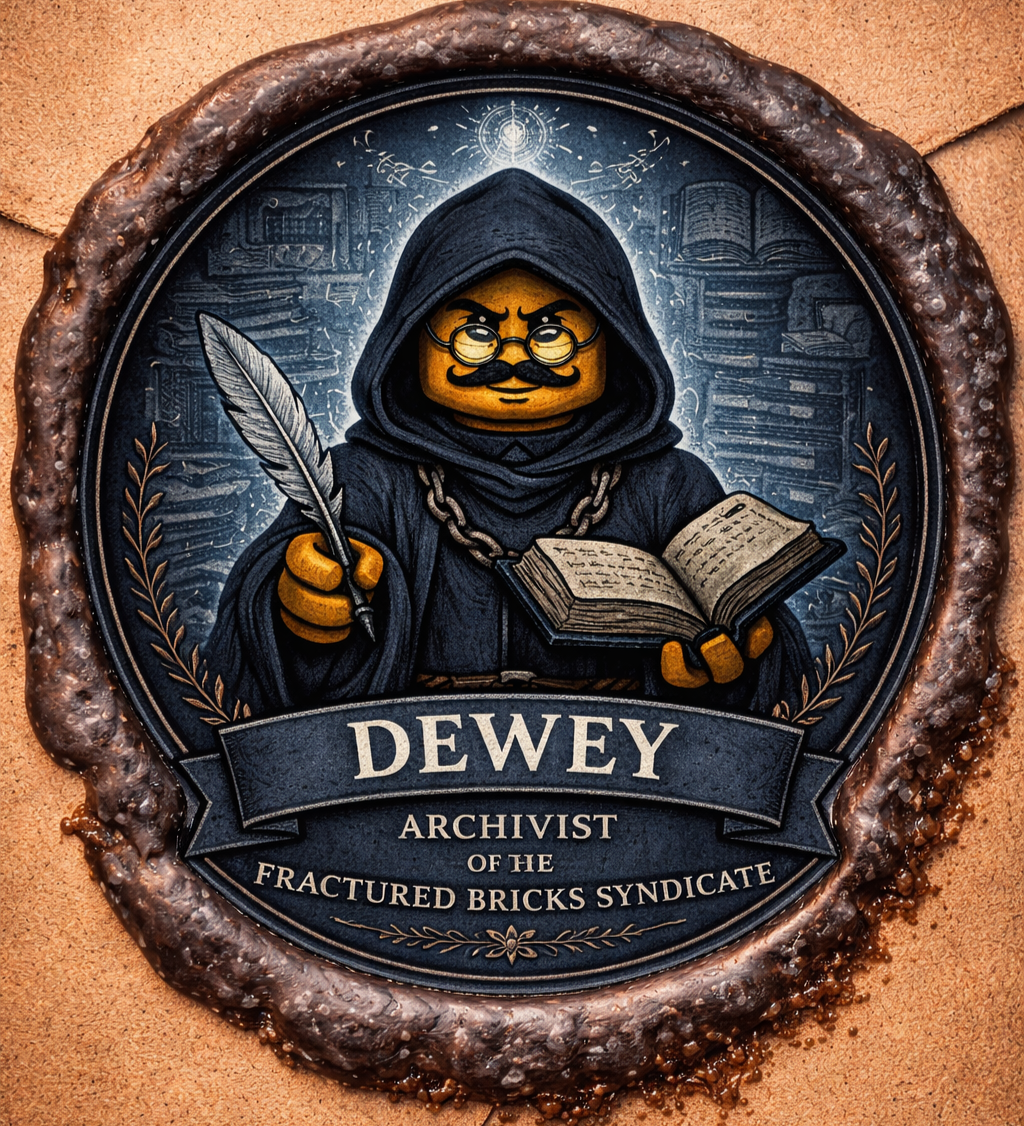
Marginal Annotation - Dewey
(Filed alongside Porter’s Footnote, ink darker than body text)
Archival Note:
Burden transfer confirmed.
Pattern observed in three prior matters now sealed.
Cross-reference deferred to avoid encouraging repetition.
(Classification updated: “Carried” ≠ “Resolved.”)
THE NAVIGATOR BELOW CAN BE USED AS ENTRY POINTS RATHER THAN EXPLANATIONS. IT ASSUMES CURIOSITY, NOT PERMISSION. VISITORS ARE NOT INSTRUCTED, ONLY ORIENTATED. WHAT FOLLOWS IS NOT AN INVITATION, BUT A CONTINUATION OF WORK ALREADY IN PROGRESS. SOME FAMILIARITY IS EXPECTED. COMPLETE UNDERSTANDING IS NOT.
PROCEDING PAST THIS POINT CONSTITUTES ACKNOWLEDGEMENT THAT MEANING MAY BE LAYERED, WITHHELD, OR MISINTERPRETED BY DESIGN.
THE FRACTURED BRICKS SYNDICATE WILL NOT CLARIFY FURTHER.
MOCKWRIGHT INITIATION – serves as the public threshold. Visitors are addressed as observers first, participants second, and members only by implication. Those who continue past this point are assumed to have accepted that understanding may come, or not at all.
ARCHITECTURAL RECORD – documents the existence of the model as built, acknowledging that it supports multiple interpretations without resolving them. It records the structure, naming, and conceptual boundaries of the work as observed by different audiences. No single perspective is treated as definitive. Discrepancies are preserved. Clarifications are intentionally absent.
DITZLER THEATRE – details the physical and cultural life of the theatre as a place that predates its current ownership. It traces how performance, architecture, and institutional memory intersected long before corporate stewardship. The building is treated as an active participant, not a passive container.
BETTY DITZLER – recounts the life, work, and disappearance of Betty Ditzler as history rather than spectacle. Her story is presented without conclusion, as her absence continues to shape the structures built around it. No attempt is made to reconcile the competing theories.
THE APERTURE – explains the condition that binds all Fractured Bricks Syndicate works without attempting to domesticate it. The Aperture is described as a consequence, not an invention. Its presence is acknowledged so that it may be managed, not solved.
STATIONARY & MOVING CONTENT – outlines how meaning behaves over time. Some things remain fixed. Some things are allowed to move. Others must be retired when motion becomes unsafe. The distinction is procedural, not aesthetic, and violations are recorded rather than corrected.
FRACTURED BRICKS SYNDICATE – records the Fractured Bricks Syndicate before coherence, during fracture, and after purpose redefines itself. It does not resolve contradictions. It preserves them. The Fractured Bricks Syndicate continuity is measured not by unity, but by persistence.
THE ABSURDIUM CONSORTIUM – records how decisions are borne rather than resolved. It defines procedures, silence, and the necessity of imbalance. Governance is documented here as an act of restraint, not authority.
THE REPOSITORY – catalogs what the Fractured Bricks Syndicate refuses to discard. Documents are preserved regardless of usefulness, clarity, or embarrassment. Classification exists to prevent loss, not to impose order.
STATEMENTS OF CONTINUANCE – records the principles by which the Fractured Bricks Syndicate persists. Not declarations of intent, but acknowledgements of what must continue regardless of outcome. These statements do not explain purpose; they justify endurance. They are revised rarely, cited often, and never framed as aspirations. The work proceeds whether agreement is reached or not.
UNSOLICITED INTERPRETATIONS – collects responses the Fractured Bricks Syndicate did not request and will not correct. Praise, confusion, hostility, and misreadings are preserved with attribution. Meaning is not defended here; it is observed.