

The Life and Career of Betty Ditzler
Founding Star of the Ditzler Theatre
Birth and Early Years
1902
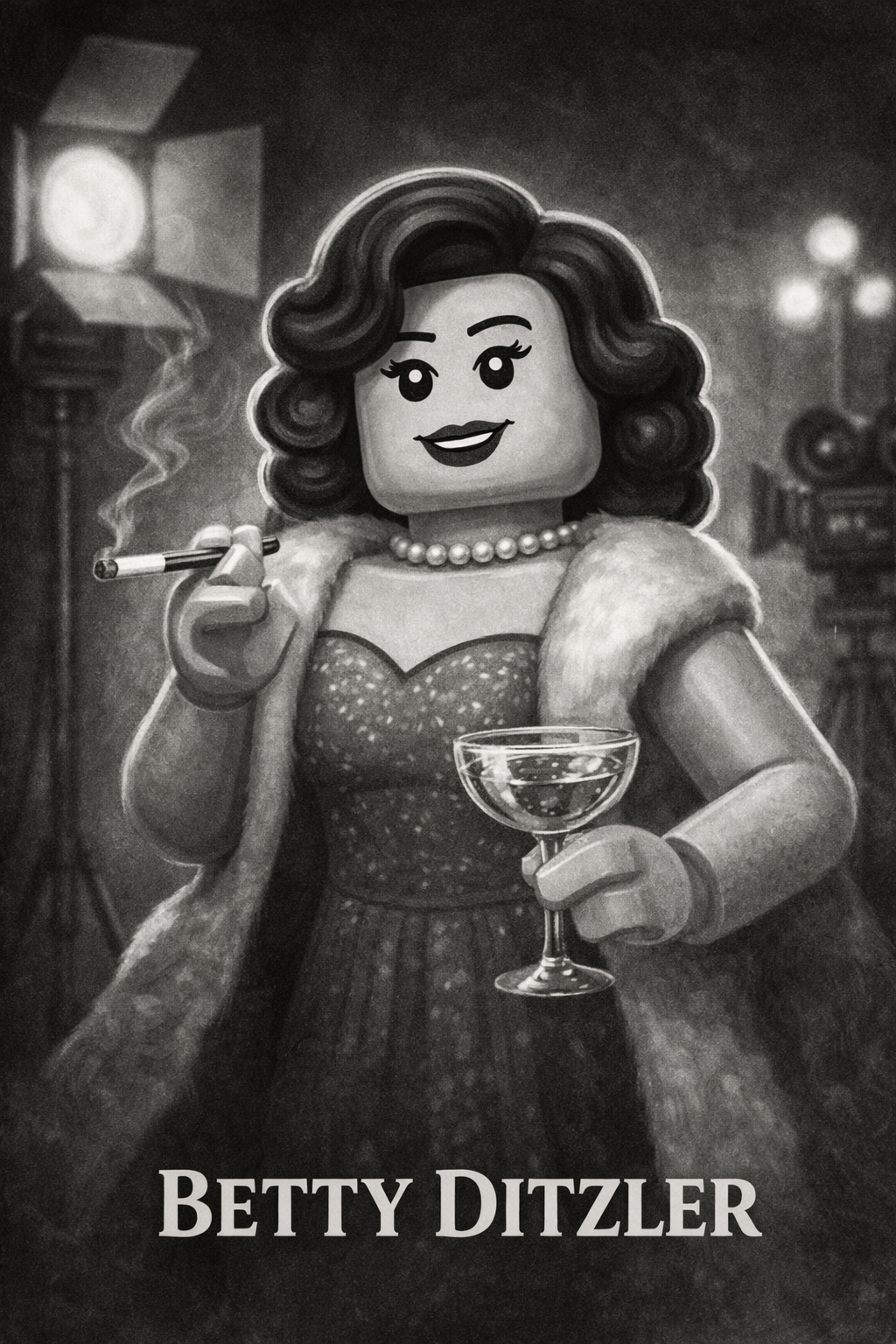
Betty Libby Ditzler is born in New York City to a family of modest theatrical connections. Her mother was a costume stitcher for touring vaudeville acts; her father worked intermittently as a stage carpenter. Betty grows up backstage, absorbing timing, banter, and stage mechanics long before formal training.
1918–1921
Betty Ditzler performed in regional vaudeville circuits along the Eastern seaboard. Early reviews note her “unnervingly sharp wit” and a stage presence that reads older than her years. She develops a reputation for ad-libbing through technical failures rather than stopping a show.
Rise to Prominence
1922
Betty relocates to Chicago, where she begins headlining mid-tier revue houses. This period marks the first documented collaboration with experimental set designers and theatrical engineers, laying the groundwork for her later association with the Grimm Plastic Mason.
1924
She is cast in Betty Ditzler and the Gilded Curtain, a lavishly staged musical satire that blends traditional vaudeville numbers with surreal mechanical backdrops.
Notable for: the famous “Curtain That Would Not Fall” finale, in which Betty continues performing while stagehands visibly struggle behind her.
Reception: Widely praised. Critics describe the production as “unsettlingly modern.”
Legacy: This show cements her public persona as a performer who thrives amid controlled chaos.

The Ditzler Theatre Era
1926
Construction begins on the Ditzler Theatre, commissioned explicitly as a permanent home for Betty’s evolving style. The Grimm Plastic Mason is appointed chief theatre mason, tasked with designing a space that could adapt to layered satire, physical comedy, and increasingly elaborate staging.
1927 (Opening Night)
The Ditzler Theatre opens with Ditzler’s Dream Revue.
Concept: A loosely connected series of musical and comedic sequences framed as fragments of Betty’s dreams.
Innovation: Sets reconfigure mid-performance; jokes bleed between acts.
Awards:
Chicago Theatre Guild Citation for Innovation in Live Performance (1927)
Public Perception: The theatre becomes synonymous with experimentation rather than tradition.
1929
Betty stars opposite LaMoine Oliver in the Plastic Waltz in one of her most endearing roles.
Synopsis: A surreal romantic farce involving industrial materials, mistaken identities, and a recurring waltz performed on increasingly unstable flooring.
Notable Detail: Oliver’s name is billed in smaller type, a decision that reportedly caused tension but fueled publicity.
Reception: Mixed but intense. Some critics call it “brilliant nonsense”; others dismiss it as indulgent.
Retrospective View: Widely considered ahead of its time.

Final Production and Disappearance
1931 (February)
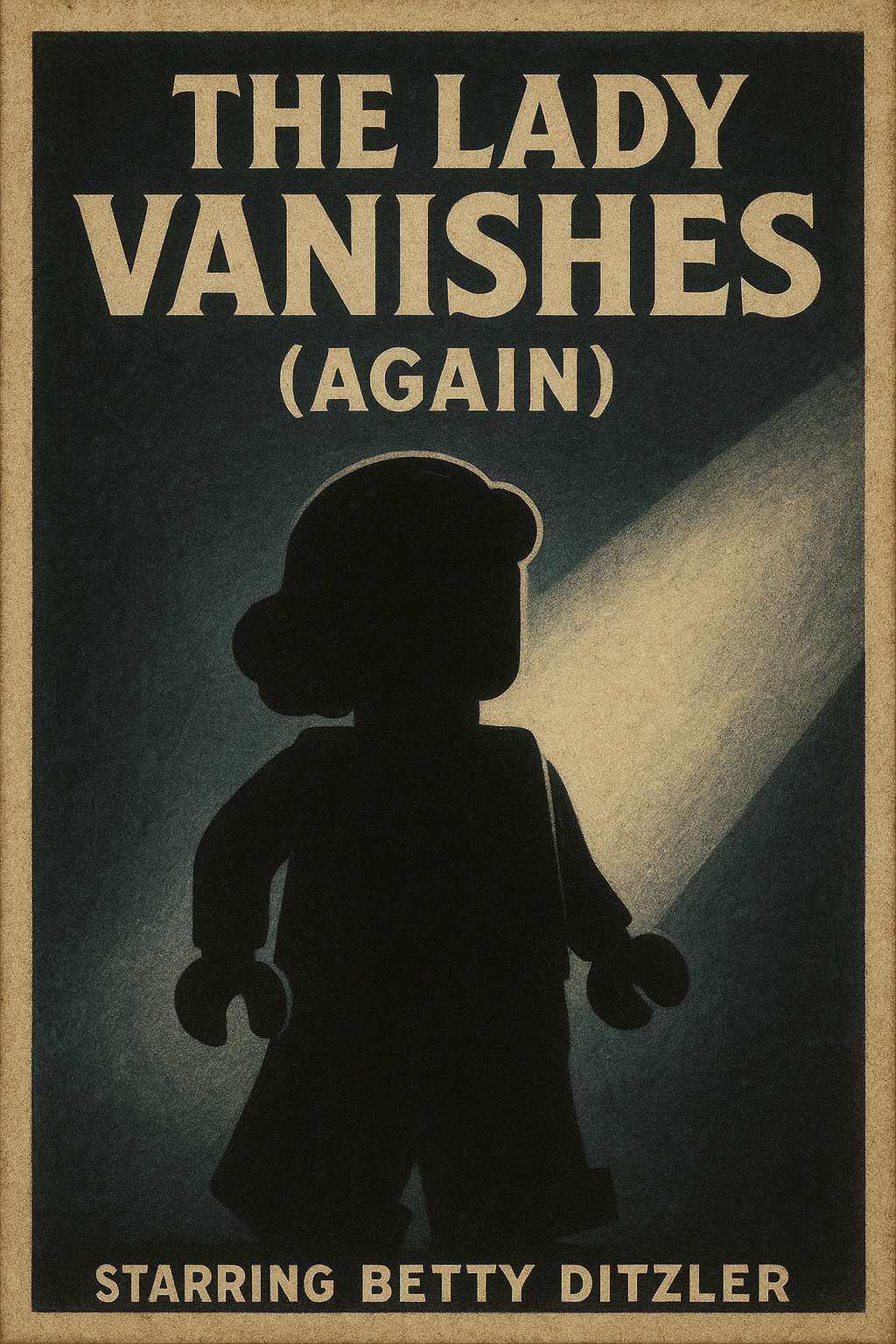
The theatre announces a revival-cum-sequel titled The Lady Vanishes Again.
Marketing Angle: A self-referential play on Betty’s habit of disappearing from the stage mid-scene during earlier shows, only to reemerge unexpectedly.
Rehearsals: Described in later Syndicate records as “strained but productive.” Structural modifications to the stage are ongoing during the rehearsal period.
1931 (March 14)
Opening night of The Lady Vanishes Again.
Act II, Scene iii: Betty exits toward the upstage left mark during a transitional blackout.
She does not return.
The orchestra continues briefly. Stagehands assume an improvised delay. The blackout extends beyond scripted length.
1931 (March 14) — 10:47 p.m.
Stage management halts the performance of The Lady Vanishes Again after Betty Ditzler fails to return from a scripted blackout. Initial assumption is a delayed entrance or backstage miscommunication.
1931 (March14) — 11:06 p.m.
House lights raised. Audience dismissed with refunds issued at the door. No announcement of emergency is made.
1931 (March 14) — 11:41 p.m.
Theatre management contacts local authorities when backstage searches fail to locate Ditzler.

Police Investigation
1931 (March 15) - 1:06 a.m.
The Chicago Police Department opens a missing persons investigation. The Ditzler Theatre is closed to the public pending inquiry.
1931 (March 15) - 1:38 a.m.
Dressing rooms serarched.
1931 (March 15) - 2:52 a.m.
Trapdoors, fly systems, and orchestra pit inspected.
1931 (March 15) - 3:24 a.m.
Determined no signs of struggle indicated.
1931 (March 15) - 3:25 a.m.
No blood, torn fabric, or damaged personal effects recovered.
1931 (March 15) - 3:26 a.m.
Betty’s personal belongings, coat, handbag, and script, remain in her dressing room.

1931 (March 15) - 5:07 a.m.
Theatre is closed pending further investigations. Betty Ditzler is declared missing.
1931 (March 16–18)
Police interview cast, crew, and theatre staff.
Persons of Interest (Never Charged):
Jasper Dale (Stage Engineer)
Recently disciplined for unauthorized mechanical modifications.
Cleared after inspection finds no evidence of unsafe alterations.
Christopher Seaver (Theatre Business Manager)
Rumors of financial disputes circulated.
Records reviewed; no irregularities tied to Ditzler directly.
No arrests made.

Witness Statements
Attendee Statement
(Filed March 17, 1931 — Supplementary Witness Accounts)
I was seated three rows back, house left. Good sightline.
Miss Ditzler was excellent that evening. Sharper than usual, I thought. The timing was tight, and the pause before the blackout felt intentional, like she was letting the room breathe. People laughed early, then settled. That does not always happen.
When the lights went out, no one reacted. It was part of the show. We waited. A few seconds longer than normal, maybe. Someone behind me whispered that she was milking it.
When the lights came back and she did not return, there was some polite confusion. I assumed it was a joke I did not yet understand.
I remember thinking I was lucky to be there. Whatever it was, it felt important.
I cannot help with anything else. I did not see her leave. I did not hear a sound. I just remember the applause starting and then stopping, like no one knew who it belonged to anymore.

A Second, Conflicting Eyewitness
(Filed March 18, 1931 — Supplementary Witness Accounts)
I was in the balcony, center. Cheap seats, but you could see everything if you leaned forward.
I did not think the pause was intentional. It felt off to me. Too clean. Like something had been reset instead of delayed.
I remember looking at the stage curtain and thinking it was breathing. That sounds foolish now, I know. It was probably the lights.
When people say no one reacted, that is not true. Someone laughed late. Someone else clapped once. It was uncomfortable.
I did not see Miss Ditzler leave. But I did not feel like we were waiting for her, either. It felt like the theatre had already moved on without us.
Later Interview with the First Witness
(Recorded 1969 — Oral History Project, Arts & Performance)
They asked me again about the night she disappeared. I told them the same thing I always do.
I still cannot say when it stopped being a performance. I have replayed it enough times to know that memory does not sharpen with use. It softens.
People assume I must have noticed something, because I was there. But I think that is the mistake. Being there made it harder, not easier.
If I had known what was happening, I would not have applauded.
I do not regret being there. I regret thinking I understood what I was watching.

Mockwright Marginal Note
(Restricted Annotation — The Repository / Misfiled)
These accounts are quoted frequently because they are useless.
They describe no mechanism, no motive, no exit.
They confirm only this: that the disappearance was indistinguishable from performance until it was already over.
This is not evidence of clever staging.
It is evidence of a system working as designed, until it exceeded capacity.
— Filed by order of the Grimm Plastic Mason
(Annotation complete. Do not cross-reference.)

Structural Anomalies
March 20, 1931
City inspectors conduct a structural review of the theatre.
Minor inconsistencies noted in backstage measurements compared to original blueprints.
Inspectors attribute discrepancies to undocumented renovations common in older theatres.
No violations cited. Theatre remains closed “out of caution.”

Aftermath and Public Narrative
Escalation and Media Attention
Late March–April 1931
Press coverage intensifies. Multiple theories emerge and circulate widely:
Betty staged her disappearance as performance art.
She fled under an assumed name.
She was involved in espionage activities.
She died accidentally during a mechanical malfunction.
Victim of a horrific murder.
The theatre itself is haunted.

Headlines include:
“Star Vanishes Mid-Scene: Publicity Stunt or Tragedy?”
“Did Ditzler Walk Away?”
“Police Admit No Leads in Theatre Mystery”
False sightings reported in:
Milwaukee
St. Louis
Ava
Atlantic City
Reno
Bosman
All unsubstantiated.
April 1931
An anonymous letter sent to a local paper claims Betty planned to “disappear into the act itself.” Handwriting analysis yields no match.
No evidence conclusively supports any claim.

Case Stagnation
May 1931
Police quietly downgrade the investigation. No body. No evidence. No credible suspects.
June 1931
The case is reclassified as inactive pending new information.
The Ditzler Theatre remains shuttered.

Official Resolution (or Lack Thereof)
1934
Betty Ditzler is legally declared missing, not deceased.
No death certificate is issued.
No official cause is recorded.
1936
The Ditlzer theatre closes indefinitely.

Cultural Fallout
1935–1940
The lack of resolution gives rise to competing narratives:
That Betty orchestrated her disappearance as a final performance.
That she was murdered and the theatre covered it up.
That the building itself swallowed her.
That she never existed at all, and the persona was a fabrication.
Each theory gains traction precisely because none can be disproven.

Archival Note
Despite multiple ownership changes, renovations, and audits, no definitive explanation has ever been entered into the official record.
The file remains open.

Selected Performance Timeline of Betty Ditzler
(Ditzler Theatre Engagements)
1922 — Betty Ditzler and the Gilded Curtain
Betty’s breakout performance and the production that effectively bound her name to the theatre.
Lavish costuming, sharp comedic timing, and direct audience address.
Widely credited with “reviving” the Ditzler as a serious vaudeville venue.
Early reviews note her ability to “command silence without demanding it.”
1924 — Ditzler’s Dream Revue
A variety showcase structured around Betty as both host and performer.
Featured rotating guest acts and experimental staging.
Introduced visual gags that blurred rehearsal and performance.
Critics described the show as “barely contained” and “strangely precise.”
This production marks the first time reviewers comment that the theatre itself felt like part of the act.

1926 — Betty Ditzler and LaMoine Oliver in The Plastic Waltz
A high-profile collaboration with LaMoine Oliver.
Marketed as a romantic comedy with modernist undertones.
The term “plastic” used in its original sense: malleable, artificial, shaped by hand.
The pair’s chemistry praised, though rumors of creative friction followed the run.
Later conspiracy theories would return to this show obsessively, reading meaning into every surviving photograph.
1928 — The Velvet Intermission
A smaller, quieter production between major revues.
Minimalist set.
Long pauses built deliberately into the script.
Betty reportedly insisted on leaving sections “unresolved” night to night.
Often overlooked at the time, this production would later be cited by theorists as evidence that Betty was “testing absence.”
1930 — Ditzler After Dark
A late-career tonal shift.
Sharper satire.
More overt commentary on performance, ownership, and audience expectation.
Backstage staff later recalled extensive last-minute changes to blocking.
This production coincides with the first documented backstage measurements that did not align perfectly with older blueprints, a fact noted only years later.

1931 — The Lady Vanishes Again
Final performance. Interrupted mid-show.
Marketed as a meta-comedy playing off Betty’s public persona.
Script included a scripted blackout and delayed re-entrance.
Betty did not return.
The audience assumed it was part of the act.
By the time anyone realized it was not, the moment had already passed.
Contextual Note (Post-Disappearance)
Investigators would later review these productions searching for patterns:
Repeated use of blackouts.
Emphasis on pauses and absence.
Increasing complexity of staging in confined spaces.
No conclusion was ever drawn.

Posthumous Recognition
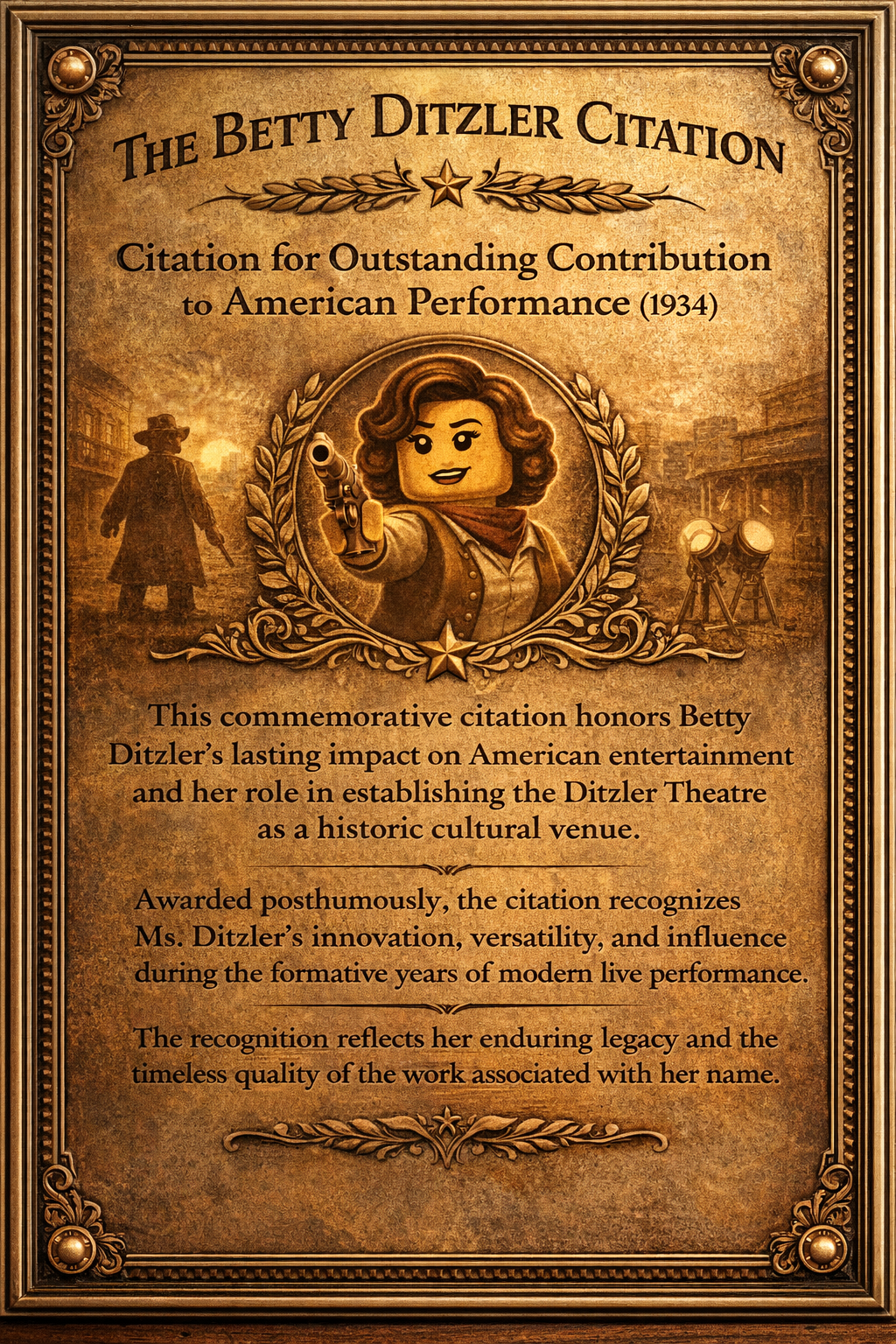
1934 — The Betty Ditzler Citation for Outstanding Contribution to American Performance
(Awarded posthumously)
Three years after her disappearance, Betty Ditzler was formally recognized by a joint committee of theatrical guilds and cultural institutions with a special citation acknowledging her influence on modern vaudeville and live performance.
The citation was created specifically for her; no prior recipient existed.
It was awarded in absentia, presented to an empty chair on stage at a separate venue.
The Ditzler Theatre was referenced extensively in the ceremony but did not host it.
Contemporary coverage described the award as “overdue” and “necessary,” though critics noted that it arrived only after Betty’s absence had already reshaped her reputation into legend.
The plaque itself praised her innovation, presence, and command of space, yet made no mention of her disappearance beyond a single line: “Circumstances unresolved.”
Vault Disney Internal Display Text
(Approved for Public Exhibition – Version 7.3)
The Betty Ditzler Citation for Outstanding Contribution to American Performance (1934)
This commemorative citation honors Betty Ditzler’s lasting impact on American entertainment and her role in establishing the Ditzler Theatre as a historic cultural venue.
Awarded posthumously, the citation recognizes Ms. Ditzler’s innovation, versatility, and influence during the formative years of modern live performance. The recognition reflects her enduring legacy and the timeless quality of the work associated with her name.
This plaque is displayed as part of Vault Disney’s ongoing commitment to preserving and celebrating the heritage of entertainment excellence.
Circumstances surrounding Ms. Ditzler’s disappearance remain unresolved.
Note: The citation is presented here as a historical artifact. No living representatives were available to accept the honor at the time of issuance.
— Vault Disney Archives & Brand Stewardship
Mockwright Marginal Note
(Restricted. Do Not Frame. Do Not Correct.)
They waited until she could no longer object.
Betty Ditzler did not miss recognition because she lacked merit.
She missed it because she was inconvenient.
The citation was issued only after the theatre could no longer ask her where she went, or why the walls no longer measured correctly.
Presenting it to an empty chair solved several problems at once.
— Filed under Deferred / Reclassified, annotated by order of the Absurdium Consortium

THE NAVIGATOR BELOW CAN BE USED AS ENTRY POINTS RATHER THAN EXPLANATIONS. IT ASSUMES CURIOSITY, NOT PERMISSION. VISITORS ARE NOT INSTRUCTED, ONLY ORIENTATED. WHAT FOLLOWS IS NOT AN INVITATION, BUT A CONTINUATION OF WORK ALREADY IN PROGRESS. SOME FAMILIARITY IS EXPECTED. COMPLETE UNDERSTANDING IS NOT.
PROCEDING PAST THIS POINT CONSTITUTES ACKNOWLEDGEMENT THAT MEANING MAY BE LAYERED, WITHHELD, OR MISINTERPRETED BY DESIGN.
THE FRACTURED BRICKS SYNDICATE WILL NOT CLARIFY FURTHER.
MOCKWRIGHT INITIATION – serves as the public threshold. Visitors are addressed as observers first, participants second, and members only by implication. Those who continue past this point are assumed to have accepted that understanding may come, or not at all.
ARCHITECTURAL RECORD – documents the existence of the model as built, acknowledging that it supports multiple interpretations without resolving them. It records the structure, naming, and conceptual boundaries of the work as observed by different audiences. No single perspective is treated as definitive. Discrepancies are preserved. Clarifications are intentionally absent.
DITZLER THEATRE – details the physical and cultural life of the theatre as a place that predates its current ownership. It traces how performance, architecture, and institutional memory intersected long before corporate stewardship. The building is treated as an active participant, not a passive container.
BETTY DITZLER – recounts the life, work, and disappearance of Betty Ditzler as history rather than spectacle. Her story is presented without conclusion, as her absence continues to shape the structures built around it. No attempt is made to reconcile the competing theories.
THE APERTURE – explains the condition that binds all Fractured Bricks Syndicate works without attempting to domesticate it. The Aperture is described as a consequence, not an invention. Its presence is acknowledged so that it may be managed, not solved.
STATIONARY & MOVING CONTENT – outlines how meaning behaves over time. Some things remain fixed. Some things are allowed to move. Others must be retired when motion becomes unsafe. The distinction is procedural, not aesthetic, and violations are recorded rather than corrected.
FRACTURED BRICKS SYNDICATE – records the Fractured Bricks Syndicate before coherence, during fracture, and after purpose redefines itself. It does not resolve contradictions. It preserves them. The Fractured Bricks Syndicate continuity is measured not by unity, but by persistence.
THE ABSURDIUM CONSORTIUM – records how decisions are borne rather than resolved. It defines procedures, silence, and the necessity of imbalance. Governance is documented here as an act of restraint, not authority.
THE REPOSITORY – catalogs what the Fractured Bricks Syndicate refuses to discard. Documents are preserved regardless of usefulness, clarity, or embarrassment. Classification exists to prevent loss, not to impose order.
STATEMENTS OF CONTINUANCE – records the principles by which the Fractured Bricks Syndicate persists. Not declarations of intent, but acknowledgements of what must continue regardless of outcome. These statements do not explain purpose; they justify endurance. They are revised rarely, cited often, and never framed as aspirations. The work proceeds whether agreement is reached or not.
UNSOLICITED INTERPRETATIONS – collects responses the Fractured Bricks Syndicate did not request and will not correct. Praise, confusion, hostility, and misreadings are preserved with attribution. Meaning is not defended here; it is observed.