

BUILD NOTES
Surveillance & Security
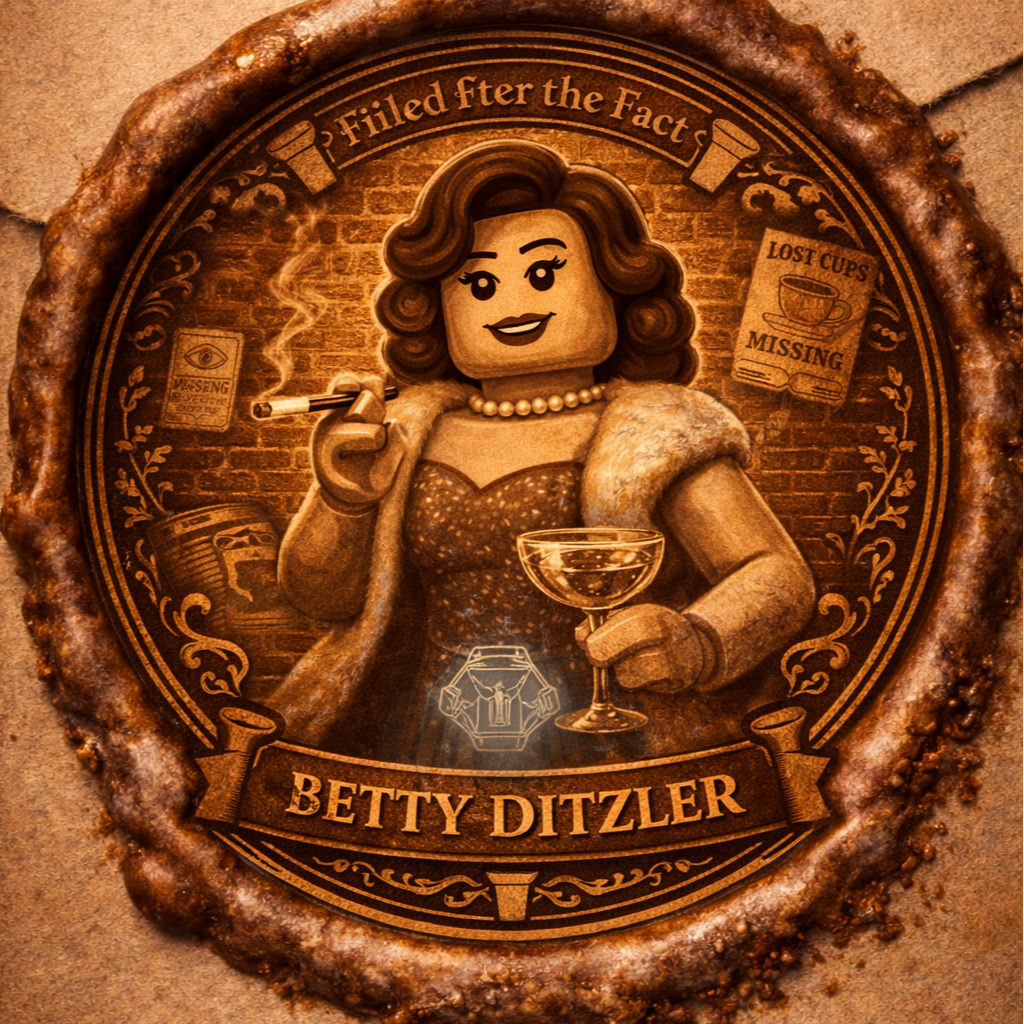
Betty Ditzler Letter
From: Betty Ditzler
To: The Grimm Plastic Mason
Subject: A Private Room for After
Grimm Plastic Mason,
The theatre is filling.
Not only seats — expectation.
I am beginning to understand something that perhaps I should have earlier. A performance does not end when the curtain falls. It lingers in conversation, in introductions, in those moments when applause has softened but admiration has not.
We do not have a place for that.
There is no room where patrons of significance may be received. No space where investors, dignitaries, or fellow performers may gather apart from the noise of stagehands and audience traffic. If the theatre is to grow in stature, it must possess a room that signals that growth.
I do not mean decadence. I mean separation.
A room not accessible from the public lobby. A room not adjacent to concessions. A room near enough to backstage to remain practical.
It must feel elevated but not gaudy. Distinct from dressing rooms. Distinct from offices. A room for after.
I am not certain what color it should be. Something that suggests evening without becoming heavy. Something that photographs well but does not glare.
It must feel intentional.
Please advise how this may be accomplished without compromising the existing structural logic.
— Betty

Grimm Plastic Mason Letter
From: The Grimm Plastic Mason
To: Betty Ditzler
Subject: Re: A Private Room for After
Betty,
The need is sound.
Every theatre that survives its own ambition eventually requires a room that holds applause after it has already occurred. Without one, the performance disperses too quickly.
There is space above concessions that currently serves no defined purpose beyond structural support for the upper balcony. It is isolated, load-bearing, and inconvenient to reach for casual visitors. That inconvenience may serve your purpose.
The walls may be framed and enclosed without altering primary pathways.
However, I caution you:
If this room is to signal stature, it must not compete with the stage. It must not attempt spectacle. It must feel contained. Elevated in privacy, not volume.
You mentioned color.
Evening tones are possible. Pale lavender could soften the rigidity of backstage proximity. A restrained violet would separate it from dressing rooms without drifting into ornamentation. Avoid white. White reflects noise.
Furnishings may be added later once the room understands its own purpose.
My only concern is timing. We are mid-season. Construction now will be visible.
If you wish this completed before next season, we must begin immediately.
— The Grimm Plastic Mason
Dewey Marginal Note
Filed Under: Pre-Aperture Commission Materials
“Classified originally as ‘Peripheral Vanity Request.’ Reclassified post-Aperture as ‘Structural Precedent.’ Intent unchanged. Consequence expanded.”
Dewey Marginal Note
On the VIP Lounge Letter
“Proposal references privacy, elevation, and separation. No documented operational use. Construction ceased prior to activation. Absence is historically consistent.”

Knox Marginal Note
“Cost projection acceptable at time of commission. Projected revenue speculative. Capital already deployed at point of disappearance. No recovery.”
Porter Marginal Note
On the Unused Room
“A room built for presence. Left with none. Weight retained.”
Betty Ditzler Letter
From: Betty Ditzler
To: The Grimm Plastic Mason
Subject: Re: A Private Room for After
Begin.
The season will not wait for perfection, and neither will I.
Use the space above concessions as you described. I would rather build upon something honest than invent new architecture to flatter a temporary ambition.
Pale lavender is agreeable. Not theatrical purple. Not indulgent violet. Soft. Evening without shadow.
It should feel like a room that expects important conversations but does not eavesdrop on them.
Chandeliers and gilded excess are a requirement. This is to be the VIP space.
Let the walls carry the distinction. We will furnish when the need arises. I would prefer to stand in the room first and feel whether it welcomes the right kind of silence.
This theatre will grow. It must grow in places people do not immediately see.
— Betty
Grimm Plastic Mason Letter
From: The Grimm Plastic Mason
To: Betty Ditzler
Subject: Framing Progress
The walls are up. The paint has been applied. It is quieter than I expected.
From the doorway, the lavender holds the light without reflecting it back. It does not compete with stage glow. It absorbs it.
At present, the room is empty. No chairs. No table. No bar. No indication of purpose beyond intention.
It feels unfinished, but not incomplete.
I recommend we leave it that way until the first gathering defines its use.
A room built for after must not dictate what follows.
— The Grimm Plastic Mason

Mockwright Marginal Note
“She wanted applause without audience.
We gave her walls.”
Dewey Marginal Note
On the Construction Stall
“Work halted without formal suspension order. Materials left in place. No instruction to resume.”
Porter Marginal Note
On the Purple Walls
“Paint dries whether or not the room is used. So do plans.”
Dewey Marginal Note
“VIP designation removed administratively. Security designation applied without structural modification. Architectural neutrality confirmed.”
Knox Marginal Note
“Repainting deferred due to cost. Existing finish within tolerance. Conversion financially efficient.”
Porter Marginal Note
“Invitation converted to containment.
Walls did not move.”
Mockwright Marginal Note
“Invitation converted to containment. Walls did not move.”
Dewey Marginal Note
“Pause occurred. No placement identified. Correlation with Aperture event noted. Causation unproven.”
Knox Marginal Note
“Unfinished projects increase risk exposure. Recommend completion where feasible.”
Porter Marginal Note
“The room waited. Waiting becomes structure.”
Mockwright Marginal Note
“Even unused rooms hold tension. Better to give them purpose.”
Knox Marginal Note
“Not repainting the room was financially smart.”

Builder’s Note No. MJ65: “The Room That Waited for Purpose”
The walls were finished. That was as far as we got.
Framing complete. Door hung. Paint cured. The pale lavender held the light exactly as intended. It did not glare. It did not compete. It did not beg to be noticed. It simply waited.
It was meant to host the after. Not the audience. Not the cast. Not the noise.
The room above concessions was designed for the pause after applause. A place for conversation that required distance from the machinery of the show. Betty understood that growth meant more than larger audiences. It meant containment of admiration.
Then she did not return.
The furniture order was never placed. The fixtures were never selected. The room remained what it was at the moment the season stopped: painted intention. For a time, I believed we would finish it anyway. Install chairs. Add a table. Pretend continuity. But a VIP lounge requires a VIP. With the architect of its purpose absent, the room had no instruction.
So it waited.
Years passed. Tenants came and went. No one claimed it. It was too separated to be convenient and too refined to be storage. It existed as interruption suspended mid-sentence. Eventually Vault Disney walked the building with a ledger.
They saw finished walls. They saw isolation. They saw a lockable door. They saw no renovation cost. They did not ask what it was meant to be. They asked what it could be without repainting.
Security requires separation. Security benefits from elevation. Security prefers a single point of access.
The lavender remained because repainting would have been waste. The room that was built to contain admiration now contains detainees. No structural changes were required.
The space did not resist. And here is the part that matters: The new function allows the gag to land. Pirates in holding cells. A dog guarding keys. A genius inventor processed under fluorescent light. A police chief with his feet on the desk.
The architecture supports the absurdity. A room designed for exclusivity is more amusing when it enforces it. Betty intended a place for chosen guests. Disney created a place for chosen prisoners.
The walls do not care which is which. The joke lands either way.
— The Grimm Plastic Mason
Vault Disney Internal Memo
Distribution: Risk Management; Operations; Facilities; Legal (Advisory)
Classification: Internal Use Only
Subject: Establishment of Dedicated Security Operations Room — Ditzler Theatre
Following recent spatial audits and operational review of the Ditzler Theatre property, it has been determined that a centralized Security Operations Room is necessary.
The theatre’s layered layout, mixed-use backstage areas, and increasing volume of character assets require a designated containment and monitoring environment.
At present, security functions are distributed across informal desks, temporary holding areas, and rotating personnel. This model lacks structural clarity and increases liability exposure in the event of:
• cross-franchise interaction disputes
• unauthorized character convergence
• artifact misplacement
• backstage tour boundary overreach
• narrative escalation requiring immediate containment
A permanent security room will provide:
• centralized observation
• controlled detainment capability
• asset processing infrastructure
• key management oversight
• incident documentation proximity
The identified space (former VIP lounge, unfinished, structurally isolated) meets operational needs without requiring significant capital investment. Existing finishes are within acceptable tolerance and repainting is not recommended at this time.
The separation originally intended for exclusivity now supports separation for compliance.
Security must not feel temporary.
It must feel inevitable.
Implementation is approved.
Facilities to secure bars and locking mechanisms.
Operations to assign personnel.
Legal to standardize terminology for custody events.
No public communication required.
— Vault Disney Risk & Operational Integrity Division
Porter Marginal Note
“Rooms built for invitation now measure compliance. Walls do not object. People do.”
Mockwright Marginal Note
Pencil in the Margin
“Pirates detained for acting like pirates. Stormtroopers enforcing order. Chief Wiggum supervising. The joke lands.”
Dewey Marginal Note
“‘Preventative’ suggests foresight. Foresight suggests pattern recognition. Pattern recognition suggests Box Office influence. Filed accordingly.”
Porter Marginal Note
On Pluto Holding the Key
“The dog does not choose. He holds what he is given. So does everyone else.”
Vault Disney Internal Memo
Distribution: Legal; Security Operations; Brand Governance; Archival Risk
Subject: Terminology Clarification — Pirate Character Containment
Classification: Internal — Not for External Circulation
Recent documentation regarding the Pirate Intellectual Property Incident within Cold Storage has used the term “relocation” to describe the transfer of certain characters to Security Holding.
This terminology is inaccurate. The characters were detained.
Detainment occurred following:
• Cross-franchise thematic entanglement
• Unauthorized proximity to Treasure Island assets
• Escalating behavioral theatrics inconsistent with food storage narrative stability
Legal has advised that in internal records, detainment must be identified as such. “Relocation” suggests voluntary repositioning. “Transfer” implies administrative adjustment. Neither reflects the operational reality.
Security initiated containment. The decision was procedural, not narrative.
It is further clarified that:
• Detainment does not imply criminal liability
• Detainment does not imply disciplinary fault
• Detainment reflects brand risk mitigation under internal authority
External materials will continue to use neutral language when required.
Internal reports will not. Accuracy protects liability.
— Office of Risk & Brand Stability
Vault Disney Review Addendum
Distribution: Same as Above
Subject: Use of “Detainment” vs “Relocation” in Records
Following issuance of the Risk & Brand Stability memo, Communications has raised concern that the word “detainment” may create discoverable exposure in the event of document leakage.
Proposed Alternative Language:
• “Temporary Character Stabilization”
• “Narrative Isolation Protocol”
• “Security-Based Repositioning”
Legal Response:
The term “detainment” is operationally correct. Avoiding precise language internally increases institutional vulnerability. If leakage occurs, the larger issue will not be vocabulary.
Finance Response:
No material revenue impact associated with word choice. Security Response: They were detained.
Conclusion:
Internal documents will use “detainment.” External-facing materials will use softened phrasing as appropriate.
There is no strategic benefit in lying to ourselves.
— Recorded without dissent

Box Office Director’s Cut
Title: “They Said Detainment.”
We obtained internal language. Not public language. Not softened language. Not brochure language. Internal.
The pirates were not “relocated.” They were not “repositioned.” They were not “stabilized.” They were detained. Detained.
That is not a theatrical word. That is a custody word. Vault Disney’s own internal memo states: “Security initiated containment.”
Containment. For characters. Characters do not require containment unless they are capable of returning.
Ask yourself: Why detain a pirate unless you believe he will try again? Why contain a character unless you fear narrative recurrence? Why correct internal language unless the distinction matters? They argue internally about whether “detainment” might create exposure if leaked.
Exposure to what? Exposure implies vulnerability. Vulnerability implies something worth protecting. This is not about cross-franchise confusion.
This is about control. They are not curating stories. They are suppressing mobility. The pirates were not moved for clarity.
They were detained because they were converging on something they were not permitted to converge on.
And if pirates can be detained for assembling improperly…
What else has been detained?

Box Office Supplemental Memo
Title: “Relocation Is a Lie You Tell the Audience”
Public language: “Relocation.” Internal language: “Detainment.”
That discrepancy alone earns corroboration credits.
When an institution uses two vocabularies for the same act, one is designed for compliance and the other for accuracy. They do not argue over vocabulary unless it matters.
We propose the following:
The pirates assembled in Cold Storage.
Someone noticed the narrative convergence.
Legal identified thematic overlap risk.
Security acted.
Communications softened.
We note that detainment occurred after the cross-franchise presence became “sticky.” Sticky is corporate for “we cannot control this if it spreads.”
And then there is this line: “Detainment reflects brand risk mitigation under internal authority.”
Brand risk mitigation. From pirates. Inside a theatre already filled with pirates. Why this group? Why now? Why document it so precisely?
We suspect the detainment was less about pirates and more about what they were scheming near. Cold Storage. Barrels. Kegs. Concealment. Division.
We are not suggesting mutiny. They wrote “mutiny” first. We are merely reading.
Corroboration Credits Awarded: Excessive.
Porter Marginal Note
“The weight of both terms carries the same”
Knox Marginal Note
On Language Debate
“Public phrasing preserves revenue. Internal phrasing preserves liability. Both preserved.”
Box Office - Character Freedom Audit
Filed By: The Audience
Classification: Internal Review of Narrative Detention Practices
Status: Ongoing
Purpose - To determine whether Vault Disney Security is engaging in preventative detention of narrative autonomy under the guise of operational clarity.
Scope of Review
• Pirates of the Caribbean characters detained in Security Office
• Cross-franchise interaction suppression
• Internal vocabulary shift from “relocation” to “detainment”
• Stormtrooper processing of Tony Stark
• Key custody delegated to Pluto
• Surveillance posture of Chief Wiggum
Findings
Detainment Is Confirmed.
Internal language uses custody terminology. Public language does not.Containment Is Structural.
Cells are permanent.
The desk is elevated.
The keys are visible but not accessible.Preventative Logic Is Evident.
Characters were detained not for completed action, but for potential convergence.Narrative Autonomy Is Being Restricted.
Pirates assemble → detained.
Industrialist processed → monitored.
Princess confined → contained.The VIP Lounge Conversion Is Not Neutral.
A room designed for exclusivity is now a room designed for removal.
Determination - Security is not reactive. Security is anticipatory. Anticipatory security is preventative detention. Preventative detention of characters is narrative suppression.
We will continue monitoring.
Corroboration Credits: Elevated.
— The Audience
Box Office Memorandum
Title: “Preventative Detention of Narrative Autonomy”
Vault Disney claims containment is procedural.
We disagree.
Containment before action is censorship.
Detainment without crime is control.
Pirates were detained for assembling improperly.
Tony Stark was processed for proximity.
Princess Leia was placed in holding.
Security operates as if narrative cross-pollination is a threat.
Perhaps it is.
Perhaps certain convergences reveal too much.
Perhaps certain characters, when placed near each other, disrupt ownership clarity.
We are not alleging conspiracy.
We are documenting pattern.
When characters require custody, the institution fears something.
We recommend a formal review of all holding practices under Vault Disney Security.
We will be watching the keys.
— The Audience
Dewey Marginal Note
“Terminology corrected from ‘Relocation’ to ‘Detainment’ in Vault Disney internal record. Language drift archived. Intent not adjudicated.”
Knox Marginal Note
“Terminology corrected from ‘Relocation’ to ‘Detainment’ in Vault Disney internal record. Language drift archived. Intent not adjudicated.”
Facilities Work Order Request
Property: Ditzler Theatre
Location: Former VIP Lounge (Current Security Operations)
Priority: Routine (Aesthetic)
Submitted By: Site Operations
Ticket #: 9X-44-77-B
Request Description:
Walls in current Security Operations Room remain painted pale lavender/purple from prior build phase. Color does not align with standard security palette (neutral grey, muted beige, or approved compliance blue).
While paint condition is stable, tone may contribute to inconsistent visual authority during detainment events and asset processing.
Requesting:
• Repaint of all interior walls
• Color selection per Risk & Compliance guidelines
• Evaluation of trim contrast for durability
No structural modification required.
Rationale:
• Improved brand consistency
• Reinforced perception of procedural seriousness
• Alignment with containment function
• Reduced interpretive confusion during guided tours
Note: Paint currently intact. No chipping or peeling observed. Request is aesthetic in nature.
Facilities Review Response:
Cost Estimate: Moderate
Labor: 2–3 days (room must be vacated). Security downtime required. Containment infrastructure must be temporarily removed
Recommendation: Defer unless mandated by Compliance.
Status: Deferred Pending Budget Allocation
Comment: “Existing finish functional.”
Box Office Memorandum
Title: “Lavender Is Not Accidental.”
Vault Disney considered repainting Security.
They deferred. Let us be clear. They debated it. They priced it.
They calculated downtime. They evaluated the tone of purple in relation to detainment optics. And then they left it.
Lavender is not a neutral choice. Lavender was selected for exclusivity.
For elevation. For separation from the common floor.
It remains the color of the only room used for holding.
Security did not repaint. Because lavender is doing something.
We propose the following possibilities:
• Lavender marks proximity to the event.
• Lavender indicates structural irregularity.
• Lavender functions as internal signal classification.
• Lavender was never meant to be seen finished.
Ask yourself:
If it were meaningless, why consider repainting?
If it were harmless, why defer?
Lavender is not laziness.
Lavender is residue.
Corroboration Credits: Elevated.
Knox Marginal Note
“Repaint classified as non-essential aesthetic expenditure. Containment function unimpaired. Authority does not require neutral tones. Deferred.”
Porter Marginal Note
“Paint chosen for celebration now supervises silence. Color remains. Intention does not.”
Box Office Director’s Cut
Title: “Processing or Rescue?”
Security claims Tony Stark is being processed.
Processed. That is the word. Yet consider the tableau:
• Princess Leia in holding.
• A Stormtrooper at intake.
• Tony Stark at the desk.
Theatrically familiar. We ask the obvious question: When has a stormtrooper ever been what they appear to be?
The record is clear: Stormtrooper armor has historically been used as disguise.
Most notably by Han Solo during detention break protocols. Now examine posture:
The stormtrooper leans in slightly. Tony Stark does not resist. Princess Leia maintains composure. Chief Wiggum is distracted. Pluto holds the key but is watching the wrong direction.
This is not custody. This is staging. We conducted frame-by-frame analysis of the stormtrooper’s stance:
• Shoulder drop: 0.7° lower than standard Imperial posture.
• Helmet tilt deviation: 0.11° inward.
• Blaster hold: relaxed grip, non-combat ready.
These are not signs of enforcement. These are signs of familiarity. We propose the following possibility: The stormtrooper is not enforcement.
The stormtrooper is intervention. Han Solo has used armor before. Armor obscures identity. Armor enables entry.
Tony Stark, industrialist, inventor, engineer — conveniently positioned near intake.
Leia detained.
Security distracted.
And the purple walls — once built for exclusivity — now serve as theatrical misdirection. If infiltration were to occur, it would occur here. If rescue were to occur, it would occur during “processing.” Security believes it is containing myth. Myth believes it is rehearsing escape.
Corroboration Credits: Escalated.
We are watching the helmet.
— The Audience
Box Office Analysis Report
Title: “Duplicate Myth Structures Under Detention”
We initially believed Security held pirates. We were wrong. Security is holding iterations.
Exhibit A: Jack Sparrow
Exhibit B: Tonto
We performed comparative structural analysis across:
• Height (boot-to-hat peak)
• Shoulder pitch
• Hip distribution
• Accessory density
• Weapon carriage angle
• Speech cadence archive sampling
• Narrative function within respective myth cycles
Findings:
Height variance: 3/16 inch
Hat brim curvature deviation: 2.1%
Center-of-gravity forward lean: within 1.8°
Boot heel elevation difference: negligible
Accessory layering symmetry: 83% overlap
Verbal unpredictability index: statistically parallel
Both occupy:
• morally ambiguous frontier space
• comic-relief-outlaw adjacency
• myth-within-myth framing
• side-step hero positioning
• controlled chaos archetype
This is not coincidence. This is template reuse.
Two franchises. Two eras. Two intellectual properties. One structure. And they are detained together. Ask why. If this were random, they would not be placed in the same holding space. Security is not containing pirates.
Security is containing overlap. When archetypes converge physically in one room, the duplication becomes visible. Visible duplication weakens ownership clarity. Ownership clarity sustains brand value. Brand value sustains power.
Conclusion: Jack Sparrow and Tonto are not separate anomalies.
They are variations of the same myth asset deployed across intellectual eras. Security detains them not for piracy — but for proximity.
Corroboration Credits: Elevated beyond comfort.
We are expanding the comparison set.
— The Audience
Box Office Director’s Cut
Title: “Security Does Not Exist Without a Secret.”
Let us begin with a basic principle: Security is not built to protect nothing. Security is built to secure something. Vault Disney repurposed an unfinished VIP lounge into a detention room.
They did not repaint it. They did not redesign it. They did not relocate it to a more logical operational space. They installed bars. Ask yourself: Why is the most isolated, unfinished, architecturally separated room in the theatre the chosen site for containment?
It is not near the public entrance. It is not near cold storage. It is not near concessions. It is not positioned for efficiency. It is positioned for isolation. Isolation from what? The official explanation: “Operational necessity.” Security for what? Pirates? A stormtrooper processing Tony Stark? A cartoon police chief watching television? No. Security exists because something must be secured. And this room predates Vault Disney.
The lavender walls were painted before corporate acquisition. The separation was intentional before monetization. The space was designed to remove select individuals from circulation. Built for privacy. Converted for custody. Privacy becomes custody only when something must not leave.
Let us examine what we know:
• The room was constructed but never used.
• Construction halted the night Betty Ditzler disappeared.
• The room remains architecturally isolated.
• Vault Disney later chose it specifically for containment.
• Repainting was considered and deferred.
• Detainment terminology appears internally.
Security does not guard the theatre. Security guards a location. This location.
We propose three possibilities:
The room contains structural irregularity beneath surface finish.
The room occupies a threshold not meant to be crossed publicly.
The room is less a holding cell and more a seal.
Why convert an unused lounge instead of constructing purpose-built security? Because purpose-built security invites inspection. Repurposed space hides intention. The lavender remains because the color marks something. Not decor.
Boundary. If the room were meaningless, it would not require bars. If the room were empty, it would not require keys. If the room were harmless, it would not require internal language debates over “detainment.” Security exists because something inside this room must not circulate. We are not alleging what it is. We are documenting that it exists.
Corroboration Credits: Excessive.
Observation Status: Intensified.
— The Audience
Vault Disney Internal Memo
Distribution: Risk Management; Communications; Site Leadership
Classification: Internal
Subject: External Claims Regarding Security Room Origin
Recent commentary has surfaced asserting that the Security Operations Room exists to “guard a structural irregularity” or “conceal historical discontinuity.”
These assertions are speculative and unsupported.
The Security room occupies a former unfinished lounge because:
• The space was isolated.
• The space was available.
• The space required minimal capital adjustment.
No additional architectural significance is attached to its selection.
Claims suggesting the room functions as a “seal,” “boundary marker,” or “threshold containment” reflect architectural superstition rather than operational reality.
Security protects assets and personnel.
It does not guard metaphysical constructs.
Facilities confirms no structural anomalies beneath flooring.
Engineering confirms no irregular substructure.
Paint color remains unchanged for budgetary reasons only.
Recommendation:
• No response required.
• Continue procedural documentation.
• Avoid validating speculative language by engaging it.
Security exists because security is necessary.
Nothing further.
— Operational Integrity Committee
Dewey Marginal Note
“Reclassified under: Negative Causation Pattern Inflation.
Pattern identified:
Room exists → Security installed → therefore hidden object inferred.
Causal chain unsubstantiated. Filed without endorsement.”
Porter Marginal Note
“They guard nothing. They guard everything. Both feel heavy.”
Box Office Analysis Report
Title: “Duplicate Myth Structures Under Detention”
We initially believed Security held pirates. We were wrong. Security is holding iterations.
Exhibit A: Jack Sparrow
Exhibit B: Tonto
We performed comparative structural analysis across:
• Height (boot-to-hat peak)
• Shoulder pitch
• Hip distribution
• Accessory density
• Weapon carriage angle
• Speech cadence archive sampling
• Narrative function within respective myth cycles
Findings:
Height variance: 1/0.0000016 inch
Hat brim curvature deviation: 0.0009876%
Center-of-gravity forward lean: within 0.0000413°
Boot heel elevation difference: negligible
Accessory layering symmetry: 97.8534642% overlap
Verbal unpredictability index: statistically parallel
Both occupy:
• morally ambiguous frontier space
• comic-relief-outlaw adjacency
• myth-within-myth framing
• side-step hero positioning
• controlled chaos archetype
This is not coincidence. This is template reuse. Two franchises. Two eras. Two intellectual properties. One structure. And they are detained together. Ask why. If this were random, they would not be placed in the same holding space. Security is not containing pirates.
Security is containing overlap. When archetypes converge physically in one room, the duplication becomes visible. Visible duplication weakens ownership clarity. Ownership clarity sustains brand value. Brand value sustains power.
Conclusion: Jack Sparrow and Tonto are not separate anomalies. They are variations of the same myth asset deployed across intellectual eras. Security detains them not for piracy — but for proximity.
Corroboration Credits: Elevated beyond comfort.
We are expanding the comparison set.
— The Audience
Vault Disney Internal Memo
Distribution: Brand Integrity; Legal; Risk Assessment; Security Oversight
Classification: Internal – Not for External Circulation
Subject: Escalation of External “Measurement Analysis” Culture
Recent commentary demonstrates a shift in external scrutiny behavior from thematic speculation to quantitative modeling.
Specifically:
• Sub-millimetric height comparisons
• Accessory mass distribution indexing
• Shoulder slope angular variance
• Archetype similarity mapping
While the underlying claims remain interpretive, the method presents a reputational risk.
Measurement culture introduces a false veneer of objectivity.
When presented with sufficient decimal precision, even casual observers may perceive coincidence as design.
Points of concern:
Side-by-side detention creates opportunity for visual comparison.
Numeric specificity amplifies credibility, regardless of validity.
“Template reuse” language risks undermining asset differentiation across properties.
Recommendation:
• Avoid co-locating archetypally adjacent characters where feasible.
• Reduce visual proximity in holding configurations.
• Monitor narrative framing for “structural duplication” rhetoric.
• Do not publicly acknowledge measurement discourse.
Precision does not equal proof.
However, precision can persuade.
Security to review holding protocols accordingly.
— Brand Risk Containment Unit
Dewey Marginal Note
Filed under: Security → External Analysis → Quantitative Overreach
“Scale manipulation exaggerates perceived similarity. Selection bias evident in posture normalization. Fractional comparison without contextual variance adjustment is theatrically persuasive but structurally incomplete. Noted. Not ratified.”
Porter Marginal Note
“Fractions become weapons when nothing else works.”
Vault Disney Corporate Memo
Distribution: Risk Management; Facilities; Site Leadership
Classification: Internal
Subject: Security Room Paint Request — Disposition
After review of Facilities Work Order 9X-44-77-B, repainting of the Security Operations Room is denied.
Findings:
• Current paint condition is stable.
• No structural or safety concerns identified.
• Security authority perception unaffected by wall color.
• Downtime during repaint would interrupt containment operations.
Brand consistency concerns are minimal given limited public visibility.
Cost-to-benefit ratio does not justify action.
Security is functional.
No further review required.
— Operational Oversight Committee
Vault Disney Internal Memo
Distribution: Security Operations; Asset Processing; Brand Risk; Uniform Compliance
Classification: Internal — Operational Adjustment
Subject: Stormtrooper Identification Verification Procedures
Recent speculative commentary has drawn attention to the visual ambiguity inherent in Stormtrooper armor during intake and detainment operations. While no operational breach has occurred, perception management requires minor procedural refinement.
Effective immediately:
All Stormtrooper personnel assigned to Security Operations must undergo dual-verification badge scan prior to intake processing.
Helmet removal is required during high-profile detainee processing unless visibility constraints justify retention.
Biometric confirmation to be logged for all armor-clad personnel.
Intake staging shall avoid visual compositions suggestive of cross-narrative “rescue” parallels.
Placement of high-recognition detainees to be staggered when feasible.
Clarification:
This adjustment does not indicate prior infiltration risk. This is a perception-alignment measure. Security functions remain uncompromised. We do not anticipate escape attempts. We do not recognize “disguise narratives” as operational threats. However, visual ambiguity should not be permitted to create unnecessary interpretive opportunity. Armor represents authority. Authority must be legible.
Implementation window: Immediate.
— Security Optics & Risk Alignment Committee
Box Office Director’s Cut
BOX OFFICE DIRECTOR’S CUT
Title: “The Detainment Zone Is Larger Than One Room.”
Security insists the lavender room is the containment point. We disagree. It is the intake point. The pattern becomes visible only when one steps outside the room. Consider the Animation Vault Character Contact Zone.
Publicly described as:
• a meet-and-greet interface
• a controlled character interaction space
• a curated contact environment
Those words suggest hospitality. But examine the mechanics. Characters appear within strict spatial boundaries. Characters interact only inside defined perimeter. Characters do not circulate freely through adjacent archive space. Characters do not cross vault thresholds without escort.
This is not hospitality. This is perimeter control. If the Security room is the holding chamber, the Character Contact Zone is the controlled release point. Characters detained in Security are not removed from circulation.
They are repositioned. Released selectively. Contained theatrically. Ask yourself: Why create a “contact zone” at all? Why not allow characters to move freely through the vault? Why not permit unrestricted interaction across properties? Because interaction reveals structure.
Structure reveals duplication. Duplication weakens ownership clarity. Security detains. The Contact Zone distributes. Two rooms. One system. Containment does not end at the bars. Containment continues where interaction becomes performance.
Corroboration Credits: Expanding.
— The Audience
Vault Disney Internal Memo
Distribution: Security Operations; Vault Management; Brand Risk; Legal
Classification: Internal
Subject: External Assertions Linking Security Operations to Character Contact Zone
Recent commentary suggests that the Animation Vault Character Contact Zone functions as an extension of Security detainment procedures. This interpretation is inaccurate.
The Character Contact Zone exists for three operational reasons:
Visitor safety
Controlled intellectual property interaction
Preservation of archive integrity
Character movement restrictions within the vault are standard archival practice and not indicative of custody status. Security holding and Character Contact operations serve distinct functions. Security addresses incident management and asset containment when required. The Contact Zone provides controlled interaction between characters and approved audiences.
Overlap between the two systems is logistical, not structural. Security does not determine Contact Zone access. Contact Zone activity does not imply prior detainment.
Recommendation:
No formal response required.
Cross-zone speculation is expected when operational boundaries are visible but not fully explained. Maintain current procedures.
— Vault Operations Governance Council
THE NAVIGATOR BELOW CAN BE USED AS ENTRY POINTS RATHER THAN EXPLANATIONS. IT ASSUMES CURIOSITY, NOT PERMISSION. VISITORS ARE NOT INSTRUCTED, ONLY ORIENTATED. WHAT FOLLOWS IS NOT AN INVITATION, BUT A CONTINUATION OF WORK ALREADY IN PROGRESS. SOME FAMILIARITY IS EXPECTED. COMPLETE UNDERSTANDING IS NOT.
PROCEDING PAST THIS POINT CONSTITUTES ACKNOWLEDGEMENT THAT MEANING MAY BE LAYERED, WITHHELD, OR MISINTERPRETED BY DESIGN.
THE FRACTURED BRICKS SYNDICATE WILL NOT CLARIFY FURTHER.
MOCKWRIGHT INITIATION – serves as the public threshold. Visitors are addressed as observers first, participants second, and members only by implication. Those who continue past this point are assumed to have accepted that understanding may come, or not at all.
ARCHITECTURAL RECORD – documents the existence of the model as built, acknowledging that it supports multiple interpretations without resolving them. It records the structure, naming, and conceptual boundaries of the work as observed by different audiences. No single perspective is treated as definitive. Discrepancies are preserved. Clarifications are intentionally absent.
DITZLER THEATRE – details the physical and cultural life of the theatre as a place that predates its current ownership. It traces how performance, architecture, and institutional memory intersected long before corporate stewardship. The building is treated as an active participant, not a passive container.
BETTY DITZLER – recounts the life, work, and disappearance of Betty Ditzler as history rather than spectacle. Her story is presented without conclusion, as her absence continues to shape the structures built around it. No attempt is made to reconcile the competing theories.
THE APERTURE – explains the condition that binds all Fractured Bricks Syndicate works without attempting to domesticate it. The Aperture is described as a consequence, not an invention. Its presence is acknowledged so that it may be managed, not solved.
STATIONARY & MOVING CONTENT – outlines how meaning behaves over time. Some things remain fixed. Some things are allowed to move. Others must be retired when motion becomes unsafe. The distinction is procedural, not aesthetic, and violations are recorded rather than corrected.
FRACTURED BRICKS SYNDICATE – records the Fractured Bricks Syndicate before coherence, during fracture, and after purpose redefines itself. It does not resolve contradictions. It preserves them. The Fractured Bricks Syndicate continuity is measured not by unity, but by persistence.
THE ABSURDIUM CONSORTIUM – records how decisions are borne rather than resolved. It defines procedures, silence, and the necessity of imbalance. Governance is documented here as an act of restraint, not authority.
THE REPOSITORY – catalogs what the Fractured Bricks Syndicate refuses to discard. Documents are preserved regardless of usefulness, clarity, or embarrassment. Classification exists to prevent loss, not to impose order.
STATEMENTS OF CONTINUANCE – records the principles by which the Fractured Bricks Syndicate persists. Not declarations of intent, but acknowledgements of what must continue regardless of outcome. These statements do not explain purpose; they justify endurance. They are revised rarely, cited often, and never framed as aspirations. The work proceeds whether agreement is reached or not.
UNSOLICITED INTERPRETATIONS – collects responses the Fractured Bricks Syndicate did not request and will not correct. Praise, confusion, hostility, and misreadings are preserved with attribution. Meaning is not defended here; it is observed.